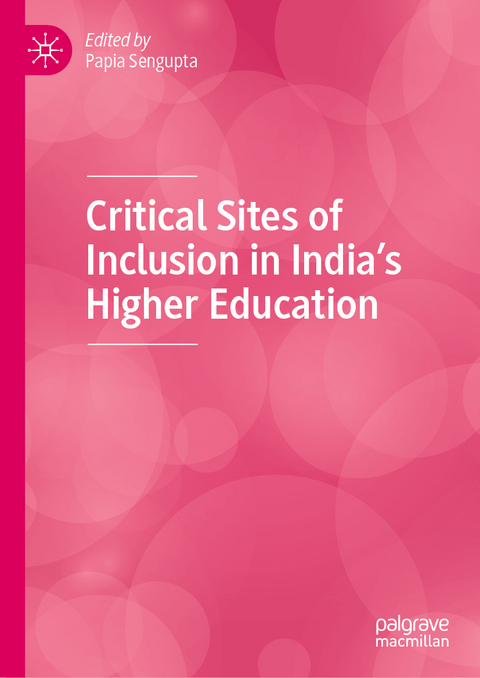
Critical Sites of Inclusion in India’s Higher Education
Palgrave Macmillan (Verlag)
978-981-16-8255-1 (ISBN)
Higher education is imperative to empowerment in socially stratified societies marred with deep inequalities like India and many other multicultural countries. Disputes over inclusion remains a critical feature in Indian higher education sector, as it is viewed as facilitating access to economic opportunities and providing vertical mobility for individuals belonging to marginalized communities. Higher education empowers, and expands individual horizons of thought and ideas of freedom, dignity, equality, enabling individuals to participate actively in the political-sociological discourses in democratic polity. Therefore, policy makers, political theorists and educationists have been examining the question of inclusion and education as public-good. Contemporary India has witnessed an unprecedented attack on academic freedom, free exchange of ideas and expressions, challenging the very idea of inclusion and inclusiveness.
Dr. Papia Sengupta is Assistant Professor at the Centre for Political Studies in Jawaharlal Nehru University, New Delhi, India. She was awarded the Distinguished Teacher award by former President A.P.J. Abdul Kalam in 2009 for her contribution to students’ mentorship. Dr Sengupta was fellow at the Institute for Advanced Studies in Humanities, University of Edinburgh (2016) and Brown University, USA (2015). Her research interests include politics of language, diversity studies, minority rights and decolonization of knowledge, gender and multiculturalism. She has been awarded fellowships from the Shastri Indo-Canadian Faculty Fellowship, Swiss International Development Agency fellowship, Switzerland and the International Institute of Social History fellowship. Her monograph titled Language as Identity in Colonial India: Policies and Politics, was published in 2018. In 2020 the International Association for Applied Linguistics, Netherlands honored her with the Solidarity Award. Dr. Sengupta’s research articles have been published in reputed national and international journals such as Economic and Political Weekly, Social Action, Geoforum and The International Journal on Diversity
Introduction.- Chapter 1 Negotiating Inclusion: Minority institutions and constitutional-legal dimensions in India.- Chapter 2 From exclusion to inclusion-the case of public madarsa education system.- Chapter 3 Language Conundrum: English language and exclusivity in Indian higher education.- Chapter 4 Invisible voices: the case of endangered languages communities.- Chapter 5 Inclusive education: Analysing the Rights of Persons with Disabilities Act 2016.- Chapter 6 Institutional barriers as hindrance to inclusion of women as members of academic community.- Chapter 7 Higher education and the question of inclusivity for LGBTQIA+ community.- Chapter 8 Interrogating neoliberal rationality and exclusivity of higher education.- Chapter 9 More technology-less access? Decoding ICT compliance in higher education.- Prologue: Placing ‘inclusion’ in the National Education Policy 2020.
| Erscheinungsdatum | 04.03.2022 |
|---|---|
| Zusatzinfo | 13 Illustrations, color; 1 Illustrations, black and white |
| Verlagsort | Singapore |
| Sprache | englisch |
| Maße | 148 x 210 mm |
| Themenwelt | Sozialwissenschaften ► Pädagogik ► Erwachsenenbildung |
| Sozialwissenschaften ► Politik / Verwaltung ► Politische Theorie | |
| Sozialwissenschaften ► Politik / Verwaltung ► Staat / Verwaltung | |
| Schlagworte | Discrimination • Education Policy • higher education • Inclusive Education • India • Minorities • Universities |
| ISBN-10 | 981-16-8255-0 / 9811682550 |
| ISBN-13 | 978-981-16-8255-1 / 9789811682551 |
| Zustand | Neuware |
| Informationen gemäß Produktsicherheitsverordnung (GPSR) | |
| Haben Sie eine Frage zum Produkt? |
aus dem Bereich