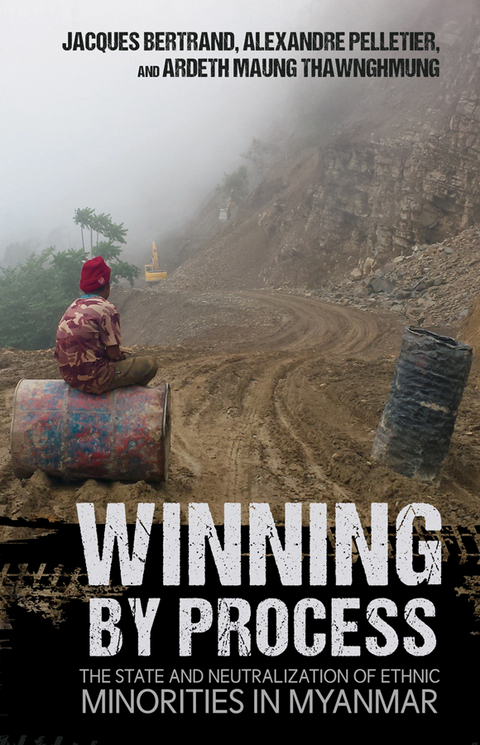
Winning by Process (eBook)
270 Seiten
Southeast Asia Program Publications (Verlag)
978-1-5017-6454-7 (ISBN)
Winning by Process asks why the peace process stalled in the decade from 2011 to 2021 despite a liberalizing regime, a national ceasefire agreement, and a multilateral peace dialogue between the state and ethnic minorities.
Winning by Process argues that stalled conflicts are more than pauses or stalemates. "Winning by process," as opposed to winning by war or agreement, represents the state's ability to gain advantage by manipulating the rules of negotiation, bargaining process, and sites of power and resources. In Myanmar, five such strategies allowed the state to gain through process: locking in, sequencing, layering, outflanking, and outgunning. The Myanmar case shows how process can shift the balance of power in negotiations intended to bring an end to civil war. During the last decade, the Myanmar state and military controlled the process, neutralized ethnic minority groups, and continued to impose their vision of a centralized state even as they appeared to support federalism.
Jacques Bertrand is Professor of Political Science at the University of Toronto. He is the author, most recently, of Ethnic Minorities and Political Change in Southeast Asia.
Alexandre Pelletier is Assistant Professor of Political Science at Université Laval. Follow him on X at @APPelletier.
Ardeth Maung Thawnghmung is Chair of Political Science at the University of Massachusetts, Lowell. She is the author, most recently, of Everyday Economic Survival in Contemporary Myanmar. Follow her on X at @AThawnghmung.
Introduction
1. Winning by Process: Leveraging Formal Negotiation, State Institutions, and War
2. The Failure to Win by War: The Limits of Bamar Dominance and Ethnic Minority Repression
3. Democratization: Layering and Sequencing in the State Institutional Arena
4. Process over War: From Ceasefire to Political Dialogue
5. Normalizing Weak Ethnic States: Constitutional Lock-In and Implementing Layers
6. Outflanking and the Erosion of De Facto Autonomy
7. Fragmentation, Marginalization, and Subjugation: Layering and Locking In Ethnic Recognition
Conclusion
| Erscheint lt. Verlag | 15.8.2022 |
|---|---|
| Zusatzinfo | 1 b&w line drawing, 2 maps, 1 chart |
| Verlagsort | Ithaca |
| Sprache | englisch |
| Maße | 150 x 150 mm |
| Themenwelt | Geisteswissenschaften ► Geschichte ► Regional- / Ländergeschichte |
| Naturwissenschaften | |
| Sozialwissenschaften ► Politik / Verwaltung ► Europäische / Internationale Politik | |
| Sozialwissenschaften ► Politik / Verwaltung ► Politische Systeme | |
| Schlagworte | civil war myanmar, ethnic conflict myanmar, tatmadaw ethnic minorities, ending civil wars, negotiations and civil war dynamics |
| ISBN-10 | 1-5017-6454-3 / 1501764543 |
| ISBN-13 | 978-1-5017-6454-7 / 9781501764547 |
| Informationen gemäß Produktsicherheitsverordnung (GPSR) | |
| Haben Sie eine Frage zum Produkt? |
 EPUB (Adobe DRM)
Kopierschutz: Adobe-DRM
Adobe-DRM ist ein Kopierschutz, der das eBook vor Mißbrauch schützen soll. Dabei wird das eBook bereits beim Download auf Ihre persönliche Adobe-ID autorisiert. Lesen können Sie das eBook dann nur auf den Geräten, welche ebenfalls auf Ihre Adobe-ID registriert sind.
Details zum Adobe-DRM
Dateiformat: EPUB (Electronic Publication)
EPUB ist ein offener Standard für eBooks und eignet sich besonders zur Darstellung von Belletristik und Sachbüchern. Der Fließtext wird dynamisch an die Display- und Schriftgröße angepasst. Auch für mobile Lesegeräte ist EPUB daher gut geeignet.
Systemvoraussetzungen:
PC/Mac: Mit einem PC oder Mac können Sie dieses eBook lesen. Sie benötigen eine
eReader: Dieses eBook kann mit (fast) allen eBook-Readern gelesen werden. Mit dem amazon-Kindle ist es aber nicht kompatibel.
Smartphone/Tablet: Egal ob Apple oder Android, dieses eBook können Sie lesen. Sie benötigen eine
Geräteliste und zusätzliche Hinweise
Buying eBooks from abroad
For tax law reasons we can sell eBooks just within Germany and Switzerland. Regrettably we cannot fulfill eBook-orders from other countries.
aus dem Bereich