Educational Research for Social Justice (eBook)
XVIII, 330 Seiten
Springer International Publishing (Verlag)
978-3-030-62572-6 (ISBN)
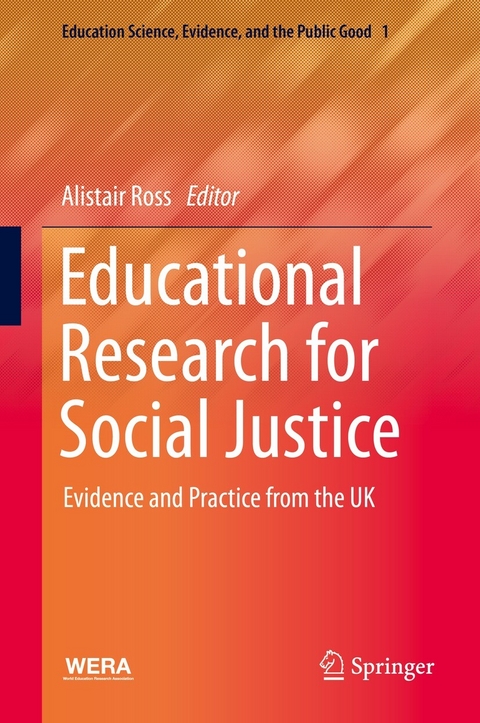
This book presents a series of analyses of educational policies - largely in the UK, but some also in Europe - researched by a team of social scientists who share a commitment to social justice and equity in education. We explore what social justice means, in educational policy and practice, and how it impacts on our understanding of both 'educational science' and 'the public good'.
Using a social constructivist approach, the book argues that social justice requires a particular and critical analysis of the meaning of meritocracy, and of the way this term turns educational policies towards treating learning as a competition, in which many young people are constructed as 'losers'. We discuss how many terms in education are essentialised and have specific, and different, meanings for particular social groups, and how this may create issues in both quantitative survey methods and in determining what is 'the public good'.
We discuss social justice across a range of intersecting social characteristics, including social class, ethnicity and gender, as they are applied across the educational policy spectrum, from early years to postgraduate education. We examine the ways that young people construct their identities, and the implications of this for understanding the 'public good' in educational practice. We consider the responsibilities of educational researchers to acknowledge these issues, and offer examples of researching with such a commitment. We conclude by considering how educational policy might contribute to a socially just, equitable and inclusive public good.
Alistair Ross is an Emeritus Professor at London Metropolitan University, holds a personal Jean Monnet chair, and is a Fellow of the Academy of Social Sciences (UK). After a career in teaching in primary schools, he lectured in teacher education, and then in education policy research. He established and directed IPSE (2000-09) and a Jean Monnet Academic Network on children's identity and citizenship in Europe (1998-2008). After retiring he has been conducting a one-person study on young European's constructions of political identities and their participation in political action. Other research interests include citizenship and refugee education, particularly with reference to social inclusion; the nature and diversity of the educational workforce; and access and achievement in education for all social groups. Recent publications include Understanding the Construction of Identities by New Europeans (Routledge 2015) and Finding Political Identities: Young people in a changing Europe (Palgrave Macmillan 2019).
| Erscheint lt. Verlag | 22.6.2021 |
|---|---|
| Reihe/Serie | Education Science, Evidence, and the Public Good | Education Science, Evidence, and the Public Good |
| Zusatzinfo | XVIII, 330 p. 1 illus. |
| Sprache | englisch |
| Themenwelt | Sozialwissenschaften ► Pädagogik ► Bildungstheorie |
| Sozialwissenschaften ► Pädagogik ► Sozialpädagogik | |
| Sozialwissenschaften ► Politik / Verwaltung | |
| Schlagworte | accountability structures of disadvantaged children • curriculum diversity and social justice education • engagement of teachers in school-based research • Intersectionality in educational research in the UK and Europe • masculisation of the teaching profession • Methodology of educational research • parental engagement in education • parents buying educational advantage for their children • Researching ethnicity and ‘race’ in education • Researching gender inequalities in education • Researching social class and economic inequalities in education • role of family and finance in higher education decisions • Testing and the use of league tables in education • the public good • young peoples' construction of political identities |
| ISBN-10 | 3-030-62572-9 / 3030625729 |
| ISBN-13 | 978-3-030-62572-6 / 9783030625726 |
| Informationen gemäß Produktsicherheitsverordnung (GPSR) | |
| Haben Sie eine Frage zum Produkt? |
 PDF (Wasserzeichen)
DRM: Digitales Wasserzeichen
Dieses eBook enthält ein digitales Wasserzeichen und ist damit für Sie personalisiert. Bei einer missbräuchlichen Weitergabe des eBooks an Dritte ist eine Rückverfolgung an die Quelle möglich.
Dateiformat: PDF (Portable Document Format)
Mit einem festen Seitenlayout eignet sich die PDF besonders für Fachbücher mit Spalten, Tabellen und Abbildungen. Eine PDF kann auf fast allen Geräten angezeigt werden, ist aber für kleine Displays (Smartphone, eReader) nur eingeschränkt geeignet.
Systemvoraussetzungen:
PC/Mac: Mit einem PC oder Mac können Sie dieses eBook lesen. Sie benötigen dafür einen PDF-Viewer - z.B. den Adobe Reader oder Adobe Digital Editions.
eReader: Dieses eBook kann mit (fast) allen eBook-Readern gelesen werden. Mit dem amazon-Kindle ist es aber nicht kompatibel.
Smartphone/Tablet: Egal ob Apple oder Android, dieses eBook können Sie lesen. Sie benötigen dafür einen PDF-Viewer - z.B. die kostenlose Adobe Digital Editions-App.
Buying eBooks from abroad
For tax law reasons we can sell eBooks just within Germany and Switzerland. Regrettably we cannot fulfill eBook-orders from other countries.
aus dem Bereich