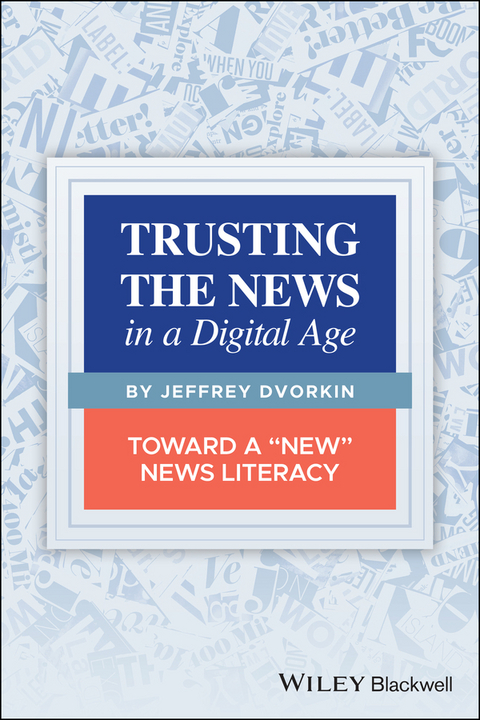
Trusting the News in a Digital Age (eBook)
John Wiley & Sons (Verlag)
978-1-119-71440-8 (ISBN)
How to use critical thinking to discern real news from fake news
Trusting the News in a Digital Age provides an ethical framework and the much-needed tools for assessing information produced in our digital age. With the tsunami of information on social media and other venues, many have come to distrust all forms of communication, including the news. This practical text offers guidance on how to use critical thinking, appropriate skepticism, and journalistic curiosity to handle this flow of undifferentiated information.
Designed to encourage critical thinking, each chapter introduces specific content, followed at the end of each section with an ethical dilemma. The ideas presented are based on the author's experiences as a teacher and public editor/ombudsman at NPR News. Trusting the News in a Digital Age prepares readers to deal with changes to news and information in the digital environment. It brings to light the fact that journalism is about treating the public as citizens first, and consumers of information second. This important text:
- Reveals how to use critical thinking to handle the never-ending flow of information
- Contains ethical dilemmas to help sharpen critical thinking skills
- Explains how to verify sources and spot frauds
- Looks at the economic and technological conditions that facilitated changes in communication
Written for students of journalism and media studies, Trusting the News in the Digital Age offers guidance on how to hone critical thinking skills needed to discern fact from fiction.
Jeffrey Dvorkin is a Senior Fellow at Massey College, University of Toronto. From 2011, he was lecturer and director of the journalism program at the University of Toronto Scarborough Campus. He began his career as a CBC journalist in Montreal, Ottawa and Toronto and became Managing Editor and Chief Journalist for CBC Radio in 1991. In 1997, he was named Vice-President, News and Information at NPR in Washington, DC where he subsequently became NPR's first news ombudsman, handling ethical questions, complaints, and concerns from listeners. Dvorkin has been an advisor and examiner for the Institute of Medical Science at the University of Toronto.
Jeffrey Dvorkin is a Senior Fellow at Massey College, University of Toronto. From 2011, he was lecturer and director of the journalism program at the University of Toronto Scarborough Campus. He began his career as a CBC journalist in Montreal, Ottawa and Toronto and became Managing Editor and Chief Journalist for CBC Radio in 1991. In 1997, he was named Vice-President, News and Information at NPR in Washington, DC where he subsequently became NPR's first news ombudsman, handling ethical questions, complaints, and concerns from listeners. Dvorkin has been an advisor and examiner for the Institute of Medical Science at the University of Toronto.
1 Introduction to News Literacy 1
2 Changing Definitions of News 15
3 Why Should We Trust the News? Why Now? 31
4 Verification = Trust 46
5 The Effect of Digital on Media Forms 61
6 When the Audience is Biased 76
7 When the News is Biased 89
8 The Economics of Journalism in a Digital Age 100
9 Framing and Deconstructing the News 115
10 News Sources: Credible and Less Credible 128
11 Trusting Journalism in a Time of "Fake News" 140
References 152
Additional Resources 152
Index 154
""Trusting the News in a Digital Age" -- Anything with that title is to be supported!"
- Adam Clayton Powell III, Executive Director, Election Cybersecurity Initiative, USC Annenberg Center on Communication Leadership and Polity
"At last there's a touchstone for genuine news reporting--written by a professional grounded in true journalism. Need to define what 'fake news' really is, and how to defeat it? Tell a reliable source from a corrupt one? Grasp the economics of digital news? It's all in Jeffrey Dvorkin's Trusting the News in a Digital Age. It's a one-volume course syllabus in 21st century news, but more, because no journalist, lawyer or communications specialist should be working a keyboard without this book within reach."
- Arthur Kent, former war correspondent and author
"As an educator, I particularly appreciate the chapter "takeaways" and "ethical dilemmas". This book is richly informative and insightful. Students will get a lot out of this book."
- Dr. Karen McCrindle, head of the Department of French Linguistics and former program director of journalism at the University of Toronto Scarborough Campus
2
Changing Definitions of News
TAKEAWAYS FROM CHAPTER 2
- Why there is a human need for information
- How different technologies and platforms change information, sometimes with unintended consequences
- How the news was changed when the technologies changed
- How people define themselves by the media they consume
- Changing cultural, institutional, and economic influences on the news
- The effect of digital technology on the news
Curiosity is one of our deepest instincts.
And technologies have always been invented and adapted to serve our instinctive need to know.
In Europe until the 15th century, literacy and the technology that served it were limited to the writings (and copying) of biblical texts. This was done exclusively in Latin by church officials whose purpose was to write the Bible out by hand. This was extremely labor intensive, and only one copy of the Bible would be produced over as many as two years.
But in 1455, a German printer named Johannes Gutenberg created a revolutionary invention: movable typesetting. This allowed for more efficient and mechanical printing of the Bible and was an early form of mass production, allowing a copy to be printed once every few weeks rather than every few years. Gutenberg wasn’t the first to come up with this remarkable invention. Korean and Chinese printers invented a similar system two centuries previously. But Gutenberg had no way of knowing this due to the lack of contact between Europe and Asia at that time. His invention was nothing short of revolutionary and changed the way Europeans (and North Americans) communicated.
We need to appreciate the enormous implications of Gutenberg’s moveable type for advancing communication. No longer could authorities, such as the Roman Catholic Church or a local potentate, maintain a monopoly on information. There were frequent attempts over the centuries to control the spread of information, but Gutenberg’s revolution proved to be unstoppable. Print newspapers, pamphlets, and, much later, electronic inventions, such as the telegraph and the telephone, allowed for a more rapid and less controlled spread of information. This coincided with the growth of literacy and public education. As written information proliferated, more people had access to books, and literacy increased. As a result, people became more curious about and engaged in the world around them. A new industrial culture of producing, sharing, and disseminating information accelerated by the early 19th century in Europe and North America. It was the beginning of what we recognize today as the modern news culture.
In the early 20th Century, the news adapted to other new technologies, such as photography, radio, and, by the 1950s, television.
Just as Gutenberg’s invention forever changed the way in which Europeans were able to articulate and express their needs, the application of electricity to new communications methods rapidly changed the world once more. Citizens in countries with access to these new technological advances were enthralled and demanded more information more quickly and more reliably.
Like Gutenberg’s invention, the effect of digitalization on the news was equally transformative. The news as a technological and cultural phenomenon was already highly profitable and hugely competitive. Newspapers in the UK and the US battled for market supremacy with lurid headlines and graphic illustrations and sometimes shocking photographs of actual news events. Throughout this, the culture of journalism and reporting grew to serve this new industry and the insatiable curiosity about other people’s lives.
As digitalization advanced, audiences became connected to the news in a way they had never been. News organizations expanded to serve these new audiences. The power of widespread information as we have seen in the twenty‐first century became a major cultural influence on all aspects of modern life, including political news.
The news makes us wonder what just happened, how it happened, and how whatever happened might affect us personally. Just think of being deprived of information, of being disconnected. How would you feel if you were truly isolated, on a virtual “news desert”? Imagine being off the grid with no smartphone, no texting, no apps, no email, even for 24 hours. The very thought probably makes you nervous: What is happening? How will friends and family get in touch if there is an emergency? Who should you contact to get back in touch? “FOMO” can be a very unnerving idea!
There may be some value in doing a digital detox once in a while to reconnect with our original, analog selves. But the power and influence of our digital culture is now irreversible, for better and for worse.
News and being literate about the news are essential aspects of being an informed citizen. It is our best guarantee against those who would wish to manipulate us to make our lives less meaningful. The news is seen by those in power (and those who want to have power) as the essential element to influence the public. In effect, the intensity around the news is due to a deep need to have the news be on their side.
Just as many civic institutions are feeling the pressures of popular criticism and resentment, so too, does news culture as it attempts to inform us in our public lives.
It wasn't always like this. But in order for us to become news literate, we need to look at how the news functioned from the time when it was universally admired to today, when the news is not always seen as a continuous benefit to society. Now journalism is seen as being in crisis and the solutions are not particularly obvious.
Watergate and the Role of the News
The economic basis of the news industry has always been part of the information‐driven culture. News organizations may believe that what they provide is a public good and an essential part of any democracy. But the need for news organizations to make a profit has always been a driving force in how the news is created and organized. Newspapers and broadcasters have relied on an advertising model to sustain them. Most news organizations in the US and Europe are supported by investors who purchase stock options. Shareholder satisfaction thus becomes an important element in how a news organization is run. Public broadcasters such as the British Broadcasting Corporation (BBC), the Canadian Broadcasting Corporation (CBC), and National Public Radio (NPR) rely in varying degrees on government funding or public subscriptions. Both public and commercial news organizations still rely heavily on substantial audiences. Tracking these audience numbers allows news organizations to charge proportional advertising rates. With public broadcasting, large audience numbers allow for continued subsidies from their respective governments. In short, competition for ratings is an essential part of the news landscape.
Getting the “big” stories into the news becomes an essential quality of this competitive aspect.
The high water mark of journalism, in North America, at least, may be the Watergate Scandal in the 1970s. Two young reporters from The Washington Post, Bob Woodward and Carl Bernstein, relentlessly pursued the story of a failed break‐in at the Democratic National Committee headquarters in the Watergate building in 1972, leading to the unveiling of a huge political scandal– they were given the freedom to chase the story to an extent that is unheard of today, when media organizations are facing tighter financial times.
As a result of their reporting (along with the reporting of other news organizations), the president of the United States, Richard Nixon, was forced to resign in disgrace.
Journalism and the news business were seen as patriotic and even saviors of the best values of civic engagement. Reporters and journalism were celebrated (for a few years anyway), and investigative reporting became a bigger part of many media organizations.
The news was also seen as a clear benefit to society, even as it became a recognizable profit center for news organizations. By the 1980s, and for the first time, the news by itself (without the financial support from other sections of the media organization, such as sports and entertainment) was able to bring new audiences and with it, more income to newspapers and broadcasters. Circulation and ratings soared. Newsrooms expanded as more journalists were hired. At the same time, universities created and expanded their academic journalism curricula.
Two factors would eventually change the once positive outlook on the news for the worse:
- The arrival of 24‐hour cable news in the early 1990s
- All news channels demanded increasing amounts of programming and content that could be buttressed by strong visuals – videos, photos, maps, graphs, typefaces and graphics, and anything else meant not only to supplement the material, but also to be eye‐catching. This allowed for the ingress of news consultants using audience analytics. Such consultants insisted that the “if‐it‐bleeds‐it‐leads” mentality should predominate.
- The rise of talk radio in the US also created an appetite and an audience for argumentative and opinion media. Fair‐minded, balanced news paled in comparison, and traditional news operations adapted and adopted a model that a few years before would have been rejected. Dramatic effect, especially in visuals, was seen as the basis for strong ratings, even if the story was...
| Erscheint lt. Verlag | 27.4.2021 |
|---|---|
| Sprache | englisch |
| Themenwelt | Sozialwissenschaften ► Kommunikation / Medien |
| Sozialwissenschaften ► Politik / Verwaltung | |
| Schlagworte | Communication & Media Studies • Journalism • Journalismus • Kommunikation • Kommunikation u. Medienforschung • Media Studies • Medienforschung • Nachricht (Journalist.) |
| ISBN-10 | 1-119-71440-0 / 1119714400 |
| ISBN-13 | 978-1-119-71440-8 / 9781119714408 |
| Informationen gemäß Produktsicherheitsverordnung (GPSR) | |
| Haben Sie eine Frage zum Produkt? |
 EPUB (Adobe DRM)
Kopierschutz: Adobe-DRM
Adobe-DRM ist ein Kopierschutz, der das eBook vor Mißbrauch schützen soll. Dabei wird das eBook bereits beim Download auf Ihre persönliche Adobe-ID autorisiert. Lesen können Sie das eBook dann nur auf den Geräten, welche ebenfalls auf Ihre Adobe-ID registriert sind.
Details zum Adobe-DRM
Dateiformat: EPUB (Electronic Publication)
EPUB ist ein offener Standard für eBooks und eignet sich besonders zur Darstellung von Belletristik und Sachbüchern. Der Fließtext wird dynamisch an die Display- und Schriftgröße angepasst. Auch für mobile Lesegeräte ist EPUB daher gut geeignet.
Systemvoraussetzungen:
PC/Mac: Mit einem PC oder Mac können Sie dieses eBook lesen. Sie benötigen eine
eReader: Dieses eBook kann mit (fast) allen eBook-Readern gelesen werden. Mit dem amazon-Kindle ist es aber nicht kompatibel.
Smartphone/Tablet: Egal ob Apple oder Android, dieses eBook können Sie lesen. Sie benötigen eine
Geräteliste und zusätzliche Hinweise
Buying eBooks from abroad
For tax law reasons we can sell eBooks just within Germany and Switzerland. Regrettably we cannot fulfill eBook-orders from other countries.
aus dem Bereich