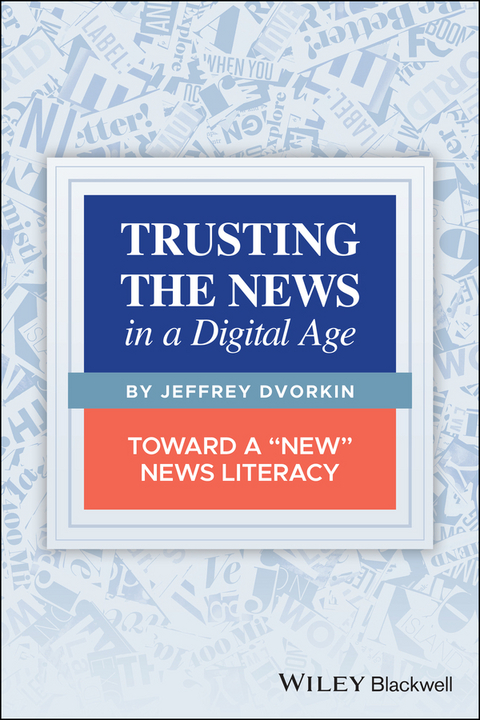
Trusting the News in a Digital Age (eBook)
John Wiley & Sons (Verlag)
978-1-119-71442-2 (ISBN)
How to use critical thinking to discern real news from fake news
Trusting the News in a Digital Age provides an ethical framework and the much-needed tools for assessing information produced in our digital age. With the tsunami of information on social media and other venues, many have come to distrust all forms of communication, including the news. This practical text offers guidance on how to use critical thinking, appropriate skepticism, and journalistic curiosity to handle this flow of undifferentiated information.
Designed to encourage critical thinking, each chapter introduces specific content, followed at the end of each section with an ethical dilemma. The ideas presented are based on the author's experiences as a teacher and public editor/ombudsman at NPR News. Trusting the News in a Digital Age prepares readers to deal with changes to news and information in the digital environment. It brings to light the fact that journalism is about treating the public as citizens first, and consumers of information second. This important text:
- Reveals how to use critical thinking to handle the never-ending flow of information
- Contains ethical dilemmas to help sharpen critical thinking skills
- Explains how to verify sources and spot frauds
- Looks at the economic and technological conditions that facilitated changes in communication
Written for students of journalism and media studies, Trusting the News in the Digital Age offers guidance on how to hone critical thinking skills needed to discern fact from fiction.
Jeffrey Dvorkin is a Senior Fellow at Massey College, University of Toronto. From 2011, he was lecturer and director of the journalism program at the University of Toronto Scarborough Campus. He began his career as a CBC journalist in Montreal, Ottawa and Toronto and became Managing Editor and Chief Journalist for CBC Radio in 1991. In 1997, he was named Vice-President, News and Information at NPR in Washington, DC where he subsequently became NPR's first news ombudsman, handling ethical questions, complaints, and concerns from listeners. Dvorkin has been an advisor and examiner for the Institute of Medical Science at the University of Toronto.
TRUSTING THE NEWS in a Digital Age How to use critical thinking to discern real news from fake newsTrusting the News in a Digital Age provides an ethical framework and the much-needed tools for assessing information produced in our digital age. With the tsunami of information on social media and other venues, many have come to distrust all forms of communication, including the news. This practical text offers guidance on how to use critical thinking, appropriate skepticism, and journalistic curiosity to handle this flow of undifferentiated information.Designed to encourage critical thinking, each chapter introduces specific content, followed at the end of each section with an ethical dilemma. The ideas presented are based on the author s experiences as a teacher and public editor/ombudsman at NPR News. Trusting the News in a Digital Age prepares readers to deal with changes to news and information in the digital environment. It brings to light the fact that journalism is about treating the public as citizens first, and consumers of information second. This important text:Reveals how to use critical thinking to handle the never-ending flow of informationContains ethical dilemmas to help sharpen critical thinking skillsExplains how to verify sources and spot fraudsLooks at the economic and technological conditions that facilitated changes in communicationWritten for students of journalism and media studies, Trusting the News in the Digital Age offers guidance on how to hone critical thinking skills needed to discern fact from fiction.
Jeffrey Dvorkin is a Senior Fellow at Massey College, University of Toronto. From 2011, he was lecturer and director of the journalism program at the University of Toronto Scarborough Campus. He began his career as a CBC journalist in Montreal, Ottawa and Toronto and became Managing Editor and Chief Journalist for CBC Radio in 1991. In 1997, he was named Vice-President, News and Information at NPR in Washington, DC where he subsequently became NPR's first news ombudsman, handling ethical questions, complaints, and concerns from listeners. Dvorkin has been an advisor and examiner for the Institute of Medical Science at the University of Toronto.
1 Introduction to News Literacy 1
2 Changing Definitions of News 15
3 Why Should We Trust the News? Why Now? 31
4 Verification = Trust 46
5 The Effect of Digital on Media Forms 61
6 When the Audience is Biased 76
7 When the News is Biased 89
8 The Economics of Journalism in a Digital Age 100
9 Framing and Deconstructing the News 115
10 News Sources: Credible and Less Credible 128
11 Trusting Journalism in a Time of "Fake News" 140
References 152
Additional Resources 152
Index 154
""Trusting the News in a Digital Age" -- Anything with that title is to be supported!"
- Adam Clayton Powell III, Executive Director, Election Cybersecurity Initiative, USC Annenberg Center on Communication Leadership and Polity
"At last there's a touchstone for genuine news reporting--written by a professional grounded in true journalism. Need to define what 'fake news' really is, and how to defeat it? Tell a reliable source from a corrupt one? Grasp the economics of digital news? It's all in Jeffrey Dvorkin's Trusting the News in a Digital Age. It's a one-volume course syllabus in 21st century news, but more, because no journalist, lawyer or communications specialist should be working a keyboard without this book within reach."
- Arthur Kent, former war correspondent and author
"As an educator, I particularly appreciate the chapter "takeaways" and "ethical dilemmas". This book is richly informative and insightful. Students will get a lot out of this book."
- Dr. Karen McCrindle, head of the Department of French Linguistics and former program director of journalism at the University of Toronto Scarborough Campus
| Erscheint lt. Verlag | 30.3.2021 |
|---|---|
| Sprache | englisch |
| Themenwelt | Sozialwissenschaften ► Kommunikation / Medien |
| Sozialwissenschaften ► Politik / Verwaltung | |
| Schlagworte | Communication & Media Studies • Journalism • Journalismus • Kommunikation • Kommunikation u. Medienforschung • Media Studies • Medienforschung • Nachricht (Journalist.) |
| ISBN-10 | 1-119-71442-7 / 1119714427 |
| ISBN-13 | 978-1-119-71442-2 / 9781119714422 |
| Informationen gemäß Produktsicherheitsverordnung (GPSR) | |
| Haben Sie eine Frage zum Produkt? |
 PDF (Adobe DRM)
Kopierschutz: Adobe-DRM
Adobe-DRM ist ein Kopierschutz, der das eBook vor Mißbrauch schützen soll. Dabei wird das eBook bereits beim Download auf Ihre persönliche Adobe-ID autorisiert. Lesen können Sie das eBook dann nur auf den Geräten, welche ebenfalls auf Ihre Adobe-ID registriert sind.
Details zum Adobe-DRM
Dateiformat: PDF (Portable Document Format)
Mit einem festen Seitenlayout eignet sich die PDF besonders für Fachbücher mit Spalten, Tabellen und Abbildungen. Eine PDF kann auf fast allen Geräten angezeigt werden, ist aber für kleine Displays (Smartphone, eReader) nur eingeschränkt geeignet.
Systemvoraussetzungen:
PC/Mac: Mit einem PC oder Mac können Sie dieses eBook lesen. Sie benötigen eine
eReader: Dieses eBook kann mit (fast) allen eBook-Readern gelesen werden. Mit dem amazon-Kindle ist es aber nicht kompatibel.
Smartphone/Tablet: Egal ob Apple oder Android, dieses eBook können Sie lesen. Sie benötigen eine
Geräteliste und zusätzliche Hinweise
Buying eBooks from abroad
For tax law reasons we can sell eBooks just within Germany and Switzerland. Regrettably we cannot fulfill eBook-orders from other countries.
aus dem Bereich