Recasting Islamic Law (eBook)
282 Seiten
Cornell University Press (Verlag)
978-1-5017-5399-2 (ISBN)
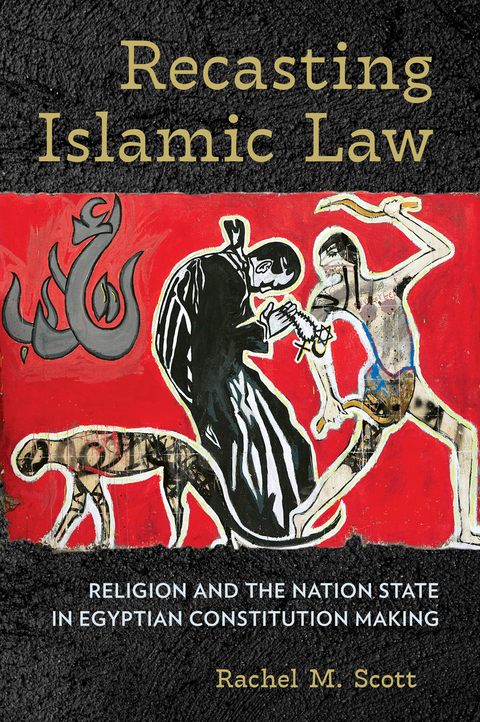
By examining the intersection of Islamic law, state law, religion, and culture in the Egyptian nation-building process, Recasting Islamic Law highlights how the sharia, when attached to constitutional commitments, is reshaped into modern Islamic state law.
Rachel M. Scott analyzes the complex effects of constitutional commitments to the sharia in the wake of the Egyptian Revolution of 2011. She argues that the sharia is not dismantled by the modern state when it is applied as modern Islamic state law, but rather recast in its service. In showing the particular forms that the sharia takes when it is applied as modern Islamic state law, Scott pushes back against assumptions that introductions of the sharia into modern state law result in either the revival of medieval Islam or in its complete transformation. Scott engages with premodern law and with the Ottoman legal legacy on topics concerning Egypt's Coptic community, women's rights, personal status law, and the relationship between religious scholars and the Supreme Constitutional Court. Recasting Islamic Law considers modern Islamic state law's discontinuities and its continuities with premodern sharia.
Thanks to generous funding from Virginia Tech and its participation in TOME (Toward an Open Monograph Ecosystem), the ebook editions of this book are available as Open Access volumes from Cornell Open (cornellpress.cornell.edu/cornell-open) and other repositories.
Rachel M. Scott is Associate Professor of Islamic Studies at Virginia Tech. She is author of The Challenge of Political Islam.
Introduction
Part I: Constitutions and the Making and Unmaking of Egyptian Nationalism
1. Constitutions, National Culture, and Rethinking Islamism
2. The Sharia as State Law
3. Constitution Making in Egypt
Part II: Recasting Islamic Law: Case Studies
4. The Ulama, Religious Authority, and the State
5. The "Divinely Revealed Religions"
6. The Family Is the Basis of Society
7. Judicial Autonomy and Inheritance
Conclusion
| Erscheint lt. Verlag | 15.3.2021 |
|---|---|
| Verlagsort | Ithaca |
| Sprache | englisch |
| Maße | 150 x 150 mm |
| Themenwelt | Geisteswissenschaften ► Geschichte ► Regional- / Ländergeschichte |
| Geisteswissenschaften ► Religion / Theologie ► Islam | |
| Recht / Steuern ► Allgemeines / Lexika | |
| Recht / Steuern ► EU / Internationales Recht | |
| Sozialwissenschaften ► Soziologie ► Spezielle Soziologien | |
| Schlagworte | Egyptian revolution of 2011, religion and state in Egypt, Sharia, Islamic Law, religion and politics, |
| ISBN-10 | 1-5017-5399-1 / 1501753991 |
| ISBN-13 | 978-1-5017-5399-2 / 9781501753992 |
| Informationen gemäß Produktsicherheitsverordnung (GPSR) | |
| Haben Sie eine Frage zum Produkt? |
 EPUB (Adobe DRM)
Kopierschutz: Adobe-DRM
Adobe-DRM ist ein Kopierschutz, der das eBook vor Mißbrauch schützen soll. Dabei wird das eBook bereits beim Download auf Ihre persönliche Adobe-ID autorisiert. Lesen können Sie das eBook dann nur auf den Geräten, welche ebenfalls auf Ihre Adobe-ID registriert sind.
Details zum Adobe-DRM
Dateiformat: EPUB (Electronic Publication)
EPUB ist ein offener Standard für eBooks und eignet sich besonders zur Darstellung von Belletristik und Sachbüchern. Der Fließtext wird dynamisch an die Display- und Schriftgröße angepasst. Auch für mobile Lesegeräte ist EPUB daher gut geeignet.
Systemvoraussetzungen:
PC/Mac: Mit einem PC oder Mac können Sie dieses eBook lesen. Sie benötigen eine
eReader: Dieses eBook kann mit (fast) allen eBook-Readern gelesen werden. Mit dem amazon-Kindle ist es aber nicht kompatibel.
Smartphone/Tablet: Egal ob Apple oder Android, dieses eBook können Sie lesen. Sie benötigen eine
Geräteliste und zusätzliche Hinweise
Buying eBooks from abroad
For tax law reasons we can sell eBooks just within Germany and Switzerland. Regrettably we cannot fulfill eBook-orders from other countries.
aus dem Bereich