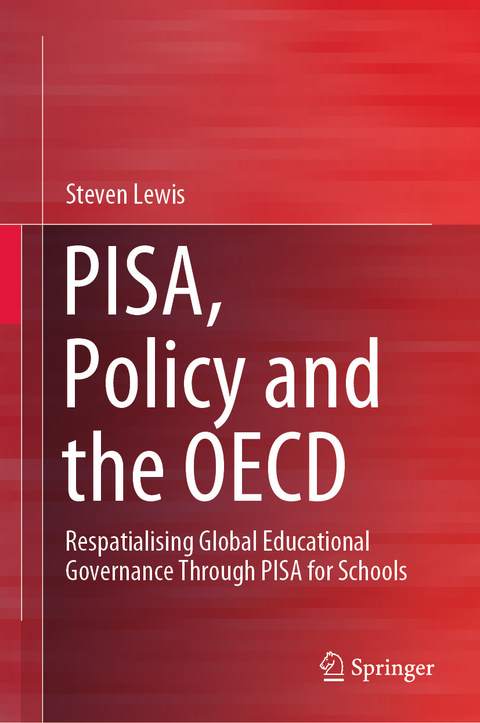
PISA, Policy and the OECD (eBook)
XIX, 192 Seiten
Springer Singapore (Verlag)
978-981-15-8285-1 (ISBN)
Dr Steven Lewis is an Australian Research Council (ARC) DECRA Fellow at the Education Governance and Policy group within the Research for Educational Impact Centre of Deakin University. His current research interests are concerned with new modes and forms of educational accountability and data infrastructures; the education policy work of the OECD and other 'non-state' actors and organisations; and how these developments help shape the understanding and practice of schooling. He has established himself as a leading global expert on the education policy work of the OECD, and has helped further the use of spatial and relational thinking to inform generative new approaches to the study of global educational policymaking and governance.
This book explores new modes, spaces and relations of the Organisation for Economic Cooperation and Development (OECD)'s global educational governance associated with the PISA for Schools test. Adopting a theoretically-rich policy sociology approach, with an emphasis on topological understandings of spatiality and power, the book examines the entire PISA for Schools policy cycle, from its initial development, to its administration and promotion in the U.S., and its local enactment by schools and teachers. It demonstrates how PISA for Schools helps to steer how schooling is locally understood and practised through separate and yet overlapping techniques: governing by (1) heterarchy, (2) respatialisation and (3) 'best practice'.The book reveals the specific effects of PISA for Schools as an exemplar of how global educational governance is increasingly enfolded within contemporary schooling, as well as discussing how we mightpractise a policy sociology in which the local is acknowledged as a relevant space of concern.
| Erscheint lt. Verlag | 29.9.2020 |
|---|---|
| Zusatzinfo | XIX, 192 p. 1 illus. |
| Sprache | englisch |
| Themenwelt | Sozialwissenschaften ► Pädagogik ► Bildungstheorie |
| Sozialwissenschaften ► Pädagogik ► Schulpädagogik / Grundschule | |
| Sozialwissenschaften ► Soziologie | |
| Schlagworte | communities of practice and PISA for Schools • governing through difference and potential • Governing through PISA for Schools • governing through what works • new topological spatialities and relationalities • PISA Yet to Come • policy, philanthrophy and profit • respatialising the OECD's global educational governance • spatialities and relationalities associated with globalization |
| ISBN-10 | 981-15-8285-8 / 9811582858 |
| ISBN-13 | 978-981-15-8285-1 / 9789811582851 |
| Informationen gemäß Produktsicherheitsverordnung (GPSR) | |
| Haben Sie eine Frage zum Produkt? |
 PDF (Wasserzeichen)
DRM: Digitales Wasserzeichen
Dieses eBook enthält ein digitales Wasserzeichen und ist damit für Sie personalisiert. Bei einer missbräuchlichen Weitergabe des eBooks an Dritte ist eine Rückverfolgung an die Quelle möglich.
Dateiformat: PDF (Portable Document Format)
Mit einem festen Seitenlayout eignet sich die PDF besonders für Fachbücher mit Spalten, Tabellen und Abbildungen. Eine PDF kann auf fast allen Geräten angezeigt werden, ist aber für kleine Displays (Smartphone, eReader) nur eingeschränkt geeignet.
Systemvoraussetzungen:
PC/Mac: Mit einem PC oder Mac können Sie dieses eBook lesen. Sie benötigen dafür einen PDF-Viewer - z.B. den Adobe Reader oder Adobe Digital Editions.
eReader: Dieses eBook kann mit (fast) allen eBook-Readern gelesen werden. Mit dem amazon-Kindle ist es aber nicht kompatibel.
Smartphone/Tablet: Egal ob Apple oder Android, dieses eBook können Sie lesen. Sie benötigen dafür einen PDF-Viewer - z.B. die kostenlose Adobe Digital Editions-App.
Buying eBooks from abroad
For tax law reasons we can sell eBooks just within Germany and Switzerland. Regrettably we cannot fulfill eBook-orders from other countries.
aus dem Bereich