


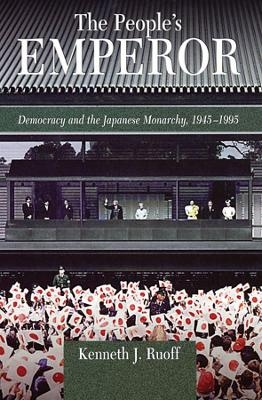
The People’s Emperor
Democracy and the Japanese Monarchy, 1945–1995
Seiten
2003
Harvard University, Asia Center (Verlag)
978-0-674-01088-8 (ISBN)
Harvard University, Asia Center (Verlag)
978-0-674-01088-8 (ISBN)
Few institutions are as well suited as the monarchy to provide a window on postwar Japan. The monarchy, which is also a family, has been significant both as a political and as a cultural institution. Ruoff analyzes numerous issues, stressing the monarchy’s “postwarness” rather than its traditionality.
Few institutions are as well suited as the monarchy to provide a window on postwar Japan. The monarchy, which is also a family, has been significant both as a political and as a cultural institution.
This comprehensive study analyzes numerous issues, including the role of individual emperors in shaping the institution, the manner in which the emperor’s constitutional position as symbol has been interpreted, the emperor’s intersection with politics through ministerial briefings, memories of Hirohito’s wartime role, nationalistic movements in support of Foundation Day and the reign-name system, and the remaking of the once sacrosanct throne into a “monarchy of the masses” embedded in the postwar culture of democracy. The author stresses the monarchy’s “postwarness,” rather than its traditionality.
Few institutions are as well suited as the monarchy to provide a window on postwar Japan. The monarchy, which is also a family, has been significant both as a political and as a cultural institution.
This comprehensive study analyzes numerous issues, including the role of individual emperors in shaping the institution, the manner in which the emperor’s constitutional position as symbol has been interpreted, the emperor’s intersection with politics through ministerial briefings, memories of Hirohito’s wartime role, nationalistic movements in support of Foundation Day and the reign-name system, and the remaking of the once sacrosanct throne into a “monarchy of the masses” embedded in the postwar culture of democracy. The author stresses the monarchy’s “postwarness,” rather than its traditionality.
Kenneth J. Ruoff is Professor of History and Director of the Center for Japanese Studies at Portland State University.
| Erscheint lt. Verlag | 30.3.2003 |
|---|---|
| Reihe/Serie | Harvard East Asian Monographs |
| Zusatzinfo | 25 halftones, 4 line illustrations |
| Sprache | englisch |
| Maße | 152 x 229 mm |
| Gewicht | 494 g |
| Themenwelt | Geschichte ► Allgemeine Geschichte ► Zeitgeschichte |
| Geisteswissenschaften ► Geschichte ► Hilfswissenschaften | |
| Geisteswissenschaften ► Geschichte ► Regional- / Ländergeschichte | |
| Sozialwissenschaften ► Politik / Verwaltung ► Staat / Verwaltung | |
| ISBN-10 | 0-674-01088-4 / 0674010884 |
| ISBN-13 | 978-0-674-01088-8 / 9780674010888 |
| Zustand | Neuware |
| Informationen gemäß Produktsicherheitsverordnung (GPSR) | |
| Haben Sie eine Frage zum Produkt? |
Mehr entdecken
aus dem Bereich

aus dem Bereich
die großen Jahre der Soziologie 1949-1969
Buch | Hardcover (2025)
Klett-Cotta (Verlag)
CHF 39,20
eine Deutschlandreise im Jahr 1958
Buch | Hardcover (2024)
C.H.Beck (Verlag)
CHF 29,90


