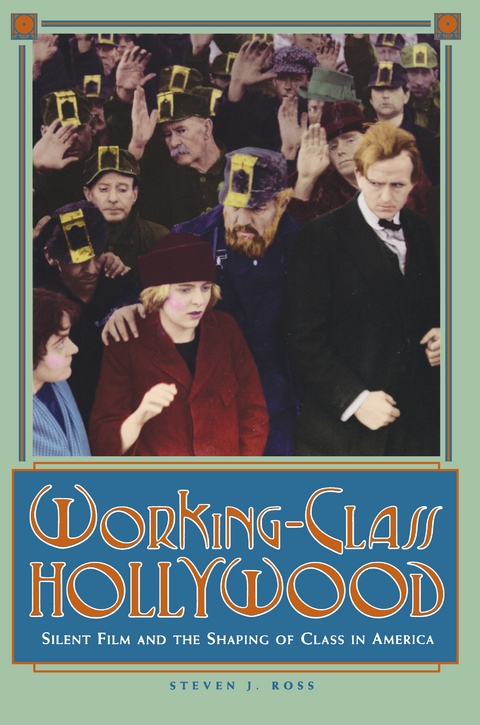
Working-Class Hollywood (eBook)
Princeton University Press (Verlag)
978-0-691-21464-1 (ISBN)
| Erscheint lt. Verlag | 30.6.2020 |
|---|---|
| Zusatzinfo | 38 halftones |
| Sprache | englisch |
| Themenwelt | Kunst / Musik / Theater ► Film / TV |
| Kunst / Musik / Theater ► Theater / Ballett | |
| Geschichte ► Teilgebiete der Geschichte ► Kulturgeschichte | |
| Sozialwissenschaften ► Kommunikation / Medien ► Journalistik | |
| Sozialwissenschaften ► Kommunikation / Medien ► Medienwissenschaft | |
| Sozialwissenschaften ► Soziologie ► Makrosoziologie | |
| Wirtschaft | |
| Schlagworte | Academy of Motion Picture Arts and Sciences • activism • Addams, Jane • Adolph Zukor • American Federation of Labor • americans • Appeal to Reason • Appeal to Reason (newspaper) • Audiences • Big Business • Biograph Film Company • block booking • blue-collar worker • bolsheviks • Box office • Capitalism • Capra, Frank • Career • Carl Laemmle • Censorship • Charlie Chaplin • Chicago New Majority • Cinema of the United States • class conflict • class consciousness • Cohen, Lizabeth • Committee on Public Information • communism • comrade • Consumerism • david horsley • Davis, Harry • documentaries • Douglas Fairbanks • D. W. Griffith • Economic Digest • Ellsworth, Ted • Employment • Entertainment • Eugene V. Debs • Famous Players-Lasky • feature film • Film • Film History • film industry • filmmaking • Film Studies • film studio • Footage • Fox, William • Frankfurt School • Gompers, Samuel • government agency • Grauman’s Theaters • Hart, William S. • Hoffa (1992) • Ideology • Independent Film • Industrial Workers of the World • Intercontinental Films • International Alliance of Theatrical Stage Employees • Intertitle • intertitles • Jacobs, Lewis • Kevin Brownlow • King Vidor • Knights of Labor • labor-capital films • laborer • labor spies • labor unrest • Labour movement • left-wing politics • Library of Congress • Loew, Marcus • lois weber • Major film studio • Marcus Loew • Mary Pickford • mass movement • May, Lary • Melodrama • middle class • Movie palace • movie theater • Moving Picture World • National Association of Manufacturers • Nestor Film Company • New Generation (Malayalam film movement) • newspaper • newsreel • Open Shop Review • Photoplay • Pickford, Mary • Playwright • Politician • Politics • popular culture • Populism • production company • Publicity • Radicalism (historical) • red squad • salary • Samuel Gompers • Screen Actor • screenwriter • Silent Film • Slavery • Social Class • Social Realism • sound film • Strikebreaker • Struggle (TV series) • Studio executive • Studio System • Sweatshop • Theatre • The Birth of A Nation • The Moving Picture World • Trade Union • UCLA Film and Television Archive • union organizer • United Artists • Upton Sinclair • Vaudeville • Wealth • Western Federation of Miners • What Happened • Working Class • workplace |
| ISBN-10 | 0-691-21464-6 / 0691214646 |
| ISBN-13 | 978-0-691-21464-1 / 9780691214641 |
| Informationen gemäß Produktsicherheitsverordnung (GPSR) | |
| Haben Sie eine Frage zum Produkt? |
 PDF (Adobe DRM)
Kopierschutz: Adobe-DRM
Adobe-DRM ist ein Kopierschutz, der das eBook vor Mißbrauch schützen soll. Dabei wird das eBook bereits beim Download auf Ihre persönliche Adobe-ID autorisiert. Lesen können Sie das eBook dann nur auf den Geräten, welche ebenfalls auf Ihre Adobe-ID registriert sind.
Details zum Adobe-DRM
Dateiformat: PDF (Portable Document Format)
Mit einem festen Seitenlayout eignet sich die PDF besonders für Fachbücher mit Spalten, Tabellen und Abbildungen. Eine PDF kann auf fast allen Geräten angezeigt werden, ist aber für kleine Displays (Smartphone, eReader) nur eingeschränkt geeignet.
Systemvoraussetzungen:
PC/Mac: Mit einem PC oder Mac können Sie dieses eBook lesen. Sie benötigen eine
eReader: Dieses eBook kann mit (fast) allen eBook-Readern gelesen werden. Mit dem amazon-Kindle ist es aber nicht kompatibel.
Smartphone/Tablet: Egal ob Apple oder Android, dieses eBook können Sie lesen. Sie benötigen eine
Geräteliste und zusätzliche Hinweise
Buying eBooks from abroad
For tax law reasons we can sell eBooks just within Germany and Switzerland. Regrettably we cannot fulfill eBook-orders from other countries.
aus dem Bereich