


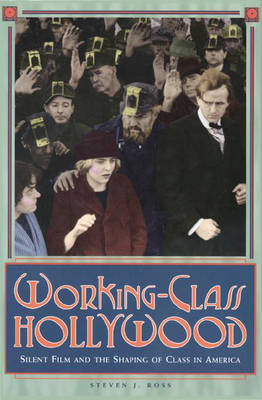
Working-Class Hollywood
Silent Film and the Shaping of Class in America
Seiten
1998
Princeton University Press (Verlag)
978-0-691-03234-4 (ISBN)
Princeton University Press (Verlag)
978-0-691-03234-4 (ISBN)
- Titel ist leider vergriffen;
keine Neuauflage - Artikel merken
This study of the rise of a working-class film movement in America during the early 20th-century, shows how filmmakers were far more concerned with class conflict during the silent era than at any other time. It also shows how silent films helped shape the belief that America is a classless nation.
Telling the story of American film-making in the early 20th-century, this book documents the rise of a working-class film movement that challenged the dominant political ideas of the day. Between 1907 and 1930, worker filmmakers repeatedly clashed with censors, film industry leaders and federal agencies over what images and subjects audiences would be allowed to see. The victors of these battles got to shape the meaning of class in 20th-century America. Surveying several hundred films made by or about working men and women, this book shows how filmmakers were far more concerned with class conflict during the silent era than at any other time. Directors such as Charlie Chaplin, D.W. Griffith and William de Mille made films that defended working people and chastised their enemies. Worker filmmakers also produced films such as " A Martyr to His Cause" (1911) and "The Gastonia Textile Strike" (1929), that depicted a unified working class using strikes, unions and socialism to transform a nation. J. Edgar Hoover considered these class-conscious productions so dangerous that he assigned secret agents to spy on worker filmmakers.
Liberal and radical films declined in the 1920s as an emerging Hollywood studio system, pressured by censors and Wall Street investors, pushed American film in increasingly conservative directions. Appealing to people's dreams of luxury and upward mobility, studios produced lavish fantasy films that shifted popular attention away from the problems of the workplace and toward the pleasures of the new consumer society. While worker filmmakers were trying to heighten class consciousness, Hollywood producers were suggesting that class no longer mattered. This book shows how silent films helped shape the belief that America is a classless nation.
Telling the story of American film-making in the early 20th-century, this book documents the rise of a working-class film movement that challenged the dominant political ideas of the day. Between 1907 and 1930, worker filmmakers repeatedly clashed with censors, film industry leaders and federal agencies over what images and subjects audiences would be allowed to see. The victors of these battles got to shape the meaning of class in 20th-century America. Surveying several hundred films made by or about working men and women, this book shows how filmmakers were far more concerned with class conflict during the silent era than at any other time. Directors such as Charlie Chaplin, D.W. Griffith and William de Mille made films that defended working people and chastised their enemies. Worker filmmakers also produced films such as " A Martyr to His Cause" (1911) and "The Gastonia Textile Strike" (1929), that depicted a unified working class using strikes, unions and socialism to transform a nation. J. Edgar Hoover considered these class-conscious productions so dangerous that he assigned secret agents to spy on worker filmmakers.
Liberal and radical films declined in the 1920s as an emerging Hollywood studio system, pressured by censors and Wall Street investors, pushed American film in increasingly conservative directions. Appealing to people's dreams of luxury and upward mobility, studios produced lavish fantasy films that shifted popular attention away from the problems of the workplace and toward the pleasures of the new consumer society. While worker filmmakers were trying to heighten class consciousness, Hollywood producers were suggesting that class no longer mattered. This book shows how silent films helped shape the belief that America is a classless nation.
Steven J. Ross is Professor of History at the University of Southern California, where he teaches courses in American Social History and popular culture. He is the author of Workers on the Edge: Work, Leisure, and Politics in Industrializing Cincinnati, 1788-1890, and has published numerous articles on film history, labor history, and social history.
| Erscheint lt. Verlag | 11.1.1998 |
|---|---|
| Zusatzinfo | 38 halftones |
| Verlagsort | New Jersey |
| Sprache | englisch |
| Maße | 197 x 254 mm |
| Gewicht | 709 g |
| Themenwelt | Kunst / Musik / Theater ► Film / TV |
| Geschichte ► Teilgebiete der Geschichte ► Kulturgeschichte | |
| Sozialwissenschaften ► Kommunikation / Medien ► Journalistik | |
| Sozialwissenschaften ► Kommunikation / Medien ► Medienwissenschaft | |
| Sozialwissenschaften ► Soziologie ► Makrosoziologie | |
| Wirtschaft | |
| ISBN-10 | 0-691-03234-3 / 0691032343 |
| ISBN-13 | 978-0-691-03234-4 / 9780691032344 |
| Zustand | Neuware |
| Informationen gemäß Produktsicherheitsverordnung (GPSR) | |
| Haben Sie eine Frage zum Produkt? |
Mehr entdecken
aus dem Bereich



aus dem Bereich
Die Revolution des Gemeinen Mannes
Buch | Softcover (2024)
C.H.Beck (Verlag)
CHF 16,80
Eine Geschichte des Geschmacks
Buch | Hardcover (2025)
C.H.Beck (Verlag)
CHF 49,95


