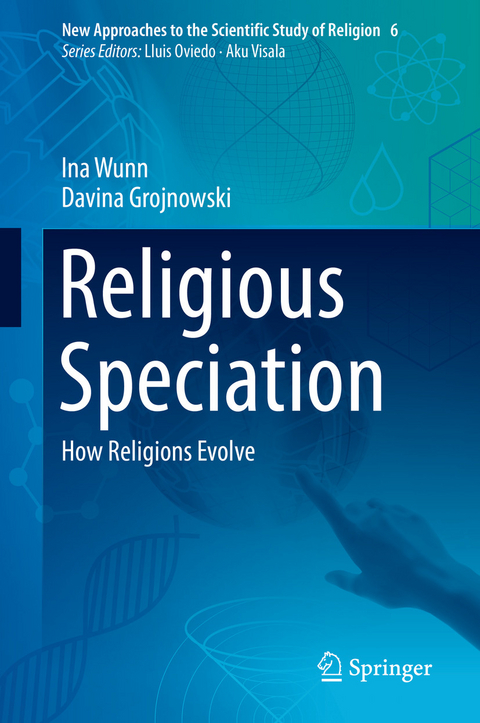
Religious Speciation (eBook)
VIII, 280 Seiten
Springer International Publishing (Verlag)
978-3-030-04435-0 (ISBN)
This book presents a consecutive story on the evolution of religions. It starts with an analysis of evolution in biology and ends with a discussion of what a proper theory of religious evolution should look like. It discusses such questions as whether it is humankind or religion that evolves, how religions evolve, and what adaptation of religions means. Topics examined include inheritance and heredity, religio-speciation, hybridization, ontogenetics and epigenetics, phylogenetics, and systematics. Calling attention to unsolved problems and relating the evolutionary subject matter to appropriate material, the book integrates and interprets existing data. Based on the belief that an unequivocal stand is more likely to produce constructive criticism than evasion of an issue, the book chooses that interpretation of a controversial matter which seems most consistent with the emerging picture of the evolutionary process.
'Nothing in biology makes sense except in the light of evolution,' the evolutionary biologist and co-founder of the so-called New Synthesis in Evolutionary Biology, Theodosius Dobszhansky (1900-1975), wrote in his famous essay of 1973, opposing creationism in American society. Today, Dobszhansky's statement is not only fully accepted in biology, but has become the scientific paradigm in disciplines such as psychology, archaeology and the study of religions. Yet in spite of this growing interest in evolutionary processes in religion and culture, the term 'evolution' and the capability of an evolutionary account have to date still not been properly understood by scholars of the Humanities. This book closes that gap.Ina Wunn studied Biology and Geology at Philipps-University of Marburg and received a doctorate in Palaeontology (Dr. rer. nat.) in 1985. After a three-year stay in Africa she returned to university to study Religious Studies and Philosophy and to do a doctoral degree in Religious Studies in 1999. In 2002, she received the postdoctoral lecturer qualification (venia legendi) in Religious Studies from University of Hanover and has subsequently been Professor of Religious Studies at the Universities of Bielefeld and, later, Hanover. In her research Ina Wunn focuses on theory of science, especially scientific approaches in the humanities, as well as theories of the origin of religion and prehistoric religion.
Ina Wunn studied Biology and Geology at Philipps-University of Marburg and received a doctorate in Palaeontology (Dr. rer. nat.) in 1985. After a three-year stay in Africa she returned to university to study Religious Studies and Philosophy and to do a doctoral degree in Religious Studies in 1999. In 2002, she received the postdoctoral lecturer qualification (venia legendi) in Religious Studies from University of Hanover and has subsequently been Professor of Religious Studies at the Universities of Bielefeld and, later, Hanover. In her research Ina Wunn focuses on theory of science, especially scientific approaches in the humanities, as well as theories of the origin of religion and prehistoric religion.Davina Grojnowski completed her doctoral degree in the field of Theology and Religious Studies at King's College London, UK. She holds an Undergraduate degree in Classics, also from King’s, and a Master’s degree in Jewish Studies from the University of Oxford. Her research interests lie in the religious literature of the Second Temple period, including the representation of the body in religious thought, and the origins of religion. She has taught at the University of Bielefeld, Germany, and King's College London, UK.
Chapter 1. Nothing makes sense except in the light of evolution… (State of research and critique of current evolutionary accounts in the Study of Religions).- Chapter 2. What is Evolution? (An analysis of biological evolution.).- Chapter 3. What does evolve? Humankind or Religion Itself? (That means: Is religion a by-product of our brain and is religion adaptive? Or are we in search for a theory of how religion itself evolves? These are very different questions!).- Chapter 4. The question of the evolving unit. (What is the equivalent of the “species”).- Chapter 5. How do religions evolve? (The search for the driving forces behind religious evolution: variability and selection).- Chapter 6. The adaptation of a religion – what does it mean?.- Chapter 7. The “Natural environment” and the evolving religion (What is the environment to which an evolving religion has to adapt? – see our discussion in: Wunn & Grojnowski: “Ancestors, Territoriality, and Gods”, Springer 2016).- Chapter 8. Inheritance among religions (What does the term “heredity” mean – as far as religions are concerned?).- Chapter 9. Religio-speciation.- Chapter 10. Hybridization (What happens when two religions influence each other and become one?).- Chapter 11. Ontogenetics and Epigenetics: Religions and the short-term adaptation to a changing environment.- Chapter 12. Phylogenetics or: a Tree of Life for religions.- Chapter 13. Systematics: How are the historical and recent religions related to each other?.- Chapter 14. The evolution of Judeo-Christian religion (an example. Also possible: The evolution of the religions of the Indian Subcontinent).
| Erscheint lt. Verlag | 7.2.2019 |
|---|---|
| Reihe/Serie | New Approaches to the Scientific Study of Religion |
| New Approaches to the Scientific Study of Religion | New Approaches to the Scientific Study of Religion |
| Zusatzinfo | VIII, 280 p. 22 illus., 15 illus. in color. |
| Verlagsort | Cham |
| Sprache | englisch |
| Themenwelt | Geisteswissenschaften ► Religion / Theologie |
| Sozialwissenschaften ► Politik / Verwaltung | |
| Schlagworte | adaptation of a religion • by-product of religion • evolution in studies of religion • heredity and inheritance among religions • hybridization of religions • religion an evolving unit • religio-speciation • Religious evolution • selection of a religion • Systematics of religions |
| ISBN-10 | 3-030-04435-1 / 3030044351 |
| ISBN-13 | 978-3-030-04435-0 / 9783030044350 |
| Informationen gemäß Produktsicherheitsverordnung (GPSR) | |
| Haben Sie eine Frage zum Produkt? |
 PDF (Wasserzeichen)
DRM: Digitales Wasserzeichen
Dieses eBook enthält ein digitales Wasserzeichen und ist damit für Sie personalisiert. Bei einer missbräuchlichen Weitergabe des eBooks an Dritte ist eine Rückverfolgung an die Quelle möglich.
Dateiformat: PDF (Portable Document Format)
Mit einem festen Seitenlayout eignet sich die PDF besonders für Fachbücher mit Spalten, Tabellen und Abbildungen. Eine PDF kann auf fast allen Geräten angezeigt werden, ist aber für kleine Displays (Smartphone, eReader) nur eingeschränkt geeignet.
Systemvoraussetzungen:
PC/Mac: Mit einem PC oder Mac können Sie dieses eBook lesen. Sie benötigen dafür einen PDF-Viewer - z.B. den Adobe Reader oder Adobe Digital Editions.
eReader: Dieses eBook kann mit (fast) allen eBook-Readern gelesen werden. Mit dem amazon-Kindle ist es aber nicht kompatibel.
Smartphone/Tablet: Egal ob Apple oder Android, dieses eBook können Sie lesen. Sie benötigen dafür einen PDF-Viewer - z.B. die kostenlose Adobe Digital Editions-App.
Buying eBooks from abroad
For tax law reasons we can sell eBooks just within Germany and Switzerland. Regrettably we cannot fulfill eBook-orders from other countries.
aus dem Bereich