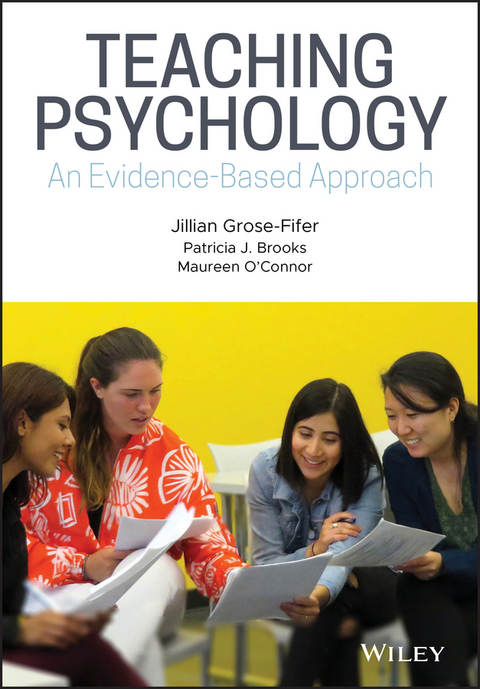
Teaching Psychology (eBook)
John Wiley & Sons (Verlag)
978-1-118-98145-0 (ISBN)
Teaching Psychology offers an evidence-based, student-centered approach that is filled with suggestions, ideas, and practices for teaching college-level courses in ways that contribute to student success. The authors draw on current scientific studies of learning, memory, and development, with specific emphasis on classroom studies. The authors offer practical advice for applying scholarly research to teaching in ways that maximize student learning and personal growth. The authors endorse the use of backward course design, emphasizing the importance of identifying learning goals (encompassing skills and knowledge) and how to assess them, before developing the appropriate curriculum for achieving these goals. Recognizing the diversity of today's student population, this book offers guidance for culturally responsive, ethical teaching.
The text explores techniques for teaching critical thinking, qualitative and quantitative reasoning, written and oral communication, information and technology literacy, and collaboration and teamwork. The authors explain how to envision the learning objectives teachers want their students to achieve and advise how to select assessments to evaluate if the learning objectives are being met. This important resource:
- Offers an evidence-based approach designed to help graduate students and new instructors embrace a student-centered approach to teaching;
- Contains a wealth of examples of effective student-centered teaching techniques;
- Surveys current findings from the Scholarship of Teaching and Learning;
- Draws on the American Psychological Association's five broad goals for the undergraduate Psychology major and shows how to help students build life-long skills; and,
- Introduces Universal Design for Learning as a framework to support diverse learners.
Teaching Psychology offers an essential guide to evidence-based teaching and provides practical advice for becoming an effective teacher. This book is designed to help graduate students, new instructors, and those wanting to update their teaching methods. It is likely to be particularly useful for instructors in psychology and other social science disciplines.
JILLIAN GROSE-FIFER, PhD, is a cognitive neuroscientist and Associate Professor of Psychology at John Jay College of Criminal Justice and The Graduate Center, City University of New York (CUNY).
PATRICIA J. BROOKS, PhD, is a developmental psychologist and Professor of Psychology at the College of Staten Island and The Graduate Center, City University of New York (CUNY).
MAUREEN O'CONNOR, PhD, JD, is President of Palo Alto University (PAU), an institution dedicated to education and research in psychology and counseling.
JILLIAN GROSE-FIFER, PhD, is a cognitive neuroscientist and Associate Professor of Psychology at John Jay College of Criminal Justice and The Graduate Center, City University of New York (CUNY). PATRICIA J. BROOKS, PhD, is a developmental psychologist and Professor of Psychology at the College of Staten Island and The Graduate Center, City University of New York (CUNY). MAUREEN O'CONNOR, PhD, JD, is President of Palo Alto University (PAU), an institution dedicated to education and research in psychology and counseling.
Introduction
We represent three very different subfields in psychology—Jill Grose‐Fifer is a cognitive neuroscientist, Patricia Brooks is a developmental psychologist, and Maureen O'Connor studies the intersection between psychology and the law—but we have a shared passion: teaching! We came up with the idea for this book when all three of us taught at various colleges of the City University of New York (), arguably one of the most diverse universities in the world. The seeds were sown about 10 years ago, when Maureen O'Connor, as Executive Officer of the Ph.D. program in Psychology at the Graduate Center, was overseeing the training of doctoral students in psychology at CUNY. It became very clear to her that although the majority of the doctoral students had fellowships that required them to teach, most had no training or experience in pedagogy, and they were feeling overwhelmed and unprepared. Together with a group of enthusiastic doctoral students, we formed a Teaching of Psychology Task Force and put together a training program for emerging teachers. This included an annual Pedagogy Day conference and the creation of a graduate Seminar and Practicum on the Teaching of Psychology, which we began running at CUNY in 2012. Over the years, we mostly co'taught (in various combinations) the Teaching of Psychology course, but we consistently struggled to find a manageable set of weekly readings. We wanted to adequately expose our students to the depth and breadth of pedagogical research that would help them hone their developing teaching practices, but it was difficult to achieve this using a small number of primary sources. This book emerged as a result of our trying to summarize the large body of literature on effective pedagogical practices so that students could develop an evidence‐based teaching philosophy. We have tried, in particular, to draw on evidence from basic scientific inquiry into learning, memory, and development, in addition to well‐designed studies within classrooms. As such, we think that this book is scholarly, but also offers practical advice for the application of evidence from the scholarship of teaching and learning () in designing or adapting courses, and maximizing student learning and personal growth.
To orient you to the approach we have taken in writing this book, we want to explain a little more about our teaching philosophies. As undergraduates, all three of us sat through lectures where the professor was the only one talking in the room. This teacher‐centered method of instruction is still relatively popular in colleges today. Indeed, many of our doctoral students were taught in this way, but it contrasts strongly with the highly interactive student‐centered approach that we have adopted in this book and in our classes. Like many others in our generation, we were not trained as teachers, but we have improved our teaching by learning from others, and by taking risks and experimenting in our classes. Importantly, we use an evidence‐based approach to inform our “experiments.” Research has conclusively demonstrated that learning occurs best when students are active participants in the process, rather than just sitting passively in the classroom listening (or mind‐wandering) while the instructor talks. Therefore, the focus of our book is on assisting instructors in adopting a student‐centered pedagogy. Since psychology is our area of expertise, we have titled this book Teaching Psychology, and have provided many suggestions about how to apply best practices for teaching in psychology classes. However, nothing we say about teaching per se applies only to psychology classes. Therefore, we hope that this book will be helpful to instructors in other disciplines too. Similarly, we have couched much of this material in terms of teaching undergraduates, but the general ideas are also applicable when teaching graduate‐level classes. Masters and doctoral students also benefit from active learning, and scaffolded support helps to improve their scientific literacy, critical thinking, communication, and collaboration skills.
In Chapter 1, which serves as an extended introduction to the book, we outline the rationale and evidence for using a student‐centered approach. Given the emphasis on students (rather than instructors), we also provide demographic information that highlights the diversity of today's undergraduate population and make concrete suggestions about how best to support them in ways that are culturally sensitive. This theme of supporting diverse learners permeates the other chapters of the book too, beginning in Chapter 2, where we introduce the concept of Universal Design for Learning, a framework that acknowledges that building the accommodations that many students need into the curriculum not only supports at‐risk students, but benefits all other students, too.
We know from our Teaching of Psychology course that instructors may initially be resistant to adopting a student‐centered approach, especially if they have not had personal experience with it. To some, it seems to be a time‐consuming and inefficient way of transmitting information—a typical goal of teacher‐centered pedagogy. In general, after reading the relevant literature in our Teaching of Psychology class, even reluctant students have gradually become convinced not only that is lecturing a relatively ineffective way of promoting learning, but that teachers of psychology should embrace the tenets of a liberal arts education, a framework that is commensurate with the five broad goals that the American Psychological Association (APA, 2013) endorses for the psychology undergraduate major. APA advocates that, in addition to acquiring a knowledge base in psychology, students are expected to be able to think critically and reason scientifically, communicate well, demonstrate ethical and socially responsible behavior, work effectively with others, and be cognizant of the careers and educational opportunities that they will be qualified for based on the knowledge and skills acquired over the span of their undergraduate studies.
To help achieve these goals, we have devoted chapters to teaching critical thinking, including scientific literacy (Chapter 4), writing (Chapter 6), and learning to collaborate with others (Chapter 5). Critically, throughout the book, we focus on approaches that are likely to help students develop holistically as people. We endorse teaching methods that allow undergraduates to better understand themselves as learners and how they relate to others, as well as those that help them to develop an awareness of the utility of their knowledge and skills in their post‐graduation careers, either in the workforce or in graduate school.
Given our evidence‐based approach, it is fitting that our book has a heavy emphasis on the importance of assessment. This is also in keeping with the increasing focus on accountability in higher education. In Chapter 2, we describe how to use backward design (Wiggins & McTighe, 2005) for course planning. This begins with envisioning the skills and knowledge (learning objectives) one wants one's students to have gained by the end of the course, then selecting various assessments to evaluate whether one's learning objectives have been met, and finally, planning the curriculum to provide opportunities for students to develop the requisite knowledge and skills. Although many colleges require that syllabi include learning objectives, they can sometimes be added as an afterthought, rather than being the driving force behind course design. Backward design ensures a more intentional approach to instruction and increases the likelihood that a learning objective is both addressed in the curriculum and assessed in appropriate ways. We provide various models to help instructors design learning objectives that emphasize higher‐order thinking. Once these and their assessments are formulated, SoTL‐established methods can then be used to help students reach these goals. We describe such methods throughout the book. In addition to the chapters already mentioned, Chapter 3 describes how technology can support student learning (this theme is continued in Chapter 8, where we discuss how to move elements of a face‐to‐face class online in order to promote learning), while Chapter 7 describes how students learn through the use of testing and by developing a metacognitive awareness of their knowledge and skills, and how to improve them. Chapter 7 also provides evidence for psychosocial interventions that can promote student motivation, a key component of effective learning. In Chapter 2, we introduce the importance of ongoing or formative assessment; this is then touched upon in each subsequent chapter. As teacher‐scholars, when we adopt evidence‐based best practices (such as those described in the various chapters) in our classes, we have to assess how effective they are for our particular students. Frequent formative assessment allows adjustments to be made on the fly and helps us continually learn how to become better teachers.
Although this book does not focus on teaching online, we are mindful that hybrid and fully online courses are increasingly common in higher education. Teaching an online course for the first time is not trivial; fortunately, there are now many excellent resources available to support instructors using this format. Teaching online requires a lot of technological know‐how and upfront course preparation, and...
| Erscheint lt. Verlag | 26.11.2018 |
|---|---|
| Sprache | englisch |
| Themenwelt | Geisteswissenschaften ► Psychologie ► Allgemeines / Lexika |
| Sozialwissenschaften ► Pädagogik | |
| Schlagworte | APA undergraduate learning goals • Assessment Strategies • benefits of testing • cooperative learning • creating a syllabus • critical thinking in the classroom • culturally-responsive instruction • developing assignments • developing a teaching philosophy</p> • developing qualitative reasoning skills • developing quantitative reasoning skills • Diversity in Higher Education • ethical teaching • evidence-based approaches to teaching • formative and summative assessment • fostering good study habits • group work • learning goals and objectives • Learning Theory & Research • learning to write • Lerntheorie u. -forschung • <p>Guide to teaching psychology • mindsets around testing and learning • multimedia instruction • preparing for online teaching • preparing to teach • Psychologie • Psychology • resources for teaching psychology • rubrics and feedback • Scholarship of teaching and learning • Service Learning • student evaluation • Teaching activities • textbook on teaching psychology • universal design for learning • use of course management systems • writing to learn |
| ISBN-10 | 1-118-98145-6 / 1118981456 |
| ISBN-13 | 978-1-118-98145-0 / 9781118981450 |
| Informationen gemäß Produktsicherheitsverordnung (GPSR) | |
| Haben Sie eine Frage zum Produkt? |
 EPUB (Adobe DRM)
Kopierschutz: Adobe-DRM
Adobe-DRM ist ein Kopierschutz, der das eBook vor Mißbrauch schützen soll. Dabei wird das eBook bereits beim Download auf Ihre persönliche Adobe-ID autorisiert. Lesen können Sie das eBook dann nur auf den Geräten, welche ebenfalls auf Ihre Adobe-ID registriert sind.
Details zum Adobe-DRM
Dateiformat: EPUB (Electronic Publication)
EPUB ist ein offener Standard für eBooks und eignet sich besonders zur Darstellung von Belletristik und Sachbüchern. Der Fließtext wird dynamisch an die Display- und Schriftgröße angepasst. Auch für mobile Lesegeräte ist EPUB daher gut geeignet.
Systemvoraussetzungen:
PC/Mac: Mit einem PC oder Mac können Sie dieses eBook lesen. Sie benötigen eine
eReader: Dieses eBook kann mit (fast) allen eBook-Readern gelesen werden. Mit dem amazon-Kindle ist es aber nicht kompatibel.
Smartphone/Tablet: Egal ob Apple oder Android, dieses eBook können Sie lesen. Sie benötigen eine
Geräteliste und zusätzliche Hinweise
Buying eBooks from abroad
For tax law reasons we can sell eBooks just within Germany and Switzerland. Regrettably we cannot fulfill eBook-orders from other countries.
aus dem Bereich