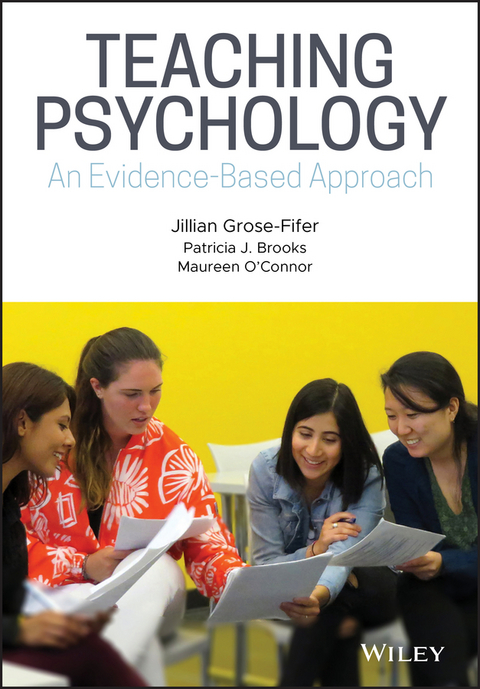
Teaching Psychology (eBook)
John Wiley & Sons (Verlag)
978-1-118-98144-3 (ISBN)
Teaching Psychology offers an evidence-based, student-centered approach that is filled with suggestions, ideas, and practices for teaching college-level courses in ways that contribute to student success. The authors draw on current scientific studies of learning, memory, and development, with specific emphasis on classroom studies. The authors offer practical advice for applying scholarly research to teaching in ways that maximize student learning and personal growth. The authors endorse the use of backward course design, emphasizing the importance of identifying learning goals (encompassing skills and knowledge) and how to assess them, before developing the appropriate curriculum for achieving these goals. Recognizing the diversity of today's student population, this book offers guidance for culturally responsive, ethical teaching.
The text explores techniques for teaching critical thinking, qualitative and quantitative reasoning, written and oral communication, information and technology literacy, and collaboration and teamwork. The authors explain how to envision the learning objectives teachers want their students to achieve and advise how to select assessments to evaluate if the learning objectives are being met. This important resource:
- Offers an evidence-based approach designed to help graduate students and new instructors embrace a student-centered approach to teaching;
- Contains a wealth of examples of effective student-centered teaching techniques;
- Surveys current findings from the Scholarship of Teaching and Learning;
- Draws on the American Psychological Association's five broad goals for the undergraduate Psychology major and shows how to help students build life-long skills; and,
- Introduces Universal Design for Learning as a framework to support diverse learners.
Teaching Psychology offers an essential guide to evidence-based teaching and provides practical advice for becoming an effective teacher. This book is designed to help graduate students, new instructors, and those wanting to update their teaching methods. It is likely to be particularly useful for instructors in psychology and other social science disciplines.
JILLIAN GROSE-FIFER, PhD, is a cognitive neuroscientist and Associate Professor of Psychology at John Jay College of Criminal Justice and The Graduate Center, City University of New York (CUNY).
PATRICIA J. BROOKS, PhD, is a developmental psychologist and Professor of Psychology at the College of Staten Island and The Graduate Center, City University of New York (CUNY).
MAUREEN O'CONNOR, PhD, JD, is President of Palo Alto University (PAU), an institution dedicated to education and research in psychology and counseling.
A guide to an evidence-based approach for teaching college-level psychology courses Teaching Psychology offers an evidence-based, student-centered approach that is filled with suggestions, ideas, and practices for teaching college-level courses in ways that contribute to student success. The authors draw on current scientific studies of learning, memory, and development, with specific emphasis on classroom studies. The authors offer practical advice for applying scholarly research to teaching in ways that maximize student learning and personal growth. The authors endorse the use of backward course design, emphasizing the importance of identifying learning goals (encompassing skills and knowledge) and how to assess them, before developing the appropriate curriculum for achieving these goals. Recognizing the diversity of today's student population, this book offers guidance for culturally responsive, ethical teaching. The text explores techniques for teaching critical thinking, qualitative and quantitative reasoning, written and oral communication, information and technology literacy, and collaboration and teamwork. The authors explain how to envision the learning objectives teachers want their students to achieve and advise how to select assessments to evaluate if the learning objectives are being met. This important resource: Offers an evidence-based approach designed to help graduate students and new instructors embrace a student-centered approach to teaching; Contains a wealth of examples of effective student-centered teaching techniques; Surveys current findings from the Scholarship of Teaching and Learning; Draws on the American Psychological Association's five broad goals for the undergraduate Psychology major and shows how to help students build life-long skills; and, Introduces Universal Design for Learning as a framework to support diverse learners. Teaching Psychology offers an essential guide to evidence-based teaching and provides practical advice for becoming an effective teacher. This book is designed to help graduate students, new instructors, and those wanting to update their teaching methods. It is likely to be particularly useful for instructors in psychology and other social science disciplines.
JILLIAN GROSE-FIFER, PhD, is a cognitive neuroscientist and Associate Professor of Psychology at John Jay College of Criminal Justice and The Graduate Center, City University of New York (CUNY). PATRICIA J. BROOKS, PhD, is a developmental psychologist and Professor of Psychology at the College of Staten Island and The Graduate Center, City University of New York (CUNY). MAUREEN O'CONNOR, PhD, JD, is President of Palo Alto University (PAU), an institution dedicated to education and research in psychology and counseling.
| Erscheint lt. Verlag | 26.11.2018 |
|---|---|
| Sprache | englisch |
| Themenwelt | Geisteswissenschaften ► Psychologie ► Allgemeines / Lexika |
| Sozialwissenschaften ► Pädagogik | |
| Schlagworte | APA undergraduate learning goals • Assessment Strategies • benefits of testing • cooperative learning • creating a syllabus • critical thinking in the classroom • culturally-responsive instruction • developing assignments • developing a teaching philosophy</p> • developing qualitative reasoning skills • developing quantitative reasoning skills • Diversity in Higher Education • ethical teaching • evidence-based approaches to teaching • formative and summative assessment • fostering good study habits • group work • learning goals and objectives • Learning Theory & Research • learning to write • Lerntheorie u. -forschung • <p>Guide to teaching psychology • mindsets around testing and learning • multimedia instruction • preparing for online teaching • preparing to teach • Psychologie • Psychology • resources for teaching psychology • rubrics and feedback • Scholarship of teaching and learning • Service Learning • student evaluation • Teaching activities • textbook on teaching psychology • universal design for learning • use of course management systems • writing to learn |
| ISBN-10 | 1-118-98144-8 / 1118981448 |
| ISBN-13 | 978-1-118-98144-3 / 9781118981443 |
| Informationen gemäß Produktsicherheitsverordnung (GPSR) | |
| Haben Sie eine Frage zum Produkt? |
 PDF (Adobe DRM)
Kopierschutz: Adobe-DRM
Adobe-DRM ist ein Kopierschutz, der das eBook vor Mißbrauch schützen soll. Dabei wird das eBook bereits beim Download auf Ihre persönliche Adobe-ID autorisiert. Lesen können Sie das eBook dann nur auf den Geräten, welche ebenfalls auf Ihre Adobe-ID registriert sind.
Details zum Adobe-DRM
Dateiformat: PDF (Portable Document Format)
Mit einem festen Seitenlayout eignet sich die PDF besonders für Fachbücher mit Spalten, Tabellen und Abbildungen. Eine PDF kann auf fast allen Geräten angezeigt werden, ist aber für kleine Displays (Smartphone, eReader) nur eingeschränkt geeignet.
Systemvoraussetzungen:
PC/Mac: Mit einem PC oder Mac können Sie dieses eBook lesen. Sie benötigen eine
eReader: Dieses eBook kann mit (fast) allen eBook-Readern gelesen werden. Mit dem amazon-Kindle ist es aber nicht kompatibel.
Smartphone/Tablet: Egal ob Apple oder Android, dieses eBook können Sie lesen. Sie benötigen eine
Geräteliste und zusätzliche Hinweise
Buying eBooks from abroad
For tax law reasons we can sell eBooks just within Germany and Switzerland. Regrettably we cannot fulfill eBook-orders from other countries.
aus dem Bereich