


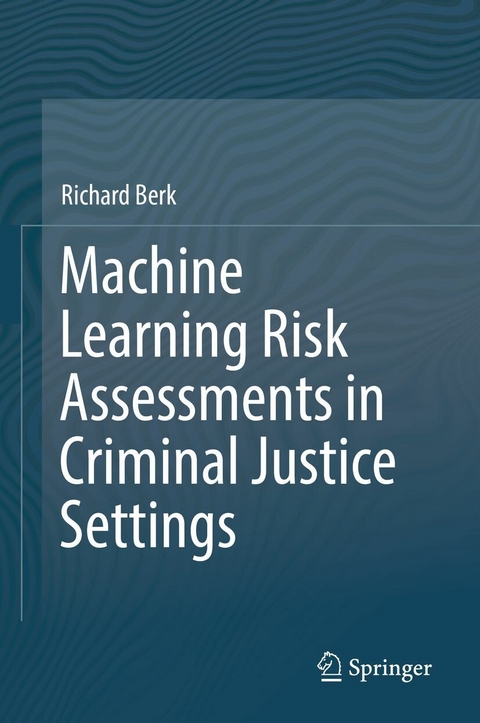
Machine Learning Risk Assessments in Criminal Justice Settings (eBook)
IX, 178 Seiten
Springer International Publishing (Verlag)
978-3-030-02272-3 (ISBN)
This book puts in one place and in accessible form Richard Berk's most recent work on forecasts of re-offending by individuals already in criminal justice custody. Using machine learning statistical procedures trained on very large datasets, an explicit introduction of the relative costs of forecasting errors as the forecasts are constructed, and an emphasis on maximizing forecasting accuracy, the author shows how his decades of research on the topic improves forecasts of risk.
Criminal justice risk forecasts anticipate the future behavior of specified individuals, rather than 'predictive policing' for locations in time and space, which is a very different enterprise that uses different data different data analysis tools.
The audience for this book includes graduate students and researchers in the social sciences, and data analysts in criminal justice agencies. Formal mathematics is used only as necessary or in concert with more intuitive explanations.
Richard Berk is a Professor in the Department of Statistics and Department of Criminology at the University of Pennsylvania. He was previously a Distinguished Professor Statistics at UCLA. He has published 14 books and over 150 papers and book chapters on a wide range applied statistical issues, including many criminal justice applications.
Richard Berk is a Professor in the Department of Statistics and Department of Criminology at the University of Pennsylvania. He was previously a Distinguished Professor Statistics at UCLA. He has published 14 books and over 150 papers and book chapters on a wide range applied statistical issues, including many criminal justice applications.
1 Getting Started.- 2 Some Important Background Material.- 3 A Conceptual Introduction Classification and Forecasting.- 4 A More Formal Treatment of Classification and Forecasting.- 5 Tree-Based Forecasting Methods.- 6 Transparency, Accuracy and Fairness.- 7 Real Applications.- 8 Implementation.- 9 Some Concluding Observations About Actuarial Justice and More.
| Erscheint lt. Verlag | 13.12.2018 |
|---|---|
| Zusatzinfo | IX, 178 p. 32 illus., 27 illus. in color. |
| Verlagsort | Cham |
| Sprache | englisch |
| Themenwelt | Mathematik / Informatik ► Informatik ► Datenbanken |
| Sozialwissenschaften ► Politik / Verwaltung | |
| Schlagworte | criminal justice • Deep learning • fair algorithms • Future Dangerousness • Gradient boosting • machine learning • Neural networks • Quantitative Criminology • random forests • risk assessment • risk forecasting |
| ISBN-10 | 3-030-02272-2 / 3030022722 |
| ISBN-13 | 978-3-030-02272-3 / 9783030022723 |
| Informationen gemäß Produktsicherheitsverordnung (GPSR) | |
| Haben Sie eine Frage zum Produkt? |
 PDF (Wasserzeichen)
DRM: Digitales Wasserzeichen
Dieses eBook enthält ein digitales Wasserzeichen und ist damit für Sie personalisiert. Bei einer missbräuchlichen Weitergabe des eBooks an Dritte ist eine Rückverfolgung an die Quelle möglich.
Dateiformat: PDF (Portable Document Format)
Mit einem festen Seitenlayout eignet sich die PDF besonders für Fachbücher mit Spalten, Tabellen und Abbildungen. Eine PDF kann auf fast allen Geräten angezeigt werden, ist aber für kleine Displays (Smartphone, eReader) nur eingeschränkt geeignet.
Systemvoraussetzungen:
PC/Mac: Mit einem PC oder Mac können Sie dieses eBook lesen. Sie benötigen dafür einen PDF-Viewer - z.B. den Adobe Reader oder Adobe Digital Editions.
eReader: Dieses eBook kann mit (fast) allen eBook-Readern gelesen werden. Mit dem amazon-Kindle ist es aber nicht kompatibel.
Smartphone/Tablet: Egal ob Apple oder Android, dieses eBook können Sie lesen. Sie benötigen dafür einen PDF-Viewer - z.B. die kostenlose Adobe Digital Editions-App.
Buying eBooks from abroad
For tax law reasons we can sell eBooks just within Germany and Switzerland. Regrettably we cannot fulfill eBook-orders from other countries.
aus dem Bereich


