Work of Forgetting (eBook)
144 Seiten
Rowman & Littlefield International (Verlag)
978-1-78552-324-3 (ISBN)
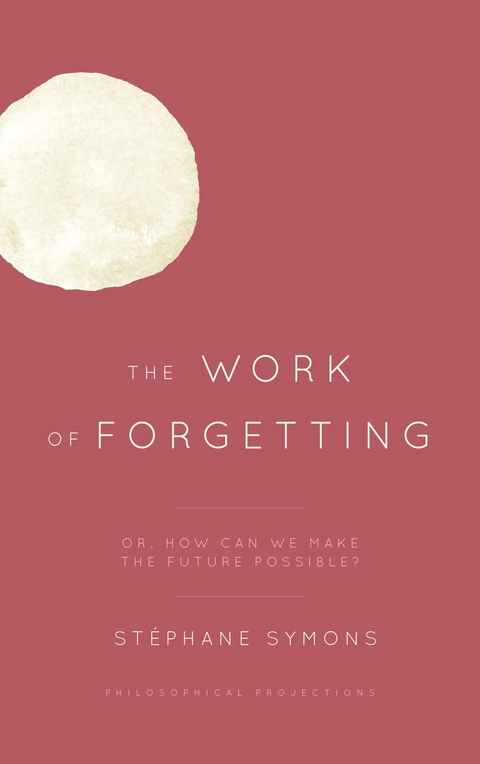
This book presents a critical discussion of the turn to memory, a key evolution in the humanities in the last 50 years. It offers an innovative interpretation of Walter Benjamin’s philosophy of history and his oeuvre at large, taking a thematic approach to the issue of forgetting, based on detailed readings of key philosophers of the 20th century.
For over fifty years the concept of memory has played a crucial role in a large number of academic and societal debates. The Work of Forgetting: Or, How Can We Make the Future Possible? draws attention to the limits of the academic field of memory studies. It argues that the faculty of memory offers an inadequate response to the challenges of the present. The book sets up a dialogue between the philosophies of forgetting that underlie the writings of Friedrich Nietzsche, Walter Benjamin and Gilles Deleuze, and the philosophies of memory that inform the work of Sigmund Freud, Martin Heidegger and Hannah Arendt. It builds on the idea that history is inseparable from a type of transience that cannot be counter-acted by the preserving work of memory and develops a new understanding of the phenomenon of forgetting in which the passage of time is asserted in thought and thus made productive.
lt;span>Stephane Symons is Assistant Professor of Philosophy at KU Leuven, Belgium. He is the author of Walter Benjamin: Presence of Mind, Failure to Comprehend (2013) and More than Life: Georg Simmel and Walter Benjamin on Art (2017), editor of The Marriage of Aesthetics and Ethics (2015) and co-editor of Walter Benjamin and Theology (2015).
Acknowledgments
Introduction: The Work of Forgetting. Or, How Can We Make the Future Possible?
Chapter One: What is Thought? And How Can We Bring It About?
Chapter Two: What is the Immemorial? And How Can We Make It Go Away?
Chapter Three: What is the Child? Or How Can We Begin Anew?
By Way of Conclusion: A Note on Shadows
Index
| Reihe/Serie | Philosophical Projections |
|---|---|
| Zusatzinfo | 2 Illustrations including: - 2 Halftones, Black & White including Black & White Photographs. |
| Sprache | englisch |
| Themenwelt | Geisteswissenschaften ► Philosophie ► Philosophie der Neuzeit |
| Geisteswissenschaften ► Sprach- / Literaturwissenschaft ► Anglistik / Amerikanistik | |
| Geisteswissenschaften ► Sprach- / Literaturwissenschaft ► Literaturwissenschaft | |
| Sozialwissenschaften | |
| Schlagworte | Aesthetics • Arendt • art theory • Benjamin • Comparative Literature • Continental Philosophy • Critical theory • Deleuze • Freud • Heidegger • Literary Studies • Literature • Nietzsche • Phenomenology • Psychoanalyis |
| ISBN-10 | 1-78552-324-4 / 1785523244 |
| ISBN-13 | 978-1-78552-324-3 / 9781785523243 |
| Informationen gemäß Produktsicherheitsverordnung (GPSR) | |
| Haben Sie eine Frage zum Produkt? |
 EPUB (Adobe DRM)
Kopierschutz: Adobe-DRM
Adobe-DRM ist ein Kopierschutz, der das eBook vor Mißbrauch schützen soll. Dabei wird das eBook bereits beim Download auf Ihre persönliche Adobe-ID autorisiert. Lesen können Sie das eBook dann nur auf den Geräten, welche ebenfalls auf Ihre Adobe-ID registriert sind.
Details zum Adobe-DRM
Dateiformat: EPUB (Electronic Publication)
EPUB ist ein offener Standard für eBooks und eignet sich besonders zur Darstellung von Belletristik und Sachbüchern. Der Fließtext wird dynamisch an die Display- und Schriftgröße angepasst. Auch für mobile Lesegeräte ist EPUB daher gut geeignet.
Systemvoraussetzungen:
PC/Mac: Mit einem PC oder Mac können Sie dieses eBook lesen. Sie benötigen eine
eReader: Dieses eBook kann mit (fast) allen eBook-Readern gelesen werden. Mit dem amazon-Kindle ist es aber nicht kompatibel.
Smartphone/Tablet: Egal ob Apple oder Android, dieses eBook können Sie lesen. Sie benötigen eine
Geräteliste und zusätzliche Hinweise
Buying eBooks from abroad
For tax law reasons we can sell eBooks just within Germany and Switzerland. Regrettably we cannot fulfill eBook-orders from other countries.
aus dem Bereich