


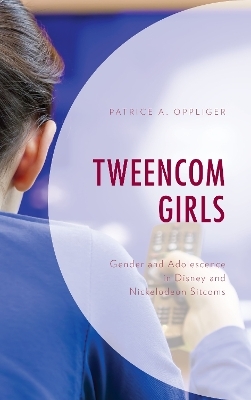
Tweencom Girls
Gender and Adolescence in Disney and Nickelodeon Sitcoms
Seiten
2018
Lexington Books (Verlag)
978-1-4985-5058-1 (ISBN)
Lexington Books (Verlag)
978-1-4985-5058-1 (ISBN)
- Titel ist leider vergriffen;
keine Neuauflage - Artikel merken
This book looks at the portrayals of girls on Disney and Nickelodeon tweencoms. It covers character tropes like main girls, mean girls, cheerleaders, and adults as well as special topics such as popularity, friendships, and girl power.
Banet-Weiser (2004) marked the debut of Clarissa Explains it All in 1991 as a crucial turning point for recognition of girls as “important empowered subjects in the social world.” The current study of tweencoms focuses on the different ways character tropes are portrayed in media targeted to 8-12 year olds, particularly female characters, over the last 25 years. The focus is limited to the cable giants Disney Channel and Nickelodeon because of their popularity and high concentration of original programming targeted to tweens that airs nearly round-the-clock.
This book employs a thematic analysis approach, similar to the one adopted by Riggs (2011) in his identification of the ways in which particular groups of characters are represented and the implications such representations might have for viewers. It incorporates cultivation theory (Gerbner 1998), which is based on media consumption’s influence on distorted perceptions of reality, and social cognitive theory (Bandura 1986), which explains the relationship between vicarious exposure to specific behaviors and imitation of those behaviors.
This book provides extensive examples and alternative interpretations of the shows’ tropes and themes, particularly for those who are unfamiliar with the genre. Past research has shown that media and popular culture portrayals are influential for young viewers and yet live-action, cable comedies targeted to adolescents have gone relatively unnoticed. Much of the previous research has focused on very young girls and princess culture. The book is broken up into two sections. The first section explores common tweencom tropes. Subsequent chapters focusing on different themes that are prevalent throughout the series. The concluding chapter includes a discussion of the big picture of how the tropes and themes give insight into the female characters portrayed in the popular tweencom programming. The final chapter will also include advice to parents and educators.
Banet-Weiser (2004) marked the debut of Clarissa Explains it All in 1991 as a crucial turning point for recognition of girls as “important empowered subjects in the social world.” The current study of tweencoms focuses on the different ways character tropes are portrayed in media targeted to 8-12 year olds, particularly female characters, over the last 25 years. The focus is limited to the cable giants Disney Channel and Nickelodeon because of their popularity and high concentration of original programming targeted to tweens that airs nearly round-the-clock.
This book employs a thematic analysis approach, similar to the one adopted by Riggs (2011) in his identification of the ways in which particular groups of characters are represented and the implications such representations might have for viewers. It incorporates cultivation theory (Gerbner 1998), which is based on media consumption’s influence on distorted perceptions of reality, and social cognitive theory (Bandura 1986), which explains the relationship between vicarious exposure to specific behaviors and imitation of those behaviors.
This book provides extensive examples and alternative interpretations of the shows’ tropes and themes, particularly for those who are unfamiliar with the genre. Past research has shown that media and popular culture portrayals are influential for young viewers and yet live-action, cable comedies targeted to adolescents have gone relatively unnoticed. Much of the previous research has focused on very young girls and princess culture. The book is broken up into two sections. The first section explores common tweencom tropes. Subsequent chapters focusing on different themes that are prevalent throughout the series. The concluding chapter includes a discussion of the big picture of how the tropes and themes give insight into the female characters portrayed in the popular tweencom programming. The final chapter will also include advice to parents and educators.
Patrice A. Oppliger is assistant professor of media science at Boston University.
Part I: Tropes
1. Main Girls
2. Mean Girls
3. Cheerleaders
4. Targets
5. Adults
Part II: Themes
6. Popularity
7. Friendships
8. Relational Aggression and Teasing
9. Physical Aggression
10. Girl Power
| Erscheinungsdatum | 10.05.2021 |
|---|---|
| Reihe/Serie | Children and Youth in Popular Culture |
| Sprache | englisch |
| Maße | 154 x 236 mm |
| Gewicht | 485 g |
| Themenwelt | Sozialwissenschaften ► Pädagogik |
| Sozialwissenschaften ► Soziologie ► Gender Studies | |
| ISBN-10 | 1-4985-5058-4 / 1498550584 |
| ISBN-13 | 978-1-4985-5058-1 / 9781498550581 |
| Zustand | Neuware |
| Informationen gemäß Produktsicherheitsverordnung (GPSR) | |
| Haben Sie eine Frage zum Produkt? |
Mehr entdecken
aus dem Bereich



aus dem Bereich
Buch | Hardcover (2026)
Springer Fachmedien Wiesbaden GmbH (Verlag)
CHF 139,95
eine Geschichte des IfS aus feministischer Perspektive
Buch | Softcover (2025)
Bertz und Fischer (Verlag)
CHF 25,20


