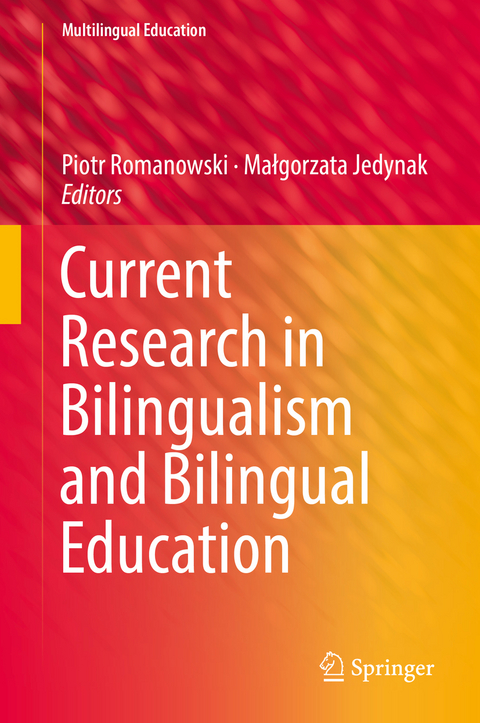
Current Research in Bilingualism and Bilingual Education (eBook)
XIX, 241 Seiten
Springer International Publishing (Verlag)
978-3-319-92396-3 (ISBN)
This book covers research topics in bilingual education, language policies, language contact, identity of bilingual speakers, early bilingualism, heritage languages, and more, and provides an overview of current theory, research and practice in the field of bilingualism. Each chapter is written by a specialist in the field. Part I focuses on the numerous and heterogeneous relations between languages as well as the implications arising from bilingual speech processing. In Part II, a series of contextualized studies on bilingual classrooms are presented, with diverse research designs applied in different educational settings being a key feature of these studies. Part III bridges theory and practice by offering an insight into mono- and multilingual school settings showcasing examples of educational institutions where bilingualism successfully soared and depicts the needs related to language education.
Acknowledgements 6
Contents 7
Contributors 9
Notes on Contributors 10
Introduction 15
Part I: Language Acquisition and Linguistic Aspects of Bilingualism 18
Strategies of Communication in an NNB Family: On the Way to Bilingual Maintenance in a Monolingual Context 19
1 Defining Non-native Bilingualism 19
2 A parent’s Role in a Child’s Second Language Acquisition 20
3 Strategies of Communication in the Family 22
4 An Imperfect L2 Spoken by the Parents 24
5 Issues Related to the Acquisition of Lexis 24
6 Hostility of the Monolingual Environment 26
7 The Researched Families and Applied Methodology 26
8 The Findings and Their Analysis 28
9 Strategies Applied in NNB Upbringing and Their Impact on the Children’s Linguistic Development 30
10 Parents’ Attitudes Towards NNB 32
11 Conclusion 34
Appendix: Non-native Bilingual Upbringing in Poland – A Case Study 35
Part 1: Linguistic Profile of the Family 35
Part 2: Attitudes Towards Bilingualism 35
References 36
Is There a Relationship Between Language Competences and Metalinguistic Awareness? 38
1 The Concept of Metalinguistic Awareness 39
2 The Relationship Between Language Competences and Metalinguistic Awareness 41
3 The Study 43
3.1 Research Questions 43
3.2 Participants 43
3.3 Research Instrument and Procedure 44
3.4 Results 47
4 Conclusion 49
Appendix: Task Sheet Used in the Study 50
References 52
Two Grammars in the Input: Two Different Strategies to Process the Input. The Usage-Based Perspective on the Development of Nominal Inflections in a Bilingual Child 55
1 Introduction 56
2 Inflection in Polish and English 58
3 Methodology 60
4 Results 61
4.1 Sadie’s Productions in English 61
4.2 Sadie’s English Inflections in the Light of Input 61
4.3 Sadie’s Productions in Polish 61
4.4 Sadie’s Polish Inflections in the Light of Input: Case Frequencies 64
4.5 The Type Frequency of the –i marking 64
4.6 Why Does the –i Marking Push Out the Selected Nominative Forms? 66
5 Conclusions 66
References 67
A Sociolinguistic Perspective of Codeswitching in French as a Foreign Language Class in Malta and its Implications for Learning 69
1 Introduction 70
2 French as a School Subject Against the Backdrop of Bilingual Malta 71
3 Studies on CS in Maltese FL Lessons 73
4 The Research Study 76
4.1 Teacher and Learner Talk and the Weight of Codeswitching 77
4.2 Main Functions Served by CS 80
5 Interpretation of Results from the Language Teaching Perspective 85
5.1 Interpretation of Results from the Sociolinguistic Perspective 86
6 Conclusion 87
References 89
Understanding Linguistic Features of Estonian-Latvian Bilingual Speech 92
1 Introduction 93
2 Estonian-Latvian Language Contacts and the Data 94
2.1 Estonian-Latvian Language Contacts 94
2.2 The Participant and the Data 95
3 Code-Copying Framework 97
4 Analysis 98
4.1 Adoption (Latvian L2 > Estonian L1)
4.1.1 Global Copying 99
4.1.2 Selective Copying 103
4.2 Imposition (Estonian L1 > Latvian L2)
4.2.1 Global Copying 104
4.2.2 Selective Copying 107
4.2.3 Mixed Copying 108
4.3 Alternation 109
5 Discussion 110
6 Conclusions 112
References 113
Part II: Language Teaching Aspects of Bilingualism 116
Learning Fractions Through Two Languages in an Elementary Classroom: The Interrelation of Maltese and English with the Mathematics Register(s) 117
1 The Aims of the Study 118
2 Theoretical Framework and Research Design 119
2.1 Theoretical Framework 119
2.2 Research Design 121
3 Data and Analysis: The Use of the Registers 123
3.1 The Everyday Register 123
3.2 The School Register 124
3.3 The Technical Register 125
3.4 Register Use During Pair-Work 127
4 Conclusions Drawn from the Data 128
4.1 Teasing Out the Registers 128
4.2 The Use of English and Maltese 129
5 Significance and Implications of the Study 130
References 131
Are Classroom Requests Similar in All EFL Settings? Focusing on a Young Multilingual Learning Environment 134
1 Introduction 135
1.1 Requestive Behaviour in the Classroom. Forms, Goals and Register 136
2 Method 140
2.1 Data 140
2.2 Data Collection Procedure and Analysis 140
3 Results and Discussion 142
3.1 Results and Discussion Related to RQ 1& HYP 1
3.2 Results and Discussion Related to RQ2& HYP2
3.3 Results and Discussion Related to RQ3& HYP3
4 Conclusion 149
References 150
Teaching English in a Multilingual Classroom: Addressing Challenges Through Teacher Education and Development 153
1 Introduction 153
2 Teacher Education and Development 154
3 The study 156
4 Challenges 157
5 Preparation for Context 159
6 Training Needs 160
7 Implications 161
8 Conclusion 162
References 162
Bilingualism with English As a “Second Language” and/or Broad Plurilingual Repertoires: A Swiss Point of View 164
1 Communicative Competence As the Goal of Language Learning and Teaching 165
2 From an “Additionist” to an “Integrative” View of Plurilingual Repertoires 166
3 How Normal, Useful: Or Dangerous: Is Language Mixing? 167
4 How Many Languages Should Educational Systems Teach Compulsorily? 169
5 Plurilingual Communication in a Context of Linguistic Diversity 171
6 Conclusion 175
References 176
Part III: Language Education Aspects of Bilingualism 180
Stop the Deficit: Preparing Pre-service Teachers to Work with Bilingual Students in the United States 181
1 The Context: Socio-political Climate on Preparing Pre-service Teachers to Work with Bilingual Students 182
2 Moving Toward an Asset-Based Approach: Frameworks for Preparing Pre-service Teachers to Work with Bilingual Students 184
2.1 Deficit Language 185
2.2 Funds of Knowledge 186
2.3 Translanguaging 186
3 Teacher Education: Suggestions and Strategies from the Field on Preparing Pre-service Teachers to Work with Bilingual Students 188
3.1 Teaching and Learning About the Deficit Language 189
3.2 Teaching and Learning About Funds of Knowledge 190
3.3 Teaching and Learning About Translanguaging 191
4 Paradigm Shift: Questions on Preparing Pre-service Teachers to Work with Bilingual Students 193
References 194
Discursive Techniques in Heritage Language Education 198
1 Introduction 199
2 Theoretical Framework: Positioning and Discourse in Heritage Language Education 199
3 Methodology 200
4 Findings and Analysis 201
4.1 Macro-analysis 201
4.2 Micro-analysis 202
5 Conclusion 209
References 210
The Evolution of Bilingual Education in Monolingual Contexts: An Andalusian Case Study 213
1 Introduction 214
2 The Theoretical Backdrop 215
2.1 From the APPP to the PEDLA 215
2.2 Prior Research 218
3 The Study 222
3.1 Objectives 222
3.2 Research Design 223
3.3 Sample 223
3.4 Variables 224
3.5 Instruments 225
3.6 Data Analysis: Statistical Methodology 226
4 Results and Discussion 226
4.1 Program Evaluation 226
4.2 Within-Cohort Comparison 230
5 Conclusion 233
Proyecto MON-CLIL: Los Efectos del Aprendizaje Integrado de Contenidos y Lenguas Extranjeras en Comunidades Monolingües: Un Estudio Longitudinal 235
Interview Protocol 235
Teachers 235
References 246
| Erscheint lt. Verlag | 24.7.2018 |
|---|---|
| Reihe/Serie | Multilingual Education | Multilingual Education |
| Zusatzinfo | XIX, 241 p. 31 illus. |
| Verlagsort | Cham |
| Sprache | englisch |
| Themenwelt | Sozialwissenschaften ► Pädagogik ► Bildungstheorie |
| Schlagworte | Broad plurilingual repertoires • Heritage language education • Language acquisition and linguistic aspects of bilingualism • metalinguistic awareness • Multilingual learning environment • Nominal inflection in a bilingual child |
| ISBN-10 | 3-319-92396-X / 331992396X |
| ISBN-13 | 978-3-319-92396-3 / 9783319923963 |
| Informationen gemäß Produktsicherheitsverordnung (GPSR) | |
| Haben Sie eine Frage zum Produkt? |
 PDF (Wasserzeichen)
DRM: Digitales Wasserzeichen
Dieses eBook enthält ein digitales Wasserzeichen und ist damit für Sie personalisiert. Bei einer missbräuchlichen Weitergabe des eBooks an Dritte ist eine Rückverfolgung an die Quelle möglich.
Dateiformat: PDF (Portable Document Format)
Mit einem festen Seitenlayout eignet sich die PDF besonders für Fachbücher mit Spalten, Tabellen und Abbildungen. Eine PDF kann auf fast allen Geräten angezeigt werden, ist aber für kleine Displays (Smartphone, eReader) nur eingeschränkt geeignet.
Systemvoraussetzungen:
PC/Mac: Mit einem PC oder Mac können Sie dieses eBook lesen. Sie benötigen dafür einen PDF-Viewer - z.B. den Adobe Reader oder Adobe Digital Editions.
eReader: Dieses eBook kann mit (fast) allen eBook-Readern gelesen werden. Mit dem amazon-Kindle ist es aber nicht kompatibel.
Smartphone/Tablet: Egal ob Apple oder Android, dieses eBook können Sie lesen. Sie benötigen dafür einen PDF-Viewer - z.B. die kostenlose Adobe Digital Editions-App.
Buying eBooks from abroad
For tax law reasons we can sell eBooks just within Germany and Switzerland. Regrettably we cannot fulfill eBook-orders from other countries.
aus dem Bereich