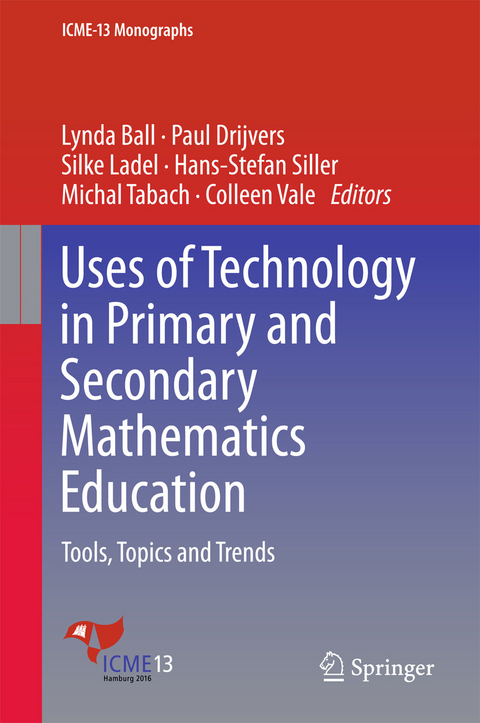
Uses of Technology in Primary and Secondary Mathematics Education (eBook)
440 Seiten
Springer International Publishing (Verlag)
978-3-319-76575-4 (ISBN)
This book provides international perspectives on the use of digital technologies in primary, lower secondary and upper secondary school mathematics. It gathers contributions by the members of three topic study groups from the 13th International Congress on Mathematical Education and covers a range of themes that will appeal to researchers and practitioners alike. The chapters include studies on technologies such as virtual manipulatives, apps, custom-built assessment tools, dynamic geometry, computer algebra systems and communication tools.
Chiefly focusing on teaching and learning mathematics, the book also includes two chapters that address the evidence for technologies' effects on school mathematics. The diverse technologies considered provide a broad overview of the potential that digital solutions hold in connection with teaching and learning. The chapters provide both a snapshot of the status quo of technologies in school mathematics, and outline how they might impact school mathematics ten to twenty years from now.
IntroductionLynda Ball, Silke Ladel, Hans-Stefan Siller
Using video analysis to explain how virtual manipulative app alignment affects children’s mathematics learning
Patricia S. Moyer-Packenham, Kristy Lister, Emma P. Bullock and Jessica F. Shumway
Applying the modification of attributes, affordances, abilities, and distance for learning framework to a child’s multi-touch interactions with an idealized number line
Stephen J. Tucker
Using one-to-one mobile technology to support student discourse
Shannon Larsen, Kelly McCormick, Josephine Louie and Pamela Buffington
Duo of digital and material artefacts dedicated to the learning of geometry at primary school
Anne Voltolini
Using cluster analysis to enhance student learning when using geometry mathematics apps
Kevin Larkin and Todd Milford
How children using counting strategies represent quantities on the virtual and physical ‘twenty frame’
Daniel Walter
Reshaping the learning experiences through apps: Affordances
Nigel Calder and Carol Murphy
Empirical evidence for benefit? Reviewing quantitative research on the use of digital tools in mathematics education
Paul Drijvers
Digital tools in lower secondary school mathematics education. A review of qualitative research on mathematics learning of lower secondary school students
M. Kathleen Heid
Classical and digital technologies for the Pythagorean theorem
Michela Maschietto
Communication when learning and teaching mathematics with technology
Lynda Ball and Bärbel Barzel
Online automated assessment and student learning: the Pépite project in elementary algebra
Brigitte Grugeon-Allys, Françoise Chenevotot-Quentin, Julia Pilet and Dominique Prévit
Using dynamic CAS and geometry to enhance digital assessments
Thomas P. Dick
Design of digital resources for promoting creative mathematical thinking
Jana Trgalová, Mohamed El-Demerdash, Oliver Labs and Jean-François Nicaud
Drawing in space: Doing mathematics with 3D pens
Oi-Lam Ng and Nathalie Sinclair
Diagrams and tool use: Making a circle with Wiigraph
Giulia Ferrari and Francesca Ferrara
A linguistic approach to written solutions in CAS-allowed exams
Johannes Beck
Technological supports for mathematical thinking and learning: Co-action and designing to democratize access to powerful ideas.
Luis Moreno-Armella and Corey Brady
Recursive exploration space for concepts in linear algebra
Ana Donevska-Todorova
Geogebra as a tool in modelling processes
Gilbert Greefrath and Hans-Stefan Siller
Instrumental genesis and proof: Understanding the use of computer algebra systems in proofs in textbooks
Morten Misfeldt and Uffe Thomas Jankvist
In search of standards: Teaching mathematics in a technological environment
Jana Trgalová and Michal Tabach
Using graphic calculators to graph quadratics
Elayne Weger Bowman
Teacher beliefs and practice when teaching with technology a latent profile analysis
Daniel Thurm
Uses of technology in K-12 mathematics education: concluding remarks
Paul Drijvers, Michal Tabach and Colleen Vale
| Erscheint lt. Verlag | 14.5.2018 |
|---|---|
| Reihe/Serie | ICME-13 Monographs | ICME-13 Monographs |
| Zusatzinfo | VII, 440 p. 129 illus. |
| Verlagsort | Cham |
| Sprache | englisch |
| Themenwelt | Sozialwissenschaften ► Pädagogik ► Schulpädagogik / Grundschule |
| Schlagworte | Activity diagram • children mathematics learning • child's' multi-touch interactions • Classical and digital technologies for the Pythagorean theorem • combining mathematics and technology • digital resources for promoting creative mathematical thinking • digital school mathematics • digital technology education • digital tools in mathematics education • Doing mathematics with 3D pens • dynamic sources and sites of mathematical thinking • k-12 mathematics education • learning and teaching mathematics with technology • mobile technology in education • Pépite project in elementary algebra • research on mathematics learning • teaching experiment with WiiGraph • Teaching mathematics in a technological environment • Technological supports for mathematical thinking and learning • Using graphic calculators to graph quadratics |
| ISBN-10 | 3-319-76575-2 / 3319765752 |
| ISBN-13 | 978-3-319-76575-4 / 9783319765754 |
| Informationen gemäß Produktsicherheitsverordnung (GPSR) | |
| Haben Sie eine Frage zum Produkt? |
 PDF (Wasserzeichen)
DRM: Digitales Wasserzeichen
Dieses eBook enthält ein digitales Wasserzeichen und ist damit für Sie personalisiert. Bei einer missbräuchlichen Weitergabe des eBooks an Dritte ist eine Rückverfolgung an die Quelle möglich.
Dateiformat: PDF (Portable Document Format)
Mit einem festen Seitenlayout eignet sich die PDF besonders für Fachbücher mit Spalten, Tabellen und Abbildungen. Eine PDF kann auf fast allen Geräten angezeigt werden, ist aber für kleine Displays (Smartphone, eReader) nur eingeschränkt geeignet.
Systemvoraussetzungen:
PC/Mac: Mit einem PC oder Mac können Sie dieses eBook lesen. Sie benötigen dafür einen PDF-Viewer - z.B. den Adobe Reader oder Adobe Digital Editions.
eReader: Dieses eBook kann mit (fast) allen eBook-Readern gelesen werden. Mit dem amazon-Kindle ist es aber nicht kompatibel.
Smartphone/Tablet: Egal ob Apple oder Android, dieses eBook können Sie lesen. Sie benötigen dafür einen PDF-Viewer - z.B. die kostenlose Adobe Digital Editions-App.
Buying eBooks from abroad
For tax law reasons we can sell eBooks just within Germany and Switzerland. Regrettably we cannot fulfill eBook-orders from other countries.
aus dem Bereich