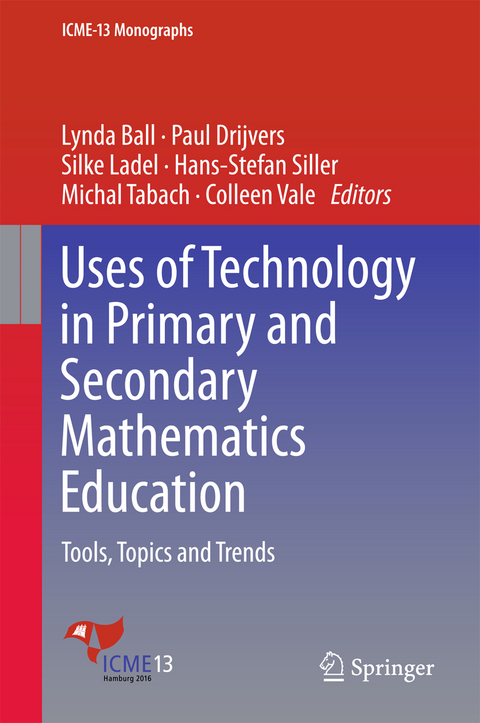
Uses of Technology in Primary and Secondary Mathematics Education
Springer International Publishing (Verlag)
978-3-319-76574-7 (ISBN)
Chiefly focusing on teaching and learning mathematics, the book also includes two chapters that address the evidence for technologies' effects on school mathematics. The diverse technologies considered provide a broad overview of the potential that digital solutions hold in connection with teaching and learning. The chapters provide both a snapshot of the status quo of technologies in school mathematics, and outline how they might impact school mathematics ten to twenty years from now.
Introduction.- Using video analysis to explain how virtual manipulative app alignment affects children's mathematics learning.- Applying the modification of attributes, affordances, abilities, and distance for learning framework to a child's multi-touch interactions with an idealized number line.- Using one-to-one mobile technology to support student discourse.- Duo of digital and material artefacts dedicated to the learning of geometry at primary school.- Using cluster analysis to enhance student learning when using geometry mathematics apps.- How children using counting strategies represent quantities on the virtual and physical 'twenty frame'.- Reshaping the learning experiences through apps: Affordances.- Empirical evidence for benefit? Reviewing quantitative research on the use of digital tools in mathematics education.- Digital tools in lower secondary school mathematics education. A review of qualitative research on mathematics learning of lower secondary school students.- Classical and digital technologies for the Pythagorean theorem.- Communication when learning and teaching mathematics with technology.- Online automated assessment and student learning: the Pépite project in elementary algebra.- Using dynamic CAS and geometry to enhance digital assessments.- Design of digital resources for promoting creative mathematical thinking.- Drawing in space: Doing mathematics with 3D pens.- Diagrams and tool use: Making a circle with Wiigraph.- A linguistic approach to written solutions in CAS-allowed exams.- Technological supports for mathematical thinking and learning: Co-action and designing to democratize access to powerful ideas..- Recursive exploration space for concepts in linear algebra.- Geogebra as a tool in modelling processes.- Instrumental genesis and proof: Understanding the use of computer algebra systems in proofs in textbooks.- In search of standards: Teaching mathematics in a technological environment.- Using graphic calculators to graph quadratics.- Teacher beliefs and practice when teaching with technology a latent profile analysis.- Uses of technology in K-12 mathematics education: concluding remarks.
| Erscheinungsdatum | 04.06.2018 |
|---|---|
| Reihe/Serie | ICME-13 Monographs |
| Zusatzinfo | VII, 440 p. 129 illus. |
| Verlagsort | Cham |
| Sprache | englisch |
| Maße | 155 x 235 mm |
| Gewicht | 830 g |
| Themenwelt | Sozialwissenschaften ► Pädagogik ► Schulpädagogik / Grundschule |
| Schlagworte | Activity diagram • children mathematics learning • child's' multi-touch interactions • Classical and digital technologies for the Pythago • Classical and digital technologies for the Pythagorean theorem • combining mathematics and technology • digital resources for promoting creative mathemati • digital resources for promoting creative mathematical thinking • digital school mathematics • digital technology education • digital tools in mathematics education • Doing mathematics with 3D pens • dynamic sources and sites of mathematical thinking • k-12 mathematics education • learning and teaching mathematics with technology • mobile technology in education • Pépite project in elementary algebra • research on mathematics learning • teaching experiment with WiiGraph • Teaching mathematics in a technological environmen • Teaching mathematics in a technological environment • Technological supports for mathematical thinking a • Technological supports for mathematical thinking and learning • Using graphic calculators to graph quadratics |
| ISBN-10 | 3-319-76574-4 / 3319765744 |
| ISBN-13 | 978-3-319-76574-7 / 9783319765747 |
| Zustand | Neuware |
| Informationen gemäß Produktsicherheitsverordnung (GPSR) | |
| Haben Sie eine Frage zum Produkt? |
aus dem Bereich