


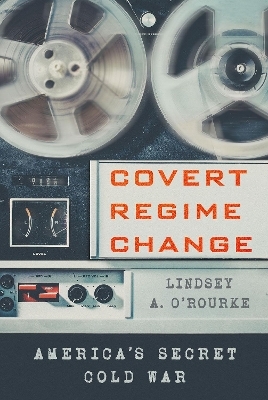
Covert Regime Change
America's Secret Cold War
Seiten
2018
Cornell University Press (Verlag)
978-1-5017-3065-8 (ISBN)
Cornell University Press (Verlag)
978-1-5017-3065-8 (ISBN)
States seldom resort to war to overthrow their adversaries. They are more likely to attempt to covertly change the opposing regime, by assassinating a foreign leader, sponsoring a coup d’état, meddling in a democratic election, or secretly aiding foreign dissident groups.In Covert Regime Change, Lindsey A. O’Rourke shows us how states really...
O'Rourke's book offers a onestop shop for understanding foreignimposed regime change. Covert Regime Change is an impressive book and required reading for anyone interested in understanding hidden power in world politics.― Political Science Quarterly
States seldom resort to war to overthrow their adversaries. They are more likely to attempt to covertly change the opposing regime, by assassinating a foreign leader, sponsoring a coup d'État, meddling in a democratic election, or secretly aiding foreign dissident groups.
In Covert Regime Change, Lindsey A. O'Rourke shows us how states really act when trying to overthrow another state. She argues that conventional focus on overt cases misses the basic causes of regime change. O'Rourke provides substantive evidence of types of security interests that drive states to intervene. Offensive operations aim to overthrow a current military rival or break up a rival alliance. Preventive operations seek to stop a state from taking certain actions, such as joining a rival alliance, that may make them a future security threat. Hegemonic operations try to maintain a hierarchical relationship between the intervening state and the target government. Despite the prevalence of covert attempts at regime change, most operations fail to remain covert and spark blowback in unanticipated ways.
O'Rourke's book offers a onestop shop for understanding foreignimposed regime change. Covert Regime Change is an impressive book and required reading for anyone interested in understanding hidden power in world politics.― Political Science Quarterly
States seldom resort to war to overthrow their adversaries. They are more likely to attempt to covertly change the opposing regime, by assassinating a foreign leader, sponsoring a coup d'État, meddling in a democratic election, or secretly aiding foreign dissident groups.
In Covert Regime Change, Lindsey A. O'Rourke shows us how states really act when trying to overthrow another state. She argues that conventional focus on overt cases misses the basic causes of regime change. O'Rourke provides substantive evidence of types of security interests that drive states to intervene. Offensive operations aim to overthrow a current military rival or break up a rival alliance. Preventive operations seek to stop a state from taking certain actions, such as joining a rival alliance, that may make them a future security threat. Hegemonic operations try to maintain a hierarchical relationship between the intervening state and the target government. Despite the prevalence of covert attempts at regime change, most operations fail to remain covert and spark blowback in unanticipated ways.
Lindsey A. O'Rourke is Assistant Professor of Political Science at Boston College. Her research focuses on regime change, international security, and US foreign policy.
List of Figures and Tables
Acknowledgments
1. The False Promise of Covert Regime Change
2. Causes: Why Do States Launch Regime Changes?
3. Conduct: Why Do States Intervene Covertly versus Overtly?
4. Consequences: How Effective Are Covert Regime Changes?
5. Overview of U.S.-backed Regime Changes during the Cold War
6. Rolling Back the Iron Curtain
7. Containment, Coup d'état and the Covert War in Vietnam
8. Dictators and Democrats in the Dominican Republic
9. Covert Regime Change after the Cold War
Notes
Index
| Erscheinungsdatum | 02.11.2018 |
|---|---|
| Reihe/Serie | Cornell Studies in Security Affairs |
| Zusatzinfo | 7 charts - 7 Charts |
| Verlagsort | Ithaca |
| Sprache | englisch |
| Maße | 152 x 229 mm |
| Gewicht | 907 g |
| Themenwelt | Sachbuch/Ratgeber ► Geschichte / Politik ► Allgemeines / Lexika |
| Geschichte ► Allgemeine Geschichte ► Zeitgeschichte | |
| Geisteswissenschaften ► Geschichte ► Regional- / Ländergeschichte | |
| Sozialwissenschaften ► Politik / Verwaltung ► Staat / Verwaltung | |
| ISBN-10 | 1-5017-3065-7 / 1501730657 |
| ISBN-13 | 978-1-5017-3065-8 / 9781501730658 |
| Zustand | Neuware |
| Informationen gemäß Produktsicherheitsverordnung (GPSR) | |
| Haben Sie eine Frage zum Produkt? |
Mehr entdecken
aus dem Bereich



aus dem Bereich
die großen Jahre der Soziologie 1949-1969
Buch | Hardcover (2025)
Klett-Cotta (Verlag)
CHF 39,20
eine Deutschlandreise im Jahr 1958
Buch | Hardcover (2024)
C.H.Beck (Verlag)
CHF 29,90


