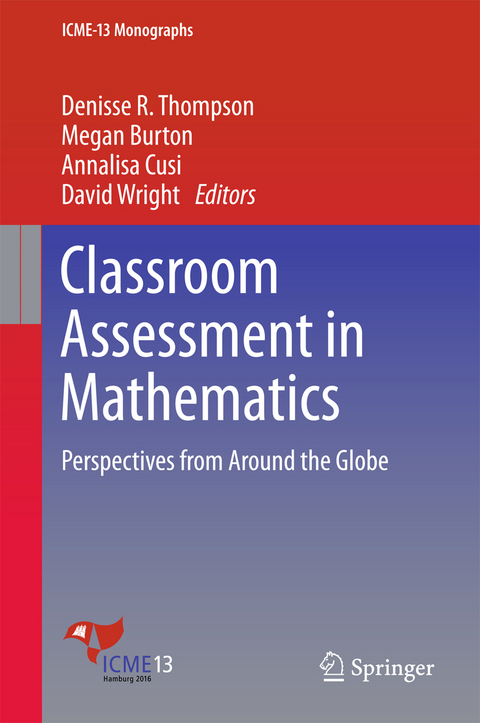
Classroom Assessment in Mathematics (eBook)
XV, 246 Seiten
Springer International Publishing (Verlag)
978-3-319-73748-5 (ISBN)
This book consists of 13 papers developed by participants in the ICME 13 Topic Study Group 40 on Classroom Assessment. The individual papers discuss various aspects of classroom assessment, focusing particularly on formative assessment as assessment for learning, and are grouped into four main sections: Examples of Classroom Assessment in Action, Technology as a Tool for Classroom Assessment, Statistical Models for Formative Assessment, and Engaging Teachers in Formative Assessment. The book opens with a brief discussion of the use of formative assessment as a critical component of the teaching-learning process and concludes with an overview of lessons learned and ideas for future research. It is of interest to classroom teachers, university teacher educators, professional development providers and school supervisors.
PrefaceSection I. Introduction to the Volume1. Formative Assessment: A Critical Component of the Teaching-Learning Process Denisse R. Thompson, University of South Florida, United States Megan Burton, Auburn University, United States Annalisa Cusi, University of Torino, Italy David Wright, Newcastle University, United Kingdom Section II. Examples of Classroom Assessment in Action 2. Formative Assessment Lessons Malcolm Swan, University of Nottingham, United Kingdom Colin Foster, University of Nottingham, United Kingdom 3. Observations and Conversations as Assessment in Secondary Mathematics Jimmy Pai, University of Ottawa, Canada 4. Using Self-Assessment for Individual Practice in Math Classes Waldemar Straumberger, University of Bielefeld, Germany Section III. Technology as a Tool for Classroom Assessment 5. Using a Digital Flip Camera: A Useful Assessment Tool in Mathematics Lessons Ann Downton, Monash University, Australia 6. The Use of Digital Technologies to Enhance Formative Assessment Processes Annalisa Cusi, University of Torino, Italy Francesca Morselli, University of Genova, Italy Cristina Sabena, University of Torino, Italy 7. ; Resources and Constraints Designed to Support Online e-Assessment of Problem Solving Galit Nagari Haddif, University of Haifa, Israel Michal Yerushalmy, University of Haifa, Israel 8. Suggestion of an E-Proof Environment in Mathematics Education Melanie Platz, University of Freiburg and University of Koblenz-Landau, Germany Miriam Krieger, University of Flensburg, Germany Engelbert Niehaus, University of Koblenz-Landau, Germany Kathrin Winter, University of Flensburg, Germany Section IV. Statistical Models for Formative Assessment 9. Cognitive Diagnostic Assessment (CDA): An Alternative Mode of Assessment for Learning Carolyn Jia Ling Sia, Universit Sains Malaysia, Malaysia Chap Sam Lim, Universit Sains Malaysia, Malaysia 10. Validating and Vertically Equating Problem-Solving Measures Jonathan D. Bostic, Bowling Green State University, United States Toni A. Sondergeld, Drexel University, United States Section V. Engaging Teachers in Formative Assessment 11. Assessment in Mathematics: A French Study Based on a Didactic Approach Nathalie Sayac, University Paris Est Creteil, Laboratoire de didactique André Revuz, France 12. Assessing Visualization: An Analysis of Chilean Teachers’ Guidelines Melissa Andrade-Molina, Chile Leonora Díaz Moreno, Chile 13. Formative Assessment and Mathematics Teaching: Leveraging Powerful Linkages in the US Context Megan Burton, Auburn University, United States Edward Silver, University of Michigan, United States Valerie Mills, Oakland Schools, United States Wanda Audrict, Consultant, United States Marilyn Strutchens, Auburn University, United States Margaret Petit, Ongoing Assessment Project, United States 14. Designing for Formative Assessment: A Toolkit for Teachers David Wright, Research Centre for Learning and Teaching, Newcastle University, United Kingdom Jill Clark, Research Centre for Learning and Teaching, Newcastle University, United Kingdom Lucy Tiplady, Research Centre for Learning and Teaching, Newcastle University, United Kingdom Section VI. Conclusion 15. Looking to the Future: Lessons Learned and Ideas for Further Research Denisse R. Thompson, University ofSouth Florida, United States Megan Burton, Auburn University, United States Annalisa Cusi, University of Torino, Italy David Wright, Newcastle University, United Kingdom
| Erscheint lt. Verlag | 1.3.2018 |
|---|---|
| Reihe/Serie | ICME-13 Monographs | ICME-13 Monographs |
| Zusatzinfo | XV, 246 p. 45 illus., 1 illus. in color. |
| Verlagsort | Cham |
| Sprache | englisch |
| Themenwelt | Sozialwissenschaften ► Pädagogik ► Bildungstheorie |
| Sozialwissenschaften ► Pädagogik ► Schulpädagogik / Grundschule | |
| Schlagworte | assessment in mathematics education • classroom examples of assessment • Formative assessment • frameworks for assessment • mathematics education • Student learning • Teacher Education |
| ISBN-10 | 3-319-73748-1 / 3319737481 |
| ISBN-13 | 978-3-319-73748-5 / 9783319737485 |
| Informationen gemäß Produktsicherheitsverordnung (GPSR) | |
| Haben Sie eine Frage zum Produkt? |
 PDF (Wasserzeichen)
DRM: Digitales Wasserzeichen
Dieses eBook enthält ein digitales Wasserzeichen und ist damit für Sie personalisiert. Bei einer missbräuchlichen Weitergabe des eBooks an Dritte ist eine Rückverfolgung an die Quelle möglich.
Dateiformat: PDF (Portable Document Format)
Mit einem festen Seitenlayout eignet sich die PDF besonders für Fachbücher mit Spalten, Tabellen und Abbildungen. Eine PDF kann auf fast allen Geräten angezeigt werden, ist aber für kleine Displays (Smartphone, eReader) nur eingeschränkt geeignet.
Systemvoraussetzungen:
PC/Mac: Mit einem PC oder Mac können Sie dieses eBook lesen. Sie benötigen dafür einen PDF-Viewer - z.B. den Adobe Reader oder Adobe Digital Editions.
eReader: Dieses eBook kann mit (fast) allen eBook-Readern gelesen werden. Mit dem amazon-Kindle ist es aber nicht kompatibel.
Smartphone/Tablet: Egal ob Apple oder Android, dieses eBook können Sie lesen. Sie benötigen dafür einen PDF-Viewer - z.B. die kostenlose Adobe Digital Editions-App.
Buying eBooks from abroad
For tax law reasons we can sell eBooks just within Germany and Switzerland. Regrettably we cannot fulfill eBook-orders from other countries.
aus dem Bereich