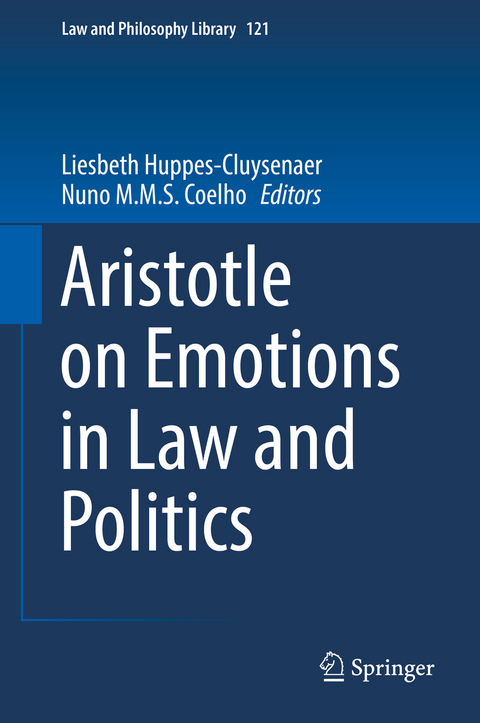
Aristotle on Emotions in Law and Politics (eBook)
XIV, 473 Seiten
Springer International Publishing (Verlag)
9783319667034 (ISBN)
Liesbeth Huppes-Cluysenaer has a guest-appointment at the Faculty of Law of the University of Amsterdam to 2020 in order to complete a project about leading Dutch legal theorist Paul Scholten (1875-1946). Before she retired she taught legal philosophy and legal sociology at the same faculty. Since 2009 she and Nuno Coelho have convened a special workshop at the bi-annual conferences of the IVR on the philosophy of Aristotle, which resulted in the edited volume Aristotle and the Philosophy of Law Theory, Practice and Justice in 2013.
Nuno Coelho teaches law, ethics and philosophy of law in Brazil (USP, UNAERP, USU). He published articles and books on Aristotle's Ethics and Politics, such as 'ἕτεροι καὶ ἶσοι: Aristotle on diversity and equality in the constitution of polis' and 'Aristotle and The Philosophy of Law: Theory, Practice and Justice'.
Liesbeth Huppes-Cluysenaer has a guest-appointment at the Faculty of Law of the University of Amsterdam to 2020 in order to complete a project about leading Dutch legal theorist Paul Scholten (1875-1946). Before she retired she taught legal philosophy and legal sociology at the same faculty. Since 2009 she and Nuno Coelho have convened a special workshop at the bi-annual conferences of the IVR on the philosophy of Aristotle, which resulted in the edited volume Aristotle and the Philosophy of Law Theory, Practice and Justice in 2013.Nuno Coelho teaches law, ethics and philosophy of law in Brazil (USP, UNAERP, USU). He published articles and books on Aristotle's Ethics and Politics, such as “ἕτεροι καὶ ἶσοι: Aristotle on diversity and equality in the constitution of polis” and “Aristotle and The Philosophy of Law: Th eory, Practice and Justice".
Part I. Introduction.- Chapter 1. The Debate about Emotion in Law and Politics (Liesbeth Huppes-Cluysenaer).- Chapter 2. Judicial Emotion as Vice or Virtue: Perspectives both Ancient and New (Terry A. Maroney).- Chapter 3. Dispassionate Judges Encountering Hotheaded Aristotelians (Christof Rapp).- Part II. Cognition.- Chapter 4. Emotion and Rationality in Aristotle’s Model: From Anthropology to Politics (Giovanni Bombelli).- Chapter 5. Logoi enuloi. Aristotle’s Contribution to the Contemporary Debate on Emotions and Decision-making (Stefano Fuselli).- Chapter 6. Aristotle’s Functionalism and the Rise of Nominalism in Law and Politics: Law, Emotion and Language (Saulo de Matos).- Chapter 7. On Logos, Pathos and Ethos in Judicial Argumentation (Fabiana Pinho).- Chapter 8. Religion of Humanity. A Shift from a Dialogical to a Categorical Model of Rationality (Liesbeth Huppes-Cluysenaer).- Part III. Moral Agency.- Chapter 9. Aristotle on Emotions in Ethics and in Criminal Justice (José de Sousa e Brito).- Chapter 10. Ethical Theory and Judicial Practice: Passions and Crimes of Passion in Plato, Aristotle and Lysias (Cristina Viano).- Chapter 11. What does Nemesis have to do with the Legal System? Discussing Aristotle’s Neglected Emotion and its Relevance for Law and Politics (Daniela Bonanno and Lucia Corso).- Chapter 12. Rethinking Legal Education from Aristotle’s Theory of Emotions and the Contemporary Challenges of the Practical Realization of Law (Ana Carolina de Faria Silvestre).- Chapter 13. Remorse and Virtue Ethics (Humber van Straalen).- Chapter 14. Virtue as a Synthesis of Extremes versus Virtue as a Mean between Extremes. A Comparison of Chesterton’s Account of Virtue with Aristotle’s (Wojciech Zaluski).- Chapter 15. The Place of Slavery in the Aristotelian Framework of Law, Reason and Emotion (Peter Langford and Ian Bryan).- Part IV. Legitimation.- Chapter 16. Empathic Political Animal: What a North Korean Prison Camp can reveal about the Aristotelian Political Association (Tommi Ralli).- Chapter 17. How Emotions can be Both an Impediment as well as a Basis of Political Life (Nuno Coelho).- Chapter 18. Aristotle’s Rhetoric and the Persistence of the Emotions in the Courtroom (Emma Cohen de Lara).- Chapter 19. Rhetoric, Emotions and the Rule of Law in Aristotle (Daniel Simão Nascimento).- Chapter 20. Aristotle’s Political Friendship (politikē philia) as Solidarity (Misung Jang).- Chapter 21. Between Nomos and Pathos: Emotions in Aristotelian Theory of Adjudication and the Dual Process Theory (Mariusz Jerzy Golecki and Mateusz Franciszek Bukaty).
| Erscheint lt. Verlag | 13.2.2018 |
|---|---|
| Reihe/Serie | Law and Philosophy Library | Law and Philosophy Library |
| Zusatzinfo | XIV, 473 p. |
| Verlagsort | Cham |
| Sprache | englisch |
| Themenwelt | Geisteswissenschaften |
| Recht / Steuern ► Allgemeines / Lexika | |
| Sozialwissenschaften ► Politik / Verwaltung | |
| Schlagworte | Adjudication • Aristotle • Court decision • criminal justice • Decision-Making • Dual process theory • Judicial argumentation • Judicial decision • Judicial emotion • Kant • Legal Positivism • Morality • Nicomachean Ethics • Opinion of the court • Rationality • Reasons for the judgment • Rousseau • Rule of Law • Virtue Ethics |
| ISBN-13 | 9783319667034 / 9783319667034 |
| Informationen gemäß Produktsicherheitsverordnung (GPSR) | |
| Haben Sie eine Frage zum Produkt? |
 PDF (Wasserzeichen)
DRM: Digitales Wasserzeichen
Dieses eBook enthält ein digitales Wasserzeichen und ist damit für Sie personalisiert. Bei einer missbräuchlichen Weitergabe des eBooks an Dritte ist eine Rückverfolgung an die Quelle möglich.
Dateiformat: PDF (Portable Document Format)
Mit einem festen Seitenlayout eignet sich die PDF besonders für Fachbücher mit Spalten, Tabellen und Abbildungen. Eine PDF kann auf fast allen Geräten angezeigt werden, ist aber für kleine Displays (Smartphone, eReader) nur eingeschränkt geeignet.
Systemvoraussetzungen:
PC/Mac: Mit einem PC oder Mac können Sie dieses eBook lesen. Sie benötigen dafür einen PDF-Viewer - z.B. den Adobe Reader oder Adobe Digital Editions.
eReader: Dieses eBook kann mit (fast) allen eBook-Readern gelesen werden. Mit dem amazon-Kindle ist es aber nicht kompatibel.
Smartphone/Tablet: Egal ob Apple oder Android, dieses eBook können Sie lesen. Sie benötigen dafür einen PDF-Viewer - z.B. die kostenlose Adobe Digital Editions-App.
Buying eBooks from abroad
For tax law reasons we can sell eBooks just within Germany and Switzerland. Regrettably we cannot fulfill eBook-orders from other countries.
aus dem Bereich