


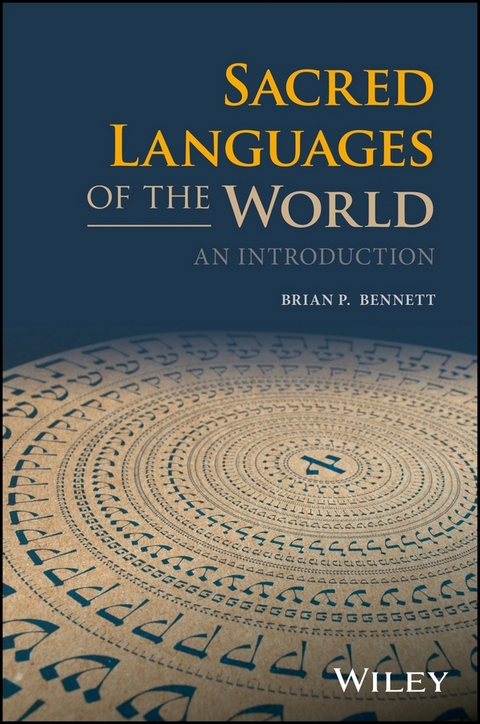
Sacred Languages of the World (eBook)
John Wiley & Sons (Verlag)
978-1-118-97076-8 (ISBN)
Brian P. Bennett is Professor of Religious Studies and Chair of the Religious Studies Department at Niagara University, New York, USA. He is a comparatist whose research focuses on sacred languages.
Brian P. Bennett is Professor of Religious Studies and Chair of the Religious Studies Department at Niagara University, New York, USA. He is a comparatist whose research focuses on sacred languages.
Preface vi
Acknowledgments xii
1 What Exactly Is a Sacred Language? 1
2 Sacred Languages, Past and Present 21
3 Not Dead Yet: Latin as Test Case 48
4 Beliefs about Sacred Languages 77
5 Practices: Religious, Political, Artistic 102
6 Learning a Sacred Language 129
7 Communities and Controversies 155
8 Borderlines: Sacred Languages, Fundamentalism, and Globalization 183
9 Conclusion 210
Index 219
"Bennett has done scholars of religion and of their various scriptures a great service by focusing our attention on the contemporary phenomenon of sacred languages, their variety, and their continuing power in the lives of millions of people worldwide. His book should prompt us to more self-reflection about our roles as teachers of sacred languages." - RBL 04/2022 by the Society of Biblical Literature
Preface
What are the most important languages in the world? The answer depends in part on one’s location:
The relative importance of … languages currently alternates during the course of each day. When the sun is over the western Pacific, the national language of China is the most in use, but when the sun is over the Atlantic and China sleeps, English takes the lead. The world’s second most spoken language also alternates daily, between Hindi + Urdu and Spanish respectively.
(Dalby 2001, 24)
Yet other languages, ancient consecrated codes, which can still be seen and heard across the globe, also merit consideration. Five times a day, millions of Muslims stop what they are doing, face Mecca, and recite their prayers in Classical Arabic, the language of the Qur’an. Buddhist monks in the Theravada tradition rise at the crack of dawn and begin a chanting session in Pali, said to be the language of Gautama Buddha himself, who lived 2500 years ago. Scriptores in Vatican City work on translating the pope’s words into Latin. Russian Orthodox priests from Moscow to Bellingshausen Station in Antarctica celebrate the liturgy in Church Slavonic. Ultra‐Orthodox Jews utter blessings in Hebrew throughout the day, while at the other end of the ideological spectrum so‐called Jubus (Jewish Buddhists) meditate using Hebraic mantras. Coptic Christians in Egypt and the diaspora sing hymns in a language that can be traced back some five millennia to the time of the pharaohs. In gyms and studios across America, practitioners try to master Sanskrit names for yoga poses at the same time as enthusiasts in India trumpet Sanskrit as a symbol of the nation’s spiritual and technological prowess. When the sun rises the next day, it happens all over again.
Around the world, in temples, monasteries, synagogues, and mosques – but also in tattoo studios and concert halls – people interact with these allegedly dead languages in a variety of ways and for a host of different reasons. These are not the major languages that confidently bestride the globe, though some of them did so in their heyday. Rather, these are conserved languages, precious symbolic resources, utilized for scriptures, rituals, chants, and amulets. Ancient? Yes. Dead? No. In fact, many devotees would insist that these are truly the most significant languages in the world.
This book offers a kind of guided tour of these sacred languages and locales. Drawing upon the academic disciplines of comparative religion and sociolinguistics, it is neither a narrow treatise in linguistics nor a comprehensive global history (see, for example, Ostler 2005). We are interested in the “outside,” not the “inside,” of sacred languages. That is to say, instead of focusing on the nuts and bolts of the language (grammar, morphology, phonology, etc.), we will be looking at languages as a social and religious phenomenon. Though sacred languages are typically used for worship and scripture, this is not the place to find a rundown of all the rituals and canons of Judaism, Islam, Buddhism, and so on, as there are plenty of handbooks and websites that provide such information. Instead, we are interested in the following questions:
Why do some religions conserve these ancient languages? What mythic conceptions exalt them above regular vernaculars?
How are sacred languages used? And if adherents do not actually understand what they read or chant, what is the point?
Since no one grows up speaking Latin or Pali or the rest, how do people actually go about learning a sacred language?
Why is it that sacred languages seem uniquely qualified to foster a sense of collective identity – yet also be so divisive?
Finally, what place do these hallowed languages have at a time of rapid cultural change, globalization, and fundamentalism?
Despite the fact that sacred languages are still vital to different branches of Judaism, Hinduism, Islam, Buddhism, Christianity, and Zoroastrianism, the phenomenon is not particularly well understood. Excellent histories penned by experts are available for individual languages – Arabic, Hebrew, Sanskrit, and especially Latin (e.g., Versteegh 2014; Spolsky 2014; Pollock 2006; Leonhardt 2013). But those admirable studies tend to focus on the ancient and medieval periods, giving the impression that the recent history of sacred languages is somehow less interesting or authentic. Moreover, they provide few details about the various and sundry ways that sacred languages figure in the lives of believers. By contrast, this book is comparative in scope and is intended for those unfamiliar with the global phenomenon of sacred languages. It concentrates on recent times, tracing the myths and mysteries that surround these ancient tongues, the diverse practices they are used for, the distinctive methods employed for teaching them, and the ways they can unite – and divide – international faith communities. This is a vast terrain. Our survey is far from complete. We will not be able to see everything and many important locations (e.g., Ecclesiastical Greek, Classical Tibetan) have been left off the itinerary altogether.
Instead of simply describing the sacred languages in serial fashion (Hebrew, Latin, Sanskrit, and so on), we take a more structural and thematic approach. With the exception of the first, each chapter starts with one sacred language to illustrate a particular aspect of the phenomenon, but is broadly comparative in approach, noting various points of similarity and difference between the specimens. This strategy makes it possible to learn something about the individual languages while at the same time to acquire a conceptual framework that can be applied to other examples and help guide further research and investigation. Chapter 1 discusses what makes a sacred language, and considers alternative classifications, such as dead or classical. Chapter 2 looks at Arabic – to many, the sacred language par excellence – as a way to sketch the emergence of sacred languages in world history and locate their current position in the “linguasphere,” the network of languages that encircles the planet. In Chapter 3 we lay out our conceptual framework for sacred languages and introduce Ecclesiastical Latin as a test case. This framework starts with four main factors or components: beliefs, practices, institutions, and communities. Based on the example of Latin, we also argue that sacred languages should be considered fixed or conserved, not dead or extinct. The next four chapters zoom in to explore in more detail the four components, while also adding further distinctions and sub‐types. The case of Pali, a Buddhist language, illustrates the myths and beliefs that accompany sacred languages. Following that, Hebrew showcases the surprising range of practices – not only religious, but political and artistic – that a single sacred language can be deployed for. Coptic leads off our discussion of why and how people learn these ancient idioms. Next the example of Church Slavonic demonstrates the fact that sacred languages can provide an essential fizz to social chemistry, but can also be combustible. Chapter 8 zooms back out to consider the role of sacred languages in relation to fundamentalism and globalization: Sanskrit provides a telling instance of these opposing trends. In the Conclusion we distill the key features of sacred languages in the contemporary world and ponder their fate in cyberspace.
Since it can be difficult for non‐specialists to observe or get information about how sacred languages are actually used by contemporary religious practitioners, each chapter includes a vignette of a particular language “in action,” from well‐known locales like London, Rome, Moscow, Jerusalem, and Hong Kong, to less familiar ones such as Fort Ross, California, and North Tonawanda, New York. These tableaux provide entry points for discussing different facets of the phenomenon, as well as helping to convey something of the ongoing global significance of sacred languages.
Michael Pye reminds us that, “any attempts to view religions in their plurality, in a conspectual frame of reference, involve the intellectual act of comparison” (2013, 350). Each sacred language discussed in this book has its own complex backstory and is embedded in specific places, people, practices, polemics, and paraphernalia. While remaining cognizant of history and cultural context, a comparative approach involves isolating and foregrounding certain aspects for consideration, while leaving everything else in the background. Such an artificial procedure necessarily involves a difference of perspective – even a certain tension – between the “committed insider and the observing comparativist” (Paden 2009, 236). It is important for all parties to remember that comparison is never a matter of identity: Sanskrit, Hebrew, Latin, and the others are not the “same” – nor are they totally dissimilar. The very format of a book seems to compel a black‐or‐white linearity that can be harmful to the comparative enterprise. It would be preferable if we could somehow present the information by means of a volvelle or kaleidoscope, each click of which would bring into focus a pattern of chromatic similarities and differences. Comparison is fraught with difficulties, yet there is no way to achieve a conspectual view of things – no way to understand the world – without it (Smith 2004).
***
This book is an excursion into the world of sacred...
| Erscheint lt. Verlag | 18.7.2017 |
|---|---|
| Sprache | englisch |
| Themenwelt | Geschichte ► Teilgebiete der Geschichte ► Religionsgeschichte |
| Geisteswissenschaften ► Religion / Theologie ► Weitere Religionen | |
| Geisteswissenschaften ► Sprach- / Literaturwissenschaft ► Sprachwissenschaft | |
| Sozialwissenschaften ► Ethnologie | |
| Sozialwissenschaften ► Soziologie | |
| Schlagworte | Anthropologie • Anthropologie der Religion • Anthropology • Anthropology of Religion • brian bennett • Church Slavonic • Comparative & World Religions • Comparative Religion • comparative study of latin • education and language • God talk • Hebrew • history of ecclesiastical latin • history of sacred languages • Language and Religion • language in religious practice • language in religious practices • latin doxology • Linguistics • neurolinguistics and sacred languages • Pali • pali and church slavonic • pali and its influence on the practice of buddhism • PhD • relationships between language and religion • Religion • Religion & Theology • Religionsanthropologie • Religion u. Theologie • religious literacy • religious practices and sacred languages • Religious Studies • sacred languages cultural significance • sacred languages geopolitical implications • sacred languages social impact • sanskrit and hinduism • Scripture • Sociolinguistics • sociolinguistics and religion • Sociology of Language • sociology of language and religion • Sociology of Religion • Soziolinguistik • Sprachwissenschaften • Vergleichende Religionswissenschaft |
| ISBN-10 | 1-118-97076-4 / 1118970764 |
| ISBN-13 | 978-1-118-97076-8 / 9781118970768 |
| Informationen gemäß Produktsicherheitsverordnung (GPSR) | |
| Haben Sie eine Frage zum Produkt? |
 EPUB (Adobe DRM)
Kopierschutz: Adobe-DRM
Adobe-DRM ist ein Kopierschutz, der das eBook vor Mißbrauch schützen soll. Dabei wird das eBook bereits beim Download auf Ihre persönliche Adobe-ID autorisiert. Lesen können Sie das eBook dann nur auf den Geräten, welche ebenfalls auf Ihre Adobe-ID registriert sind.
Details zum Adobe-DRM
Dateiformat: EPUB (Electronic Publication)
EPUB ist ein offener Standard für eBooks und eignet sich besonders zur Darstellung von Belletristik und Sachbüchern. Der Fließtext wird dynamisch an die Display- und Schriftgröße angepasst. Auch für mobile Lesegeräte ist EPUB daher gut geeignet.
Systemvoraussetzungen:
PC/Mac: Mit einem PC oder Mac können Sie dieses eBook lesen. Sie benötigen eine
eReader: Dieses eBook kann mit (fast) allen eBook-Readern gelesen werden. Mit dem amazon-Kindle ist es aber nicht kompatibel.
Smartphone/Tablet: Egal ob Apple oder Android, dieses eBook können Sie lesen. Sie benötigen eine
Geräteliste und zusätzliche Hinweise
Buying eBooks from abroad
For tax law reasons we can sell eBooks just within Germany and Switzerland. Regrettably we cannot fulfill eBook-orders from other countries.


