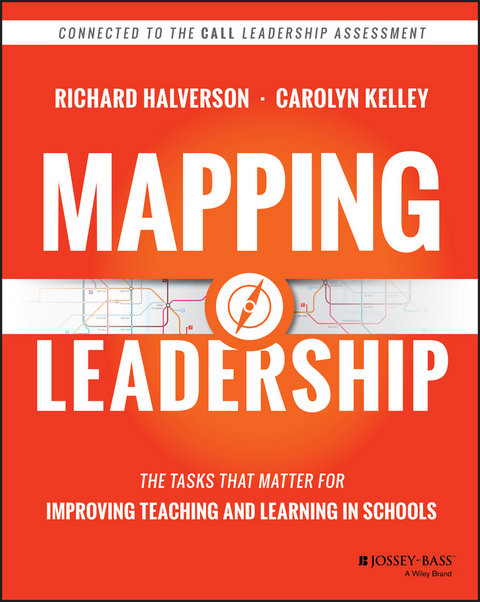
Mapping Leadership (eBook)
224 Seiten
John Wiley & Sons (Verlag)
9781118711514 (ISBN)
* Focus on Learning
* Monitoring Teaching and Learning
* Building Nested Learning Communities
* Acquiring and Allocating Resources
* Maintaining a Safe and Effective Learning Environment
Recognizing that the principal is a single actor in a complex web of activity influencing student learning, the focus is not only on the principal's role but on a range of leadership and instructional practices to be shared across the leadership team (including APs, counselors, teachers, and support personnel). These tasks, organized into 21 subdomains, have been demonstrated through extensive research to contribute to improved student learning.
RICHARD HALVERSON is a Professor of Educational Leadership and Policy Analysis in the University of Wisconsin-Madison School of Education. Rich co-directs the Wisconsin Collaborative Education Research Network and the Comprehensive Assessment of Leadership for Learning project, and was a co-founder and co-director of the Games + Learning + Society Research Center. He is a former high school teacher and administrator. He is co-author (with Allan Collins) of Rethinking Education in the Age of Technology. CAROLYN KELLEY is Senior Associate Dean for Academic Programs in the School of Education at the University of Wisconsin-Madison, and the Jim and Georgia Thompson Distinguished Professor of Education in the Department of Educational Leadership and Policy Analysis. She co-directs the Comprehensive Assessment of Leadership for Learning project, and is co-author (with Jim Shaw) of Learning First!.
About the Authors xi
Acknowledgments xiii
Prologue 1
Chapter 1 Distributed Leadership in Action 9
Leadership and Span of Control 12
Leader of Leaders 14
Distributed Leadership in Action 14
Tasks versus Skills 17
Comprehensive Assessment of Leadership for Learning 18
Chapter 2 Mapping School Leadership: Research Base and Domains 23
Knowledge Base for the CALL Domains 25
CALL Domains of School Leadership Practice 28
The CALL Survey in Action 34
Chapter 3 Domain 1: Focus on Learning 39
1.1 Maintaining a Schoolwide Focus on Learning 43
1.2 Recognition of Formal Leaders as Instructional Leaders 46
1.3 Collaborative Design of Integrated Learning Plan 48
1.4 Providing Appropriate Services for Students Who Traditionally Struggle 50
Putting It All Together to Focus on Learning 53
Chapter 4 Domain 2: Monitoring Teaching and Learning 59
A Brief History of Accountability and Schools: Emergence of a New Model of Instructional Leadership 62
Building Information Ecologies to Support Teaching and Learning 66
2.1 Formative Evaluation of Student Learning 67
2.2 Summative Evaluation of Student Learning 71
2.3 Formative Evaluation of Teaching 73
2.4 Summative Evaluation of Teaching 77
Putting It All Together: Information Ecologies for Schools 80
Chapter 5 Domain 3: Building Professional Community 87
Designing Professional Community 91
3.1 Collaborative Schoolwide Focus on Problems of Teaching and Learning 92
3.2 Professional Learning 93
3.3 Socially Distributed Leadership 96
3.4 Coaching and Mentoring 97
Putting It All Together: Design as a Model for Building Professional Community 99
Lessons for Building Professional Community in Schools 101
Chapter 6 Domain 4: Acquiring and Allocating Resources 107
4.1 Personnel Practices 111
4.2 Structuring and Maintaining Time 115
4.3 School Resources Focus on Student Learning 118
4.4 Integrating External Expertise into the School Instructional Program 120
4.5 Coordinating and Supervising Relations with Families and External Communities 122
Putting It All Together: Acquiring and Allocating Resources 124
Chapter 7 Domain 5: Establishing a Safe and Effective Learning Environment 131
The Practices That Matter to Develop Safe and Effective Learning Environments 134
5.1 Clear, Consistent, and Enforced Expectations for Student Behavior 135
5.2 Clean and Safe Learning Environment 141
5.3 Support Services for Students Who Traditionally Struggle 142
Putting It All Together: Innovative Practices for Building Safe and Effective Learning Environments 148
Chapter 8 Mapping Leadership Practice 157
Mapping Leadership Practice 163
Using the CALL Map 169
Charting the Course to Improved Teaching and Learning 171
Appendix A CALL Research Publications 173
Appendix B Observations about Some Differences in CALL Results between Secondary and Elementary Schools 175
Appendix C Description of the CALL Research and Validation Project 181
Appendix D CALL Domains 193
References 195
Index 205
| Erscheint lt. Verlag | 29.6.2017 |
|---|---|
| Sprache | englisch |
| Themenwelt | Sozialwissenschaften ► Pädagogik ► Bildungstheorie |
| Schlagworte | Allg. Lehrpläne • Bildungswesen • Curriculum Tools - General • Education • K-12 • K-12 / Lehrerbildung • K-12 / Leitung u. Verwaltung • Leadership & Administration (K-12) • Teacher Education (K-12) |
| ISBN-13 | 9781118711514 / 9781118711514 |
| Informationen gemäß Produktsicherheitsverordnung (GPSR) | |
| Haben Sie eine Frage zum Produkt? |
 PDF (Adobe DRM)
Kopierschutz: Adobe-DRM
Adobe-DRM ist ein Kopierschutz, der das eBook vor Mißbrauch schützen soll. Dabei wird das eBook bereits beim Download auf Ihre persönliche Adobe-ID autorisiert. Lesen können Sie das eBook dann nur auf den Geräten, welche ebenfalls auf Ihre Adobe-ID registriert sind.
Details zum Adobe-DRM
Dateiformat: PDF (Portable Document Format)
Mit einem festen Seitenlayout eignet sich die PDF besonders für Fachbücher mit Spalten, Tabellen und Abbildungen. Eine PDF kann auf fast allen Geräten angezeigt werden, ist aber für kleine Displays (Smartphone, eReader) nur eingeschränkt geeignet.
Systemvoraussetzungen:
PC/Mac: Mit einem PC oder Mac können Sie dieses eBook lesen. Sie benötigen eine
eReader: Dieses eBook kann mit (fast) allen eBook-Readern gelesen werden. Mit dem amazon-Kindle ist es aber nicht kompatibel.
Smartphone/Tablet: Egal ob Apple oder Android, dieses eBook können Sie lesen. Sie benötigen eine
Geräteliste und zusätzliche Hinweise
Buying eBooks from abroad
For tax law reasons we can sell eBooks just within Germany and Switzerland. Regrettably we cannot fulfill eBook-orders from other countries.
aus dem Bereich