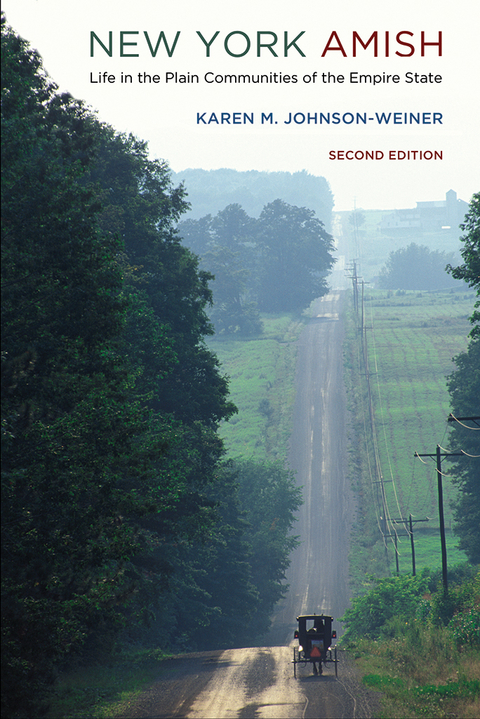
New York Amish (eBook)
280 Seiten
Cornell University Press (Verlag)
978-1-5017-0813-8 (ISBN)
This book highlights the existence and diversity of Amish communities in New York State, drawing on twenty-five years of observation, participation, interviews, and archival research.
Tracing Amish settlement in New York from the nineteenth century to the twenty-first, Karen M. Johnson-Weiner draws on more than thirty years of participant-observation, interviews, and archival research to introduce the Amish to their non-Amish neighbors.
In a book that highlights the existence and diversity of Amish communities in New York State, Karen M. Johnson-Weiner draws on twenty-five years of observation, participation, interviews, and archival research to emphasize the contribution of the Amish to the state's rich cultural heritage. While the Amish settlements in Pennsylvania and Ohio are internationally known, the Amish population in New York, the result of internal migration from those more established settlements, is more fragmentary and less visible to all but their nearest non-Amish neighbors. All of the Amish currently living in New York are post–World War II migrants from points to the south and west. Many came seeking cheap land, others as a result of schism in their home communities. The Old Order Amish of New York are relative newcomers who, while representing an old or plain way of life, are bringing change to the state.
So that readers can better understand where the Amish come from and their relationship to other Christian groups, New York Amish traces the origins of the Amish in the religious confrontation and political upheaval of the Protestant Reformation and describes contemporary Amish lifestyles and religious practices. Johnson-Weiner welcomes readers into the lives of Amish families in different regions of New York State, including the oldest New York Amish community, the settlement in the Conewango Valley, and the diverse settlements of the Mohawk Valley and the St. Lawrence River Valley. The congregations in these regions range from the most conservative to the most progressive. Johnson-Weiner reveals how the Amish in particular regions of New York realize their core values in different ways; these variations shape not only their adjustment to new environments but also the ways in which townships and counties accommodate—and often benefit from—the presence of these thriving faith communities.
Tracing Amish settlement in New York from the nineteenth century to the twenty-first, Karen M. Johnson-Weiner draws on more than thirty years of participant-observation, interviews, and archival research to introduce the Amish to their non-Amish neighbors. In the last decade, New York State has had the fastest-growing Amish population. This work highlights the diversity of Amish settlement in New York State and the contribution of New York's Amish to the state’s rich cultural heritage.
The second edition of New York Amish updates settlement areas to acknowledge recently established communities and to demonstrate the impact of growth, schism, and migration on existing settlements. In addition, chapters treating external and internal challenges to Amish settlement and the challenges Amish settlement poses to neighboring non-Amish communities have been updated, and a new chapter looks to the future of New York’s Amish. All maps have been updated, and a new map showing all of New York’s Amish communities has been added.
In a book that highlights the existence and diversity of Amish communities in New York State, Karen M. Johnson-Weiner draws on twenty-five years of observation, participation, interviews, and archival research to emphasize the contribution of the Amish to the state's rich cultural heritage.While the Amish settlements in Pennsylvania and Ohio are internationally known, the Amish population in New York, the result of internal migration from those more established settlements, is more fragmentary and less visible to all but their nearest non-Amish neighbors. All of the Amish currently living in New York are post–World War II migrants from points to the south and west. Many came seeking cheap land, others as a result of schism in their home communities.The Old Order Amish of New York are relative newcomers who, while representing an old or plain way of life, are bringing change to the state. So that readers can better understand where the Amish come from and their relationship to other Christian groups, New York Amish traces the origins of the Amish in the religious confrontation and political upheaval of the Protestant Reformation and describes contemporary Amish lifestyles and religious practices.Johnson-Weiner welcomes readers into the lives of Amish families in different regions of New York State, including the oldest New York Amish community, the settlement in the Conewango Valley, and the diverse settlements of the Mohawk Valley and the St. Lawrence River Valley. The congregations in these regions range from the most conservative to the most progressive. Johnson-Weiner reveals how the Amish in particular regions of New York realize their core values in different ways; these variations shape not only their adjustment to new environments but also the ways in which townships and counties accommodate—and often benefit from—the presence of these thriving faith communities.
Karen M. Johnson-Weiner is Professor of Anthropology at SUNY Potsdam. She is author of Train Up a Child: Old Order Amish and Mennonite Schools.
1. Who Are the Amish? Meeting Our Plain Neighbors2. Cattaraugus and Chautauqua Counties: Amish Pioneers in Western New York3. St. Lawrence County's Swartzentruber Amish: The Plainest of the Plain People4. From Lancaster County to Lowville: Moving North to Keep the Old Ways5. The Mohawk Valley Amish: Old Order Diversity in Central New York6. In Search of Consensus and Fellowship: New York’s Swiss Amish7. On Franklin County’s Western Border: New Settlements in the North Country8. Challenges to Amish Settlement: Maintaining Community and Identity9. Challenging the Non-Amish Neighbors: Uneasy Integration10. The Future of New York’s Amish: Two Worlds, Side by Side
| Erscheint lt. Verlag | 2.5.2017 |
|---|---|
| Zusatzinfo | 22 b&w halftones, 2 tables, 15 maps, 3 figures, 2 charts |
| Verlagsort | Ithaca |
| Sprache | englisch |
| Maße | 150 x 150 mm |
| Themenwelt | Geisteswissenschaften ► Geschichte ► Regional- / Ländergeschichte |
| Geisteswissenschaften ► Religion / Theologie ► Christentum | |
| Sozialwissenschaften ► Soziologie ► Spezielle Soziologien | |
| Schlagworte | Amish communities, New York State, New York Amish, Amish population in New York, Amish lifestyles, Amish religious practices, Christian groups, religious confrontation, political upheaval |
| ISBN-10 | 1-5017-0813-9 / 1501708139 |
| ISBN-13 | 978-1-5017-0813-8 / 9781501708138 |
| Informationen gemäß Produktsicherheitsverordnung (GPSR) | |
| Haben Sie eine Frage zum Produkt? |
 EPUB (Adobe DRM)
Kopierschutz: Adobe-DRM
Adobe-DRM ist ein Kopierschutz, der das eBook vor Mißbrauch schützen soll. Dabei wird das eBook bereits beim Download auf Ihre persönliche Adobe-ID autorisiert. Lesen können Sie das eBook dann nur auf den Geräten, welche ebenfalls auf Ihre Adobe-ID registriert sind.
Details zum Adobe-DRM
Dateiformat: EPUB (Electronic Publication)
EPUB ist ein offener Standard für eBooks und eignet sich besonders zur Darstellung von Belletristik und Sachbüchern. Der Fließtext wird dynamisch an die Display- und Schriftgröße angepasst. Auch für mobile Lesegeräte ist EPUB daher gut geeignet.
Systemvoraussetzungen:
PC/Mac: Mit einem PC oder Mac können Sie dieses eBook lesen. Sie benötigen eine
eReader: Dieses eBook kann mit (fast) allen eBook-Readern gelesen werden. Mit dem amazon-Kindle ist es aber nicht kompatibel.
Smartphone/Tablet: Egal ob Apple oder Android, dieses eBook können Sie lesen. Sie benötigen eine
Geräteliste und zusätzliche Hinweise
Buying eBooks from abroad
For tax law reasons we can sell eBooks just within Germany and Switzerland. Regrettably we cannot fulfill eBook-orders from other countries.
aus dem Bereich