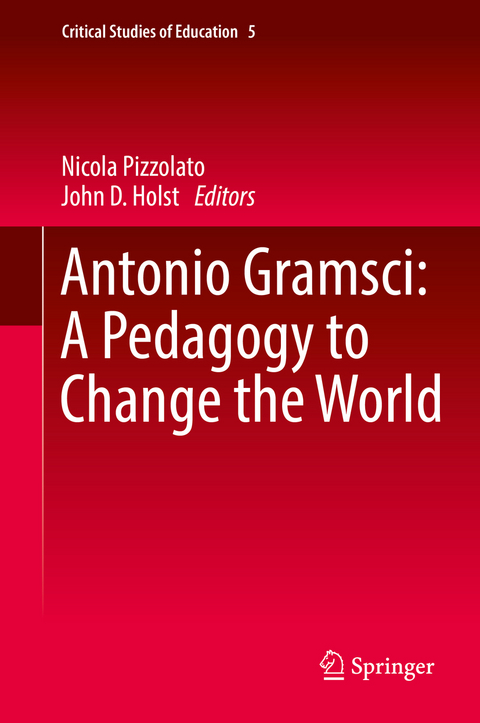
Antonio Gramsci: A Pedagogy to Change the World (eBook)
XX, 227 Seiten
Springer International Publishing (Verlag)
9783319404493 (ISBN)
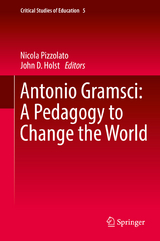
This volume provides evidence for the argument of a central place of pedagogy in the interpretation of Gramsci's political theory. Gramsci's view that 'every relationship of hegemony is necessarily a pedagogical relationship' makes it imperative to dismiss narrow and formal interpretations of his educational theories as applying to schooling only. This book argues that what is required rather is an inquiry into the Italian thinker's broad conceptualisation of pedagogy, which he thought of as a quintessential political activity, central to understanding and transforming society.
Preceded by a broad introduction that positions Gramsci in his context and in the literature, the essays in this book critically revisit the many passages of the Prison Notebooks and pre-prison writings where Gramsci addresses the nexus between politics and pedagogy. Some essays apply those concepts to specific contexts. The book for the first time brings to the attention of an English-speaking audience voices from the current historiography in Italy and Latin America.
We are forced at regular intervals to consider how Gramsci might still be useful, in particular national territories, in an international context. How can we carry on with pessimism of the intelligence, but find some basis for optimism of the will?
From the foreword of Anne Showstack Sassoon, Visiting Professor of Politics at the Department of Politics at Birbeck, University of London
Dedication 6
Foreword 7
References 9
Preface 10
References 13
Acknowledgements 14
Contents 15
Abbreviations for English Translationsof Gramsci’s Writings 17
Pre-prison Writings 17
Prison Writings 17
Chapter 1: Gramsci, Politics and Pedagogy: An Interpretative Framework 19
1.1 Gramsci the Pedagogist: The Early Years 21
1.2 Political Education in the ‘New Order’ 29
1.3 The Prison Years: Education as a Relationship of Hegemony 35
1.4 Gramsci’s Legacy to Critical Pedagogy and Radical Adult Education 40
References 46
Part I: Understanding Gramsci and Education 51
Chapter 2: Gramsci, Hegemony and Educational Politics 52
2.1 Introduction: Italy’s Contribution to Critical Education Praxis 52
2.2 Reading Gramsci Holistically 53
2.3 Education and the Integral State 55
2.4 Broad Range of Educators 58
2.5 The Question of Content 60
2.6 Conclusion 62
References 63
Chapter 3: Culture, Education and Political Leadership in Gramsci’s Thought 65
3.1 Culture as a ‘Worldview’ 66
3.2 Education: A Synthesis of Knowledge, Historical Consciousness and Practice 70
3.3 Political Leadership as an Educational Activity 77
References 82
Chapter 4: The Pedagogy of Praxis and the Role of Education in the Prison Notebooks 83
4.1 Introduction 83
4.2 A Pedagogical Obsession 84
4.3 Praxis and Pedagogy 87
4.4 The Educational Model 90
4.5 By Way of Conclusion 97
References 100
Part II: Using a Gramscian Framework for Research 102
Chapter 5: A Pedagogy for Power: Antonio Gramsci and Luis Emilio Recabarren on the Educational Role of Working-Class Organizations 103
5.1 Recabarren’s Views on the Role of the Organizations (1903–1922) as Compared to Gramsci’s 107
5.2 Comparing Recabarren’s and Gramsci’s Views on the Role of the Party 114
5.3 The Party and Its Participation in Parliamentary Politics 116
5.4 Conclusion 117
References 119
Chapter 6: Gramsci as Theory, Pedagogy, and Strategy: Educational Lessons from the Brazilian Landless Workers Movement 121
6.1 Background: MST, Education, and Gramsci 122
6.2 Gramsci’s Theory of Social Change: Grassroots Leadership and the Myth of the Intellectual 124
6.3 Gramsci’s Pedagogical Proposal: Philosophy of Praxis and Common Sense 129
6.4 Gramscian Strategy: Public Schools as Terrains of Contestation 133
6.5 Conclusions 138
References 139
Chapter 7: Language, Education and European Unification: Perceptions and Reality of Global English in Italy 141
7.1 Why a Gramscian Approach? 143
7.1.1 The Folklorist Mentality 145
7.1.2 Unification, Diversity and Hegemony 146
7.1.3 Passive Revolution 147
7.1.4 Linguistic Insecurity and the Effects of Meritocracy 147
7.2 Why Pre-2008 Italy? 149
7.3 Foreign Language Learning in Italy 150
7.3.1 Historical Overview 150
7.3.2 Knowledge of English 151
7.3.3 Data Published Between 2006 and 2007 152
7.3.4 The Role of School Education and Vocational Training 154
7.3.5 Constraints on Other Learning Channels 156
7.4 Discussion 157
7.5 Conclusions 160
References 160
Main Sources of Data 162
Chapter 8: Teachers as Salaried Intellectual Workers: Are They Part of the ‘Pueblo’? An Argentinean Perspective 163
8.1 The Latin American Context and Cultural Struggle 163
8.2 Salaried Workers and Public Officers 167
8.3 Teachers as Part of the Social Middle Strata 171
8.4 Teachers as Intellectuals 175
8.5 Inclusive Education Policies, the Pueblo and the New Historical Bloc 178
References 181
Part III: Key Gramscian Concepts and Pedagogy 184
Chapter 9: Hegemony as Pedagogy: The Formation of a Collective Will and of Individual Personality According to Gramsci 185
Reference 196
Chapter 10: A Pedagogy of the Subalterns: Gramsci and the Groups ‘on the margins of history’ 197
References 207
Chapter 11: Catharsis: Antonio Gramsci, Pedagogy, and the Political Independence of the Working Class 209
11.1 The Political Independence of the Working Class 212
11.2 Catharsis as Gramsci’s Pedagogical Conceptualization of Political Independence 214
11.3 Gramsci’s Major Concepts as Interrelated Elements of a Revolutionary Pedagogical Project 217
11.3.1 Intellectuals as the Pedagogues of Hegemony and Independence 217
11.3.2 The Political Party as an Essential Site of Revolutionary Pedagogy 221
11.3.3 Civil Society, Hegemony, and Revolutionary Pedagogy and Strategy 224
11.3.4 Pedagogy, Spontaneity, and the Path from Commonsense to Good Sense 226
11.3.5 Catharsis as Revolutionary Participatory Action Research 228
11.4 Conclusion 230
References 231
Erratum 233
Index 235
| Erscheint lt. Verlag | 12.6.2017 |
|---|---|
| Reihe/Serie | Critical Studies of Education | Critical Studies of Education |
| Zusatzinfo | XX, 227 p. 1 illus. |
| Verlagsort | Cham |
| Sprache | englisch |
| Themenwelt | Sozialwissenschaften ► Pädagogik ► Bildungstheorie |
| Schlagworte | Adult Education • Antonio Gramsci • Critical pedagogy • critique of education • education and power • Gramscian pedagogy • Marxism • pedagogy and hegemony • philosophy of praxis • Prison Notebooks • Social Theory • workers education |
| ISBN-13 | 9783319404493 / 9783319404493 |
| Informationen gemäß Produktsicherheitsverordnung (GPSR) | |
| Haben Sie eine Frage zum Produkt? |
 PDF (Wasserzeichen)
DRM: Digitales Wasserzeichen
Dieses eBook enthält ein digitales Wasserzeichen und ist damit für Sie personalisiert. Bei einer missbräuchlichen Weitergabe des eBooks an Dritte ist eine Rückverfolgung an die Quelle möglich.
Dateiformat: PDF (Portable Document Format)
Mit einem festen Seitenlayout eignet sich die PDF besonders für Fachbücher mit Spalten, Tabellen und Abbildungen. Eine PDF kann auf fast allen Geräten angezeigt werden, ist aber für kleine Displays (Smartphone, eReader) nur eingeschränkt geeignet.
Systemvoraussetzungen:
PC/Mac: Mit einem PC oder Mac können Sie dieses eBook lesen. Sie benötigen dafür einen PDF-Viewer - z.B. den Adobe Reader oder Adobe Digital Editions.
eReader: Dieses eBook kann mit (fast) allen eBook-Readern gelesen werden. Mit dem amazon-Kindle ist es aber nicht kompatibel.
Smartphone/Tablet: Egal ob Apple oder Android, dieses eBook können Sie lesen. Sie benötigen dafür einen PDF-Viewer - z.B. die kostenlose Adobe Digital Editions-App.
Buying eBooks from abroad
For tax law reasons we can sell eBooks just within Germany and Switzerland. Regrettably we cannot fulfill eBook-orders from other countries.
aus dem Bereich