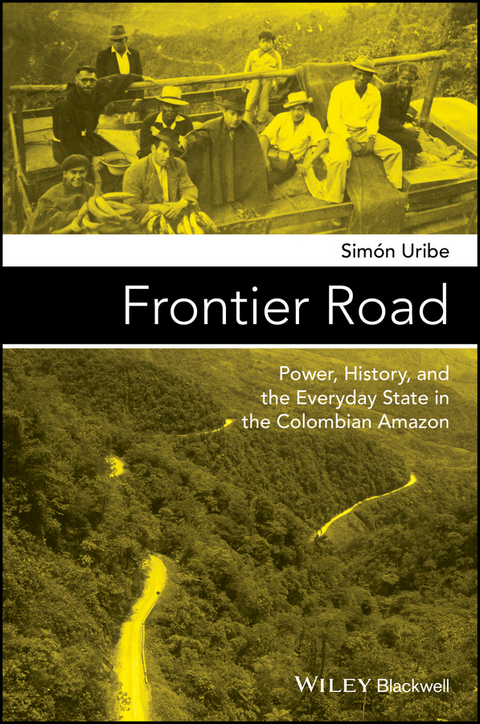
Frontier Road (eBook)
Frontier Road uses the history of one road in southern Colombia-known locally as 'the trampoline of death'-to demonstrate how state-building processes and practices have depended on the production and maintenance of frontiers as inclusive-exclusive zones, often through violent means.
- Considers the topic from multiple perspectives, including ethnography of the state, the dynamics of frontiers, and the nature of postcolonial power, space, and violence
- Draws attention to the political, environmental, and racial dynamics involved in the history and development of transport infrastructure in the Amazon region
- Examines the violence that has sustained the state through time and space, as well as the ways in which ordinary people have made sense of and contested that violence in everyday life
- Incorporates a broad range of engaging sources, such as missionary and government archives, travel writing, and oral histories
Simón Uribe is Assistant Professor in the Institute of Regional Studies, University of Antioquia.
Frontier Road uses the history of one road in southern Colombia known locally as the trampoline of death to demonstrate how state-building processes and practices have depended on the production and maintenance of frontiers as inclusive-exclusive zones, often through violent means. Considers the topic from multiple perspectives, including ethnography of the state, the dynamics of frontiers, and the nature of postcolonial power, space, and violence Draws attention to the political, environmental, and racial dynamics involved in the history and development of transport infrastructure in the Amazon region Examines the violence that has sustained the state through time and space, as well as the ways in which ordinary people have made sense of and contested that violence in everyday life Incorporates a broad range of engaging sources, such as missionary and government archives, travel writing, and oral histories
Simón Uribe is Assistant Professor in the Institute of Regional Studies, University of Antioquia.
Title Page 5
Copyright Page 6
Contents 9
Series Editors’ Preface 10
Acknowledgements 11
Introduction 13
Part I 31
Chapter 1 Reyes’ dream 33
Two frontiers 39
‘The base of a new geography’ 43
The secret of the state 55
Notes 71
Chapter 2 A Titans’ work 74
A mission’s tale 74
The General’s last sigh 82
The odyssey 85
Rituals of state-making 92
Notes 101
Chapter 3 Fray Fidel de Montclar’s deed 104
Burdens and loads 106
A tale of two towns 109
The annihilation of theory in practice 129
Stagnation and decay 139
State and frontier revisited 143
Notes 146
Part II 153
Chapter 4 The trampoline of death 155
A frontier highway 157
Reyes’ ghost 163
Jesús 165
Franco 177
Guillermo 183
Uneven frontiers 190
Notes 192
Chapter 5 On the illegibility effects of state practices 194
‘The illusion of transparency’ 197
The Forest Reserve’s cadastral ‘confusion’ 202
Becoming illegible: a short case study 208
Entangled maps 217
‘The art of being governed’ 220
Notes 222
Chapter 6 The politics of the displaced 223
The displaced 224
The making of a community 227
The struggle for resettlement 233
Villa Rosa 237
On continuity and change 245
Notes 251
Conclusion: The condition of frontier 252
Index 276
EULA 283
'What an exciting and devastating book! Philosophically as well as aesthetically it blends the material world of road-building into the Amazon with the myth of stately prowess, especially the state's heroic tropes of "opening up" the "frontier." Showing how such a road creates the state, rather than the other way around, the author also demolishes the myth of geographical determinism and does so in a calm, elegant, and lucid prose that upturns our basic concepts. By building his own road, Simón Uribe brings nature and the state into a dazzling new constellation.'
Michael Taussig, Class of 1933 Professor of Anthropology, Columbia University, New York
'A wonderful historical treat in the emerging field of infrastructure studies, Frontier Road is a rich and fascinating account of the relation between state and frontier in the Putumayo region of Colombia. The protagonist is the road - a site of hope, frustration, violence and fear, and a space where histories of the future are tracked from the mid-nineteenth century to the present day.'
Penny Harvey, Professor of Social Anthropology, University of Manchester, Manchester
'Simón Uribe takes us on an exhilarating journey to reveal how nearly two centuries of frustrated efforts to build a road through the Putumayo exposes the fantasies of state-building and uncertainty of development. With this beautifully written ethnography, Uribe introduces us to a cast of actors, from enigmatic missionaries, wizened truck drivers, and 'never present' guerrilla for whom the road is material infrastructure and symbol of state power. Frontier Road is a remarkable achievement that itself exists at the intellectual frontier of anthropology, geography and history.'
Gareth Jones, Professor of Urban Geography, London School of Economics, London
| Erscheint lt. Verlag | 25.5.2017 |
|---|---|
| Reihe/Serie | Antipode Book Series | Antipode Book Series |
| Sprache | englisch |
| Themenwelt | Naturwissenschaften ► Geowissenschaften ► Geografie / Kartografie |
| Sozialwissenschaften ► Politik / Verwaltung | |
| Schlagworte | Amazonas • Economic Geography • Geographie • Geography • Kolumbien • LATIN AMERICAN POLITICS • <p>Colombia, trampoline of death, human geography, colonialism, violence, frontier politics, postcolonialism, anthropology, ethnography, infrastructure, state building, Latin American studies, development studies</p> • Political Geography • Political Science • Politik / Lateinamerika • Politikwissenschaft • Politische Geographie • Wirtschaftsgeographie |
| ISBN-13 | 9781119100195 / 9781119100195 |
| Informationen gemäß Produktsicherheitsverordnung (GPSR) | |
| Haben Sie eine Frage zum Produkt? |
 PDF (Adobe DRM)
Kopierschutz: Adobe-DRM
Adobe-DRM ist ein Kopierschutz, der das eBook vor Mißbrauch schützen soll. Dabei wird das eBook bereits beim Download auf Ihre persönliche Adobe-ID autorisiert. Lesen können Sie das eBook dann nur auf den Geräten, welche ebenfalls auf Ihre Adobe-ID registriert sind.
Details zum Adobe-DRM
Dateiformat: PDF (Portable Document Format)
Mit einem festen Seitenlayout eignet sich die PDF besonders für Fachbücher mit Spalten, Tabellen und Abbildungen. Eine PDF kann auf fast allen Geräten angezeigt werden, ist aber für kleine Displays (Smartphone, eReader) nur eingeschränkt geeignet.
Systemvoraussetzungen:
PC/Mac: Mit einem PC oder Mac können Sie dieses eBook lesen. Sie benötigen eine
eReader: Dieses eBook kann mit (fast) allen eBook-Readern gelesen werden. Mit dem amazon-Kindle ist es aber nicht kompatibel.
Smartphone/Tablet: Egal ob Apple oder Android, dieses eBook können Sie lesen. Sie benötigen eine
Geräteliste und zusätzliche Hinweise
Buying eBooks from abroad
For tax law reasons we can sell eBooks just within Germany and Switzerland. Regrettably we cannot fulfill eBook-orders from other countries.
aus dem Bereich