Frontier Road (eBook)

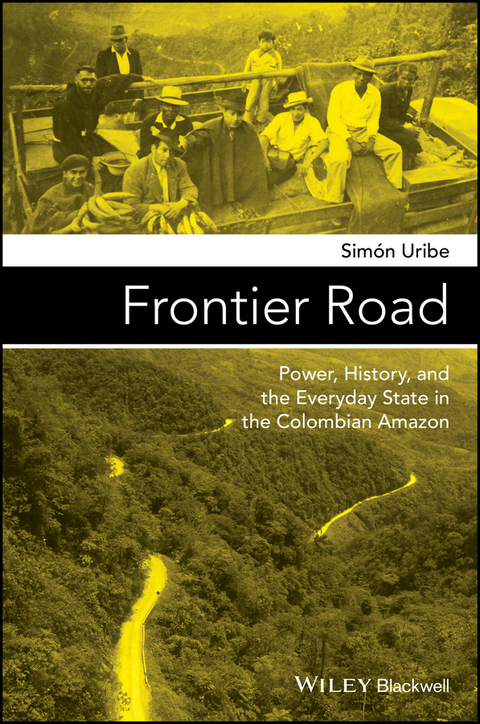
Frontier Road uses the history of one road in southern Colombia-known locally as 'the trampoline of death'-to demonstrate how state-building processes and practices have depended on the production and maintenance of frontiers as inclusive-exclusive zones, often through violent means.
- Considers the topic from multiple perspectives, including ethnography of the state, the dynamics of frontiers, and the nature of postcolonial power, space, and violence
- Draws attention to the political, environmental, and racial dynamics involved in the history and development of transport infrastructure in the Amazon region
- Examines the violence that has sustained the state through time and space, as well as the ways in which ordinary people have made sense of and contested that violence in everyday life
- Incorporates a broad range of engaging sources, such as missionary and government archives, travel writing, and oral histories
Simón Uribe is Assistant Professor in the Institute of Regional Studies, University of Antioquia.
Frontier Road uses the history of one road in southern Colombia known locally as the trampoline of death to demonstrate how state-building processes and practices have depended on the production and maintenance of frontiers as inclusive-exclusive zones, often through violent means. Considers the topic from multiple perspectives, including ethnography of the state, the dynamics of frontiers, and the nature of postcolonial power, space, and violence Draws attention to the political, environmental, and racial dynamics involved in the history and development of transport infrastructure in the Amazon region Examines the violence that has sustained the state through time and space, as well as the ways in which ordinary people have made sense of and contested that violence in everyday life Incorporates a broad range of engaging sources, such as missionary and government archives, travel writing, and oral histories
Simón Uribe is Assistant Professor in the Institute of Regional Studies, University of Antioquia.
Series Editors' Preface viii
Acknowledgements ix
Introduction 1
Part I 19
1 Reyes' dream 21
2 A Titans' work 62
3 Fray Fidel de Montclar's deed 92
Part II 141
4 The trampoline of death 143
5 On the illegibility effects of state practices 182
6 The politics of the displaced 211
Conclusion: The condition of frontier 240
References 248
Index 264
'What an exciting and devastating book! Philosophically as well as aesthetically it blends the material world of road-building into the Amazon with the myth of stately prowess, especially the state's heroic tropes of "opening up" the "frontier." Showing how such a road creates the state, rather than the other way around, the author also demolishes the myth of geographical determinism and does so in a calm, elegant, and lucid prose that upturns our basic concepts. By building his own road, Simón Uribe brings nature and the state into a dazzling new constellation.'
Michael Taussig, Class of 1933 Professor of Anthropology, Columbia University, New York
'A wonderful historical treat in the emerging field of infrastructure studies, Frontier Road is a rich and fascinating account of the relation between state and frontier in the Putumayo region of Colombia. The protagonist is the road - a site of hope, frustration, violence and fear, and a space where histories of the future are tracked from the mid-nineteenth century to the present day.'
Penny Harvey, Professor of Social Anthropology, University of Manchester, Manchester
'Simón Uribe takes us on an exhilarating journey to reveal how nearly two centuries of frustrated efforts to build a road through the Putumayo exposes the fantasies of state-building and uncertainty of development. With this beautifully written ethnography, Uribe introduces us to a cast of actors, from enigmatic missionaries, wizened truck drivers, and 'never present' guerrilla for whom the road is material infrastructure and symbol of state power. Frontier Road is a remarkable achievement that itself exists at the intellectual frontier of anthropology, geography and history.'
Gareth Jones, Professor of Urban Geography, London School of Economics, London
Introduction
The 148 kilometres that separate Mocoa from Pasto are terrifying. So say the drivers that daily cross the páramos,1 valleys and inhospitable selvas along the road between the two cities, a journey that can take up to 10 or 12 hours and sometimes much longer depending on the state of the road or the action of the guerrilla … This is the road traversed by the conqueror Hernán Pérez de Quesada, who defied the abysses, páramos and numerous water courses that criss‐cross it, accompanied by 270 soldiers, 200 horses and ten Indians that guided him in the conquest of the south. It was also the route that by 1835 was used by merchants eager to arrive at the Putumayo River to transport rubber, quinine and tagua by canoe to Manaus and Belen de Para and to return with iron, salt, liqueurs and other foreign goods.
On account of the obstacles this road imposes on travel to the Putumayo, General Rafael Reyes turned Mocoa into a prison and there exiled his political enemies. This road was also traversed by the Colombian troops who defended the national sovereignty during the conflict with Peru in 1932 … Through this same road came the stream of colonos on the pretext of transforming the region; and also those who fled political violence, immigrants attracted by the discovery of oil, and finally those deluded with the coca boom.
To get in or out of this region is uncertain … For this reason [drivers] do not hesitate to have a drink of aguardiente in order to control their nerves and face the fractured rocks, slopes flowed [sic] with high pressure water, creeks and brooks, and a dense mist that makes this place a world apart.
‘Pasto‐Mocoa road: 148 km of fear’ (El Tiempo, 3rd November 1996).
This is one of the many depictions of a road connecting the Andean and Amazon regions in southwest Colombia (see Figure I.1), infamously known as El trampolín de la muerte [the trampoline of death] due to its sheer and precipitous topography. These depictions appear from time to time in the national press, travellers’ blogs, YouTube videos and TV news reports. On the occasion that a bus falls off a cliff or is buried under an avalanche, leaving a death toll of more than 10 or 20, or when travellers are trapped in landslides and have to be air‐lifted, these descriptions multiply. During such events, condemnations and promises proliferate: journalists portray horrific scenes of mud, wreckage, blood and unfound corpses while reiterating the archaic state of the road; locals lay blame on the government for perpetual neglect; the president announces the imminent launch of a long‐awaited road project that will finally redeem a country’s rich yet forgotten margin of the state; politicians accuse each other while promising a ‘definite solution’ if they are elected. Repetition turns each tragedy into farce, as characters re‐play the same script, replicating the staple fare of the frontier: isolation, confinement, violence, lawlessness, backwardness, abandonment, neglect, terror and fear.
Figure I.1 Colombia’s Andean‐Amazon region.
Through reiteration and replication, this vocabulary has become indissoluble from the geographical imagery of the road, affixed to the various names by which it has been baptized (‘wages of fear’, ‘the longest cemetery in the world’, ‘shortcut to hell’, ‘the dumb death’). The most popular of these terms remains the trampoline of death, which sharply captures the sense of being under constant threat of plunging into a bottomless void. Each of these names, together with the written and visual accounts they echo, conveys the striking features of this infrastructural landscape: its almost impossible layout, which from the distance looks like a thin, meandering path carved in a vertical forest; the palpable fragility and instability of the entire infrastructure, denoted by all sorts of ‘danger’ and ‘caution’ signs and evinced by persistent landslides wearing away the road surface, crumbling slopes and culverts eroded or collapsed by the action of water; its unsettling atmosphere, composed by the coming and going of roaring engines muffled by thick masses of fog crawling up the cordillera; and the ubiquitous remnants of deadly events, differently marked with plaques, shrines and fragments of debris scattered throughout the road.
To traverse the trampoline of death’s exceptional landscape would most probably make the traveller feel that he is inhabiting a ‘world apart’, as the journalist euphemistically puts it. Still, for the inhabitants of regions traditionally deemed as peripheral, isolated, excluded from or yet to be assimilated into the state, regions most commonly known in official and academic language as fronteras internas (internal frontiers), infrastructures like the trampoline of death have long been the norm rather than the exception. In Colombia, where the sum of these regions is still variously estimated to comprise from three‐quarters to one‐half of the country’s total area, such infrastructures, commonly branded as trochas (trails), abound, their ruinous and neglected state often projected to the entire territory and population they encompass. This image is similarly echoed in the frontier, where these infrastructures are heavily invested with enduring feelings and memories of isolation, exclusion and abandonment from the state. Inversely, the building of smooth paved roads annihilating spatial barriers and shrinking geographical distances constitutes an everyday expectation, one that powerfully embodies the long‐awaited promise of development, progress and inclusion.
The evocative power that roads have as physical structures that express feelings and visions of modernity, backwardness, abjection or development, has been widely stressed.2 This affective dimension of roads is especially manifest in ‘peripheral’ or ‘marginal’ spaces, where they are conspicuous by their incomplete or precarious state.3 Precariousness and incompleteness, however, do not undermine the vital role roads have played in the history of these regions. This role is both related to their function as intrinsic technologies of state‐building and to their singular significance in such spaces, where they have been customarily seen as infrastructures aimed at symbolically and physically civilizing ‘savage’ or ‘backward’ lands and populations through the interwoven ends they are meant to assist and achieve: colonization, sovereignty, legibility, security and development.4
This view prevailed for many years in scholarly accounts of the frontier in the Amazon, where they came to be regarded as a primary means to materialize popular slogans such as ‘land without men for men without land’.5 The racial, environmental and social violence that this image sustained has been amply documented and criticized, throwing light on the conflicts shaping frontier processes throughout the region.6 The road from Pasto to Puerto Asís, of which the trampoline of death is one of several fragments (Figure I.1), provides a clear example of the state’s civilizing project and the violence this rhetoric has historically sustained. This violence can be traced through the road’s many characters, conflicts and events, as well as in the entangled political and social dynamics it has assisted. Although this violence has not deprived the road of its promise of connection and inclusion, it has revealed the political economies and ecologies of infrastructural development region wide. More significantly, this violence speaks of the spatio‐temporal process of state‐building and of the role the frontier has played throughout it.
Frontier Road critically examines this process through an ethnographic and historical exploration of this singular infrastructure, from its inception in the nineteenth century to the present and through its various shapes and transfigurations: indigenous and cauchero (rubber tapper) trail, missionary bridle path, colonization dirt road and interoceanic megaproject. In reconstructing this history, I show how the Colombian Amazon was constituted and assimilated into the order of the state as a frontier space and, in turn, how this condition of frontier became vital to the existence of this order. In this sense, I argue that this territory has never been excluded from the spatial and political order of the state, but rather incorporated to this order through a relationship of inclusive exclusion. The meaning and nature of this relationship, to be discussed later in this chapter, confronts traditional notions of the state and the frontier. Yet the purpose of the book, as I hope will become clear in due course, is not just to question such notions, but also, and more importantly, to expose how they have helped legitimate a hegemonic political, social and spatial order.
Colombia’s amputated map
Among the various connotations of the term ‘frontier’ (territorial or national boundary, zone of contact between different cultures, fringe of settled areas, safety valve), one of the most lasting connotations has been that of wild and untamed spaces embodying the antithesis of civilization. This image has long pervaded representations of the Colombian Amazon and other...
| Erscheint lt. Verlag | 25.5.2017 |
|---|---|
| Reihe/Serie | Antipode Book Series |
| Antipode Book Series | Antipode Book Series |
| Sprache | englisch |
| Themenwelt | Naturwissenschaften ► Geowissenschaften ► Geografie / Kartografie |
| Sozialwissenschaften ► Politik / Verwaltung | |
| Schlagworte | Amazonas • Economic Geography • Geographie • Geography • Kolumbien • LATIN AMERICAN POLITICS • <p>Colombia, trampoline of death, human geography, colonialism, violence, frontier politics, postcolonialism, anthropology, ethnography, infrastructure, state building, Latin American studies, development studies</p> • Political Geography • Political Science • Politik / Lateinamerika • Politikwissenschaft • Politische Geographie • Wirtschaftsgeographie |
| ISBN-13 | 9781119100201 / 9781119100201 |
| Informationen gemäß Produktsicherheitsverordnung (GPSR) | |
| Haben Sie eine Frage zum Produkt? |
 EPUB (Adobe DRM)
Kopierschutz: Adobe-DRM
Adobe-DRM ist ein Kopierschutz, der das eBook vor Mißbrauch schützen soll. Dabei wird das eBook bereits beim Download auf Ihre persönliche Adobe-ID autorisiert. Lesen können Sie das eBook dann nur auf den Geräten, welche ebenfalls auf Ihre Adobe-ID registriert sind.
Details zum Adobe-DRM
Dateiformat: EPUB (Electronic Publication)
EPUB ist ein offener Standard für eBooks und eignet sich besonders zur Darstellung von Belletristik und Sachbüchern. Der Fließtext wird dynamisch an die Display- und Schriftgröße angepasst. Auch für mobile Lesegeräte ist EPUB daher gut geeignet.
Systemvoraussetzungen:
PC/Mac: Mit einem PC oder Mac können Sie dieses eBook lesen. Sie benötigen eine
eReader: Dieses eBook kann mit (fast) allen eBook-Readern gelesen werden. Mit dem amazon-Kindle ist es aber nicht kompatibel.
Smartphone/Tablet: Egal ob Apple oder Android, dieses eBook können Sie lesen. Sie benötigen eine
Geräteliste und zusätzliche Hinweise
Buying eBooks from abroad
For tax law reasons we can sell eBooks just within Germany and Switzerland. Regrettably we cannot fulfill eBook-orders from other countries.
aus dem Bereich