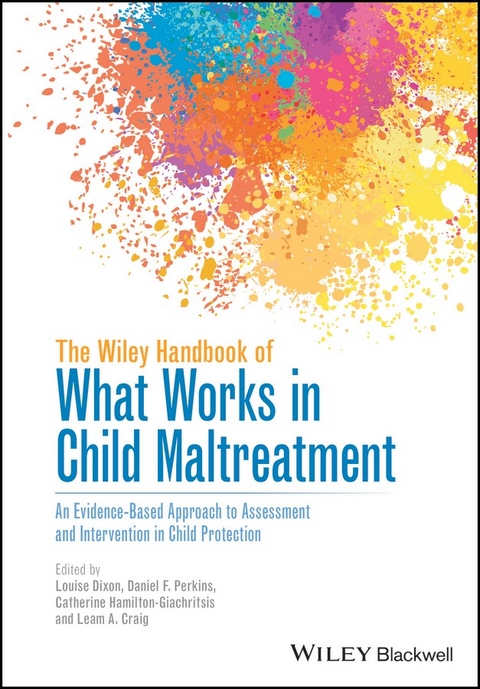
The Wiley Handbook of What Works in Child Maltreatment (eBook)
John Wiley & Sons (Verlag)
978-1-118-97610-4 (ISBN)
A comprehensive guide to empirically supported approaches for child protection cases
The Wiley Handbook of What Works in Child Maltreatment offers clinicians, psychologists, psychiatrists and other professionals an evidence-based approach to best professional practice when working in the area of child protection proceedings and the provision of assessment and intervention services in order to maximize the well-being of young people. It brings together a wealth of knowledge from expert researchers and practitioners, who provide a comprehensive overview of contemporary work informing theory, assessment, service provision, rehabilitation and therapeutic interventions for children and families undergoing care proceedings. Coverage includes theoretical perspectives, insights on the prevalence and effects of child neglect and abuse, assessment, children's services, and interventions with children, victims and families.
Louise Dixon, PhD, CPsychol is a Reader of Forensic Psychology at Victoria University of Wellington, New Zealand.
Daniel F. Perkins, PhD is a Professor of Family and Youth Resiliency and Policy at the Pennsylvania State University.
Catherine Hamilton-Giachritsis, PhD, CPsychol, AFBPsS is a Reader in Clinical Psychology at the University of Bath, UK.
Leam A. Craig, PhD, CPsychol, CSci, FBPsS, FAcSS, is a Consultant Forensic and Clinical psychologist at Forensic Psychology Practice Ltd, a visiting Professor of Forensic Clinical Psychology at Birmingham City University and Professor (Hon) of Forensic Psychology at University of Birmingham UK.
A comprehensive guide to empirically supported approaches for child protection cases The Wiley Handbook of What Works in Child Maltreatment offers clinicians, psychologists, psychiatrists and other professionals an evidence-based approach to best professional practice when working in the area of child protection proceedings and the provision of assessment and intervention services in order to maximize the well-being of young people. It brings together a wealth of knowledge from expert researchers and practitioners, who provide a comprehensive overview of contemporary work informing theory, assessment, service provision, rehabilitation and therapeutic interventions for children and families undergoing care proceedings. Coverage includes theoretical perspectives, insights on the prevalence and effects of child neglect and abuse, assessment, children s services, and interventions with children, victims and families.
Louise Dixon is a Registered Forensic Psychologist and Senior Lecturer in Forensic Psychology at the University of Birmingham, UK. In addition to her practice and teaching activities, she is an active researcher. She is Chair for the West Midlands Branch of the British Association for the Study and Prevention of Child Abuse and Neglect (BASPCAN) and sits on the board of the journals Child Maltreatment and Partner Abuse. Her research interests centre on the prevention and assessment of family aggression and aggression in young people. Daniel Perkins is Professor of Family and Youth Resiliency and Policy at the Pennsylvania State University, USA. His scholarship integrates practice and research around positive youth development, healthy family development and community collaboration. He received a grant from the US Department of Defense for the development of the Penn State Clearinghouse, an interactive platform helping professionals working with military families to support their implementation and assessment activities. He is currently studying the transition of evidence-based programs and practices into real-world settings. Leam Craig is a Consultant Forensic Clinical Psychologist, Partner at Forensic Psychology Practice Ltd. and Honorary Professor at the University of Birmingham, UK. His current practice includes direct services to forensic NHS Adult Mental Health Trusts, consultancy to Prison and Probation Services and expert witness work. The bulk of his psycho-legal work is family assessments in child care proceedings, assessing parents, other carers and children. He is the recipient of the 2013 Senior Academic Award from the BPS Division of Forensic Psychology, and has published seven books with Wiley-Blackwell. Catherine Hamilton-Giachritsis is a Registered Forensic and Clinical Psychologist and has practised in both Children's Services and the NHS. She is Senior Lecturer and Assistant Director of the Centre for Forensic and Criminological Psychology at the University of Birmingham, UK. Her research focuses on child maltreatment and family violence, including risk assessment, impact of early institutionalisation and long-term outcomes from and resilience to abuse and neglect. She has been co-PI on three EU Daphne/ World Health Organisation funded projects on young children in institutions across Europe.
About the editors
Notes on Contributors
Foreword
Acknowledgements
1 Overview and structure of the book
PART 1: RESEARCH AND THEORETICAL PERSPECTIVES
2 Child abuse and neglect: Prevalence and incidence
3 Child abuse and neglect: Ecological perspectives
4 Fatal child maltreatment
5 Psychological, Economic, and Physical Health Consequences of Child Maltreatment
6 The neurobiology and genetics of childhood maltreatment
7 Intimate partner violence and child maltreatment
PART II: CHILDREN'S SERVICES AND PUBLIC HEALTH APPROACHES TO PREVENTION
8 Implications of children's services policy on child abuse and neglect in England
9 Children's services: Toward effective child protection
10 using the formal pre-proceddings tp prevent or prepare for casre proceedings
11 The prevention of child maltreatment: The case for a public health approach to behavioural parenting intervention
12 WW to prevent the sexual exploitation of children and youth
PART III: ASSESSMENT
13 Evidence based assessments of children and families: Safeguarding Children Assessment and Analysis Framework
14 Utilising an attachment perspective in parenting assessment
15 "Evidence based and developmentaly appropriate forensic interviewing of children"
16 Considering parental risk in parenting (child custody) evaluation cases involvingchild sexual exploiation material
17 Assessments in child care proceedings: Observations in practice
PART IV: INTERVENTIONS WITH CHILDREN AND Families
18 Evidence-based approaches to empower children and families at-risk for child physical abuse to overcome abuse and violence
19 Effective therapies for children and nonoffending caregivers in the aftermath of child sexual abuse or other traumas 20 Effectiveness of cognitive and behavioural group based parenting programmes to enhance child protective factors and reduce risk factors for maltreatment
21 critical factors in the successful implementation of evidence-based parenting programmes: Fidelity, adaption and promoting quality
22 School based resilience prevention and interventin of CM
23 Using Assessment of Attachment in Child Care Proceedings to Guide Intervention
PART V: NOVEL INTERVENTIONS WITH FAMILIES
24 Working systemically with families with intimate partner violence
25 Working with nonoffending parents in cases of child sexual abuse
26 Working with Parents with Intellectual Disabilities in childcare proceedings
27 Working with parents with a diagnosis of personality disorder
28 Working with parents who use drugs and alcohol
Notes on Contributors
Nick Axford, PhD is Senior Researcher and Head of What Works at the Dartington Social Research Unit. He leads a team that focuses on identifying effective interventions to improve child well‐being through evidence reviews and evaluations. Nick is a member of the Early Intervention Foundation Evidence Panel and an Advisor to the Board of the European Society for Prevention Research, and was co‐editor of the Journal of Children’s Services (2006–2015). He tweets about evidence‐based prevention and early intervention @nick_axford.
Clark Baim, MEd (BPA, UKCP) is a Senior Trainer in Psychodrama Psychotherapy and Co‐Director of Change Point Ltd. Clark has worked as a psychotherapist, group facilitator and trainer in prisons, probation centres, forensic hospitals and therapist training programmes in 15 countries. He was the lead national trainer for the sexual offending treatment programmes run by the probation service in England and Wales (2000–2012). He publishes in the fields of attachment, psychodrama psychotherapy, co‐working, working with survivors of trauma, offender rehabilitation and theatre‐based approaches with offenders and youth at risk. Clark is the co‐author of Attachment‐based Practice with Adults (2011) and is a fellow of the Berry Street Childhood Institute in Melbourne, Australia.
Victoria Baker, MA is an Associate of the Dartington Social Research Unit. She specialises in children’s services research and theory of change development, and has trained practitioners and commissioners in evidence‐based service design and how to promote implementation fidelity. Victoria is studying for a PhD on the experiences of young people who instigate parent abuse, and is a member of the Connect Centre for International Research on Interpersonal Violence and Harm at the University of Central Lancashire.
Dr Arnon Bentovim, FRCPsych, FRCPCH is a Child and Family Psychiatrist, Director and co‐founder of Child and Family Training, and Visiting Professor, Royal Holloway University of London. He trained as a psychoanalyst and family therapist, and worked at Great Ormond Street Children’s Hospital and the Tavistock Clinic. At Great Ormond Street he shared responsibility for Child Protection, and helped to initiate services (e.g., the first Sexual Abuse Assessment and Treatment Service in the UK; Child Care Consultation Service).
Vashti Berry, PhD is a Senior Research Fellow at the University of Exeter Medical School, within the South West Peninsula’s Collaboration for Leadership in Applied Health Research and Care (PenCLAHRC). Her research interests are intervention development and evaluation, specifically around improving children’s mental health and enhancing parenting support. Vashti is an expert reviewer for the NIHR, and is on the Early Intervention Foundation’s evidence review panel. Vashti tweets about issues in the application of evidence @vashtilou.
Liza Bingley Miller, MSc is a co‐founder of Child and Family Training. She was National Training Coordinator and a Director until retiring in December 2013. Liza currently chairs adoption panels for North Yorkshire’s children and family care service. Liza is a social worker and family therapist by training, working for many years at Great Ormond Street Children’s Hospital, London, including as a Leverhulme Research Fellow, and as a Lecturer in social work at the University of York.
Sarah Blower, PhD is a Research Fellow in the Department of Health Sciences at the University of York. Her research interests and expertise are in the design, implementation and evaluation of services designed to improve the well‐being of children and families. Sarah is currently part of the Healthy Children Healthy Families Theme of the NIHR CLAHRC Yorkshire and Humber, and also manages the ESEE trial – an evaluation of parent programmes delivered using a proportionate universalism approach. Sarah tweets about service design, implementation and evaluation @sarah_blower.
Karen Broadley, MSocSci, BA has more than 20 years’ experience working in child welfare. She has held a number of roles within the child protection system, including high‐risk infant specialist and adolescent consultant. Karen has researched in various areas of child welfare, including a critique of the public health model; intervening to protect children from chronic maltreatment; risk assessment; and child protection decision‐making. Karen is currently completing a PhD at Monash University studying prevention of child sexual abuse.
Tracey Bywater, PhD is Professor of Family Wellbeing in the Department of Health Sciences at the University of York. Her work focuses on enhancing parent and child outcomes, particularly around social–emotional well‐being, behaviour and health. Tracey’s work has involved randomised controlled trials of complex parent, teacher and child programmes. She is currently part of the Healthy Children Healthy Families Theme of the NIHR CLAHRC Yorkshire and Humber, and also leads on the social emotional development workstream for Better Start Bradford, and leads the ESEE trial – an evaluation of parent programmes delivered using a proportionate universalism approach. For information on research projects please see: www.york.ac.uk/healthsciences/ourstaff/tracey‐bywater/#research. For publications see/www.york.ac.uk/healthsciences/our‐staff/tracey‐bywater/#publications.
Martin C. Calder, MA, CQSW established his own company in 2005, having managed the child protection and domestic abuse services for a decade. He has written extensively about developing and disseminating assessment tools to help frontline staff. He has done significant work with managers to ensure the local environment is conducive to safe, evidence‐based assessment practice coupled with effective supervision. He works with a number of authorities to reshape frontline assessment processes, systems and assessments. He is an Honorary Senior Lecturer, Queens University, Belfast.
Antony Cox, FRCPsych is Emeritus Professor of Child and Adolescent Psychiatry at Guy’s, King’s and St Thomas’ School of Medicine. He was formerly Professor of Child and Adolescent Psychiatry at Liverpool University Medical School. Research interests included epidemiology and aspects of parenting (e.g., cultural differences, the impact of parental mental illness, parent–child interactions) and interventions (e.g., for children with autism). Recent work has focused on developing training on standardised assessments for workers in health and social services.
Leam A. Craig, PhD, MAE, CSci, CPsychol, FBPsS, FAcSS, EuroPsy is a Consultant Forensic and Clinical Psychologist. He is Professor (Hon) of Forensic Psychology, University of Birmingham, and Visiting Professor of Forensic and Clinical Psychology, Birmingham City University. He is a Fellow of the British Psychological Society, a Fellow of the Academy of Social Sciences and recipient of the Senior Academic Award by the Division of Forensic Psychology. He acts as an expert witness to civil and criminal courts in the assessment of sexual and violent offenders and in matters of child protection and currently Chair of the British Psychological Society Expert Witness Advisory Group. He has over 80 publications including ten books and he is a series editor to the What Works in Offender Rehabilitation book series for Wiley‐Blackwell. (See About the Editors section.)
Patricia McKinsey Crittenden, PhD is a developmental psychopathologist who worked with Mary Ainsworth at the University of Virginia to develop the Dynamic‐Maturational Model of Attachment and Adaptation (DMM). She pioneered video‐feedback with maltreating mothers, ran a family support centre, trained as a behavioural and family systems therapist, was the Director of the Miami Child Protection Team, and consulted to family courts in several countries. She has developed a lifespan series of assessments of attachment and has served on faculties in several countries. In 2004, she was given a Career Achievement Award by the European Family Therapy Association. She has published more than 100 empirical papers and chapters, as well as several books including: Crittenden (2015), Raising Parents: Attachment, Representation, and Treatment; Crittenden, Dallos, Landini & Kozlowska (2014), Attachment and Family Systems Therapy; Crittenden & Landini (2011), Assessing Adult Attachment: A Dynamic‐Maturational Model.
Stephanie Cruthirds, LCSW is a mental health clinician at the Child Abuse Education and Service (CARES) Institute. She provides CPC‐CBT and Trauma‐Focused Cognitive Behavioural Therapy (TF‐CBT), as well as training in CPC‐CBT and consultation to professionals in Trauma‐Focused Cognitive Behavioural Therapy (TF‐CBT).
Mireille Cyr, PhD has been a full‐time faculty member of the Psychology Department of University of Montreal for 25 years. She is the scientific director of the Centre for Interdisciplinary Research on Domestic Violence and Sexual Abuse and co‐holder of the Marie‐Vincent Inter‐university Research Chair for sexual abuse on children. Her research focuses on the effects of child sexual abuse, parental support as a determinant of child’s adaptation, and on investigative interviews of alleged young victims.
Isabelle V. Daignault, PhD is Professor at the School...
| Erscheint lt. Verlag | 12.4.2017 |
|---|---|
| Sprache | englisch |
| Themenwelt | Geisteswissenschaften ► Psychologie |
| Sozialwissenschaften ► Pädagogik ► Sozialpädagogik | |
| Sozialwissenschaften ► Soziologie | |
| Schlagworte | assessment in child protection • at risk youth best practise • Candice Feiring</p> • Catherine Hamilton‐Giachritsis • Cathy Widom • child protection best practise • child protection in court settings • child protection professionals • child protection safeguarding strategies • Child welfare • Chris Goddard • Clinical psychology • Daniel Perkins • Eileen Munro • Forensic Psychology • Forensische Psychologie • frameworks for intervention for child protection • guide for working with child protection • Kindesmisshandlung • Klinische Psychologie • Leam A. Craig • Louise Dixon • <p>evidence-based approach to child protection • Michael Lamb • professionals working with at risk youth • Psychologie • Psychology • Signs of Safety approach to casework • Social Policy & Welfare • Sozialpolitik u. Wohlfahrt • Wohlfahrt • Wohlfahrt / Kinder • working with children at risk |
| ISBN-10 | 1-118-97610-X / 111897610X |
| ISBN-13 | 978-1-118-97610-4 / 9781118976104 |
| Informationen gemäß Produktsicherheitsverordnung (GPSR) | |
| Haben Sie eine Frage zum Produkt? |
 EPUB (Adobe DRM)
Kopierschutz: Adobe-DRM
Adobe-DRM ist ein Kopierschutz, der das eBook vor Mißbrauch schützen soll. Dabei wird das eBook bereits beim Download auf Ihre persönliche Adobe-ID autorisiert. Lesen können Sie das eBook dann nur auf den Geräten, welche ebenfalls auf Ihre Adobe-ID registriert sind.
Details zum Adobe-DRM
Dateiformat: EPUB (Electronic Publication)
EPUB ist ein offener Standard für eBooks und eignet sich besonders zur Darstellung von Belletristik und Sachbüchern. Der Fließtext wird dynamisch an die Display- und Schriftgröße angepasst. Auch für mobile Lesegeräte ist EPUB daher gut geeignet.
Systemvoraussetzungen:
PC/Mac: Mit einem PC oder Mac können Sie dieses eBook lesen. Sie benötigen eine
eReader: Dieses eBook kann mit (fast) allen eBook-Readern gelesen werden. Mit dem amazon-Kindle ist es aber nicht kompatibel.
Smartphone/Tablet: Egal ob Apple oder Android, dieses eBook können Sie lesen. Sie benötigen eine
Geräteliste und zusätzliche Hinweise
Buying eBooks from abroad
For tax law reasons we can sell eBooks just within Germany and Switzerland. Regrettably we cannot fulfill eBook-orders from other countries.
aus dem Bereich