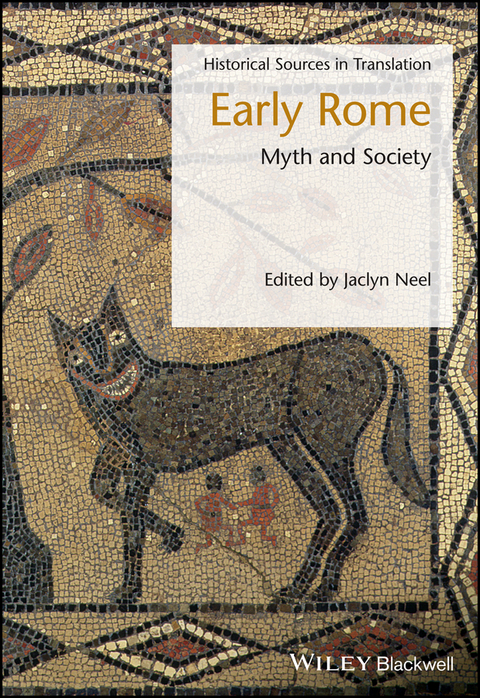
Early Rome (eBook)
John Wiley & Sons (Verlag)
978-1-119-08381-8 (ISBN)
The scholarly community has become increasingly aware of the differences between Roman myths and the more familiar myths of Greece. Early Rome: Myth and Society steps in to provide much-needed modern and accessible translations and commentaries on Italian legends.
This work examines the tales of Roman pre-and legendary history, discusses relevant cultural and contextual information, and presents author biographies. This book offers updated translations of key texts, including authors who are often absent from classical mythology textbooks, such as Dionysius of Halicarnassus and Servius. Editor Jaclyn Neel debunks the idea that Romans were unimaginative copyists by spotlighting the vitality and flexibility of Italian myth - particularly those parts that are less closely connected to Greek tales, such as the story of Caeculus of Praeneste. Finally, by calling attention to the Italian rather than Roman nature of the collection, this book suggests that Roman culture was broader than the city itself. This important work offers:
- Up-to-date and accessible translations of Roman and Italic legends from authors throughout antiquity
- Examination of compelling tales that involve the Roman equivalent of Greek 'heroes'
- Unique view of the strength and plasticity of Roman and Italic myth, particularly the parts less closely connected to familiar Greek tales
- Intelligent discussion of relevant cultural and contextual information
- Argument that Roman culture reached far beyond the city of Rome
Fresh and readable, Early Rome: Myth and Society offers essential reading for students of ancient Rome as well as those interested in Roman and Greek mythology.
Jaclyn Neel, PhD (2012) University of Toronto, is currently a Visiting Assistant Professor at York University. She has published in Classical Quarterly (forthcoming 2015) and Vetus Testamentum (2012). Jackie received her BA in Classics from Columbia University and her PhD in classics and ancient history from the Collaborative Program in Ancient History at the University of Toronto. Her research centers around questions of competition and kingship in Rome, with a specific focus on foundation figures. Her first book analyzed themes of competition in the myths of Rome, and her second will translate key texts on Roman mythology. In the next few years, she will focus more closely on Cicero. She also runs blog on resources for the study of antiquity.
The scholarly community has become increasingly aware of the differences between Roman myths and the more familiar myths of Greece. Early Rome: Myth and Society steps in to provide much-needed modern and accessible translations and commentaries on Italian legends. This work examines the tales of Roman pre-and legendary history, discusses relevant cultural and contextual information, and presents author biographies. This book offers updated translations of key texts, including authors who are often absent from classical mythology textbooks, such as Dionysius of Halicarnassus and Servius. Editor Jaclyn Neel debunks the idea that Romans were unimaginative copyists by spotlighting the vitality and flexibility of Italian myth particularly those parts that are less closely connected to Greek tales, such as the story of Caeculus of Praeneste. Finally, by calling attention to the Italian rather than Roman nature of the collection, this book suggests that Roman culture was broader than the city itself. This important work offers: Up-to-date and accessible translations of Roman and Italic legends from authors throughout antiquity Examination of compelling tales that involve the Roman equivalent of Greek heroes Unique view of the strength and plasticity of Roman and Italic myth, particularly the parts less closely connected to familiar Greek tales Intelligent discussion of relevant cultural and contextual information Argument that Roman culture reached far beyond the city of Rome Fresh and readable, Early Rome: Myth and Society offers essential reading for students of ancient Rome as well as those interested in Roman and Greek mythology.
Jaclyn Neel, PhD (2012) University of Toronto, is currently a Visiting Assistant Professor at York University. She has published in Classical Quarterly (forthcoming 2015) and Vetus Testamentum (2012). Jackie received her BA in Classics from Columbia University and her PhD in classics and ancient history from the Collaborative Program in Ancient History at the University of Toronto. Her research centers around questions of competition and kingship in Rome, with a specific focus on foundation figures. Her first book analyzed themes of competition in the myths of Rome, and her second will translate key texts on Roman mythology. In the next few years, she will focus more closely on Cicero. She also runs blog on resources for the study of antiquity.
Early Rome 3
Contents 9
Preface 13
Abbreviations & Symbols
1 Introducing Early Rome 21
Introduction 21
1.1 What Is a “Myth”? 22
1.2 Types of Stories You Will Read in this Book 24
1.3 Literary Genres in this Book 27
1.4 Theoretical Approaches to Roman Myth 30
1.5 Chronology of Early Rome 31
Conclusion 34
Notes 34
References 34
Further Reading 35
2 Rome Before the City 37
Introduction 37
For Further Thought 40
2.1 The Earliest Italians 40
2.1.1 Vergil, Aeneid 8.315–8.335 41
2.1.2 Justin 43.1.2–43.1.10 41
2.1.3 Dionysius of Halicanassus, Roman Antiquities 1.9.1–1.10.1 42
2.1.4 Strabo, Geography 13.1.53 42
2.1.5 Plutarch, Life of Romulus 2 43
2.1.6 Festus, “Rome” 43
2.1.7 (Anonymous), The Origin of the Roman People 9–10 45
2.1.8 Servius, On the Aeneid 1.273 45
2.2 Inhabitants of the Site of Rome 46
2.2.1 Diodorus Siculus, Library of History 4.21 46
2.2.2 Vergil, Aeneid 8.193–8.272 47
2.2.3 Propertius 4.9.8–4.9.20 48
2.2.4 Dionysius of Halicanassus, Roman Antiquities 1.31.1–1.31.4 49
2.2.5 Ovid, Metamorphoses 14.320–14.396 49
2.2.6 Ovid, Fasti 1.575–1.584 50
2.2.7 (Anonymous), The Origin of the Roman People 5–8 51
2.2.8 Solinus, Collected Tales 8–10 52
2.3 Aeneas in Italy 52
2.3.1 Lycophron, Alexandra 1248–1270 52
2.3.2 Vergil, Aeneid 6.82–6.100 53
2.3.3 Tibullus, Elegies 2.5.18–2.5.66 53
2.3.4 Dionysius of Halicanassus, Roman Antiquities 1.53.4–1.53.5 54
2.4 Aeneas’ Arrival in Latium 54
2.4.1 Varro, On the Latin Language 5.144 54
2.4.2 Vergil, Aeneid 7.107–7.118 55
2.4.3 Vergil, Aeneid 8.43–8.56 55
2.4.4 Servius, On the Aeneid 3.390–3.393 56
2.4.5 (Anonymous), The Origin of the Roman People 12 56
2.5 War in Italy 57
2.5.1 Livy, From the Foundation 1.1–1.2 57
2.5.2 Vergil, Aeneid 7.647–7.653 58
2.5.3 Vergil, Aeneid 12.887–12.952 59
2.5.4 Ovid, Fasti 4.880–4.896 60
2.5.5 Plutarch, Roman Questions 45 61
2.5.6 Servius, On the Aeneid 1.267 61
2.5.7 (Anonymous), On the Origin of the Roman People 13–15 61
2.6 The Death of Aeneas and “Pater Indiges” 63
2.6.1 Ovid, Metamorphoses 14.580–14.608 63
2.6.2 (Anonymous), On the Origin of the Roman People 14 64
2.6.3 Servius, On the Aeneid 4.620 64
2.6.4 Servius, On the Aeneid 12.794 65
2.7 Ascanius, Silvius, and Lavinia: the Alban Dynasty 65
2.7.1 Livy, From the Foundation 1.3 65
2.7.2 Vergil, Aeneid 6.760–6.776 66
2.7.3 Festus, “Silvi” 67
2.7.4 (Anonymous), On the Origin of the Roman People 16 67
2.7.5 Servius, On the Aeneid 6.760–6.773 68
Conclusion 69
Notes 70
References 73
Further Reading 73
3 Founding Rome 75
Introduction 75
For Further Thought 78
3.1 Conception, Birth, and Exposure 78
3.1.1 Ennius, Annals 34–50 79
3.1.2 Livy, From the Foundation 1.3–1.4 79
3.1.3 Justin, Epitome of Pompeius Trogus 38.6.7–38.6.8 80
3.1.4 Dionysius of Halicanassus, Roman Antiquities 1.76.1–1.79.3 80
3.1.5 Dionysius of Halicanassus, Roman Antiquities 1.84.2–1.84.5 82
3.1.6 Ovid, Fasti 2.383–2.420 82
3.1.7 Plutarch, Life of Romulus 2–4 83
3.1.8 Festus, “Romulus and Remus” and “Rome” 85
3.2 Youth of Romulus and Remus 85
3.2.1 Diodorus Siculus, Library of History 8.3–8.4 86
3.2.2 Livy, From the Foundation 1.5 87
3.2.3 Ovid, Fasti 2.361–2.380 87
3.2.4 Plutarch, Life of Romulus 6–8 88
3.3 Romes Foundation 89
3.3.1 Ennius, Annals 72–91 90
3.3.2 Fragment of Cassius Hemina (FRHist 6 F14) 91
3.3.3 Diodorus Siculus, Library of History 8.5 91
3.3.4 Cicero, On the State 2.4–2.5 91
3.3.5 Livy, From the Foundation 1.6–1.7 92
3.3.6 Ovid, Fasti 4.809–4.826 93
3.3.7 (Anonymous), Vatican codex (FGrHist 839 F1) 93
3.4 The Death of Remus 94
3.4.1 Diodorus, Library of History 8.6 94
3.4.2 Cicero, On Duties 3.41 94
3.4.3 Horace, Epodes 7.14–7.21 95
3.4.4 Dionysius of Halicanassus, Roman Antiquities 1.87.1–1.87.3 95
3.4.5 Ovid, Fasti 4.835–4.856 96
3.4.6 Ovid, Fasti 5.451–5.480 96
3.4.7 (Anonymous), The Origin of the Roman People 23 (Egnatius FRHist 101 F1) 97
3.4.8 Servius, On the Aeneid 1.276 97
3.4.9 Servius, On the Aeneid 6.779 98
3.4.10 Lydus, On Magistrates 1.5 (Cato FRHist 5 F3) 98
3.5 Wars with the Sabines 98
3.5.1 Varro, On the Latin Language 5.149 99
3.5.2 Livy, From the Foundation 1.9–1.10, 1.12–1.13 99
3.5.3 Dionysius of Halicanassus, Roman Antiquities 2.45.1–2.47.3 103
3.5.4 Ovid, Metamorphoses 14.778–14.804 104
3.5.5 Plutarch, Life of Romulus 16 104
3.5.6 Festus, “Luceres” 105
3.5.7 Lactantius, Divine Institutes 2.7 105
3.6 Death of Titus Tatius 106
3.6.1 Cicero, On the State 2.14 106
3.6.2 Livy, From the Foundation 1.14 107
3.6.3 Dionysius of Halicanassus, Roman Antiquities 2.52.2–2.52.5 107
3.7 Death and Apotheosis of Romulus 108
3.7.1 Ennius, Annals 105–110 108
3.7.2 Livy, From the Foundation 1.15–1.16 109
3.7.3 Ovid, Metamorphoses 14.805–14.851 110
Conclusion 111
Notes 112
References 115
Further Reading 115
4 Images and Text 117
Introduction 117
For Further Thought 119
4.1 Mlacuch 119
4.1.1 Mirror of unknown provenance (possibly Adria), c. 500–475 bce (London, British Museum) 120
4.1.2 Mirror from Vulci, fifth century bce (Vatican, Museo Gregoriano Etrusco) 120
4.2 Hercules and Juno 121
4.2.1 Mirror of unknown provenance, fourth (?) century bce (Bologna, Museo Civico Archeologico) 122
4.2.2 Mirror from Volterra, c. 325 bce (Florence, Museo Archeologico Nazionale) 123
4.2.3 Lekythos from Apulia, c. 365–350 bce (London, British Museum) 123
4.2.4 Cicero, On Divination 2.85 123
4.3 Suckling Wolf 124
4.3.1 Stele from Felsina, late fifth century bce (Bologna, Museo Civico Archeologico) 124
4.3.2 Mirror from Praeneste, fourth century bce (Rome, Antiquarium Communale) 124
4.3.3 Silver coin from Rome, mid-third century bce (New York, American Numismatic Society) 127
4.3.4 “Capitoline Wolf,” medieval (?) (Rome, Capitoline Museums) 127
4.4 Prophets 128
4.4.1 Gemstone, fourth century bce (Rome, Villa Giulia) 128
4.4.2 Mirror from Tuscania, late fourthearly third century bce (Florence, Museo Archeologico) 129
4.4.3 Cicero, On Divination 2.50–2.51 129
4.4.4 Livy, From the Foundation 2.7 130
4.4.5 Ovid, Metamorphoses 15.552–15.559 131
4.4.6 John Lydus, On Omens 3 131
4.5 Wolfman 131
4.5.1 Urn from Volterra, Hellenistic period (Volterra, Museo Guernacci) 132
4.5.2 Pliny, Natural History 2.140 132
4.6 The Vibenna Brothers 133
4.6.1 Frescoes from the François Tomb, Vulci, later fourth century bce (Rome, Villa Albani) 133
4.6.2 Mirror from Bolsena, third century bce (London, British Museum) 134
4.6.3 Urn from Chiusi, second century bce (Florence, Museo Archeologico Nazionale 74233) 135
4.6.4 Literary texts on Caelius Vibenna 136
4.6.5 Literary texts on Aulus Vibenna 137
4.7 Vulca of Veii 139
4.7.1 Statues from the Portonaccio sanctuary, Veii, c. 510 bce (Rome, Villa Giulia) 139
4.7.2 Plutarch, Life of Publicola 13 140
Conclusion 141
Notes 142
References 142
Further Reading 143
5 Romes Kings 145
Introduction 145
For Further Thought 148
5.1 The Interregnum (717–716) 149
5.1.1 Livy, From the Foundation 1.17 149
5.1.2 Plutarch, Life of Numa 2.6 150
5.2 Numa (716–674) 150
5.2.1 Numas background 150
5.2.2 Egeria 152
5.2.3 The charm against thunder 152
5.2.4 Numas descendants 156
5.2.5 Death and Books of Numa 157
5.3 Tullus Hostilius (673–642) 158
5.3.1 The war with Alba breaks out 159
5.3.2 The Horatii and Curiatii 160
5.3.3 The end of the war 163
5.3.4 Death by lightning 164
5.4 Tarquinius Priscus (616–578) 165
5.4.1 Tanaquil and arrival in Rome 166
5.4.2 Attus Navius 168
5.4.3 The Birth of Servius Tullius 171
5.4.4 Tarquins Murder 173
5.5 Servius Tullius (578–535) 175
5.5.1 Servius’ ascension and Fortune 176
5.5.2 Dianas cow 177
5.5.3 Death of Servius Tullius 178
5.6 Tarquin the Proud (534–509) 182
5.6.1 Tarquins character 183
5.6.2 Foreign affairs 184
5.6.3 Building program 188
5.6.4 Tarquin and the Sibyl 189
5.6.5 The fall of the Tarquins 191
Conclusion 193
Notes 194
References 197
Further Reading 197
6 Italy Outside Rome 199
Introduction 199
For Further Thought 201
6.1 Greek Founders in Italy 201
6.1.1 Diodorus Siculus, Library of History 5.15.1–5.15.6 202
6.1.2 Ovid, Metamorphoses 15.7–15.57 202
6.1.3 Strabo, Geography 6.1.3 203
6.1.4 Pausanias, Description of Greece 10.10.6–10.10.8 204
6.1.5 Justin, Epitome of Trogus 20.1.6–20.2.1 204
6.1.6 Servius, On the Aeneid 8.637–8.638 (Hyginus FRHist 63 F9) 205
6.2 Hercules 205
6.2.1 Stesichorus, Geryoneis fr. 12 Curtis 206
6.2.2 Diodorus Siculus, Library of History 4.22.5–4.24.4 206
6.3 Diomedes in Italy 207
6.3.1 Vergil, Aeneid 11.225–11.230 and 11.243–11.278 207
6.3.2 Ovid, Metamorphoses 14.449–14.482 and 14.505–14.511 208
6.3.3 Strabo, Geography 5.1.9 209
6.3.4 Strabo, Geography 6.3.9 209
6.3.5 Servius, On the Aeneid 2.166 210
6.4 Myths of Locri 210
6.4.1 Diodorus Siculus, Library of History 8.32.1–8.32.2 211
6.4.2 Strabo, Geography 6.1.5 211
6.4.3 Strabo, Geography 6.1.9–6.1.10 211
6.4.4 Pausanias, Description of Greece 6.6.4–6.6.11 212
6.4.5 Aelian, Historical Factoids 8.18 213
6.4.6 Justin, Epitome of Trogus 20.2.9–20.3.9 214
6.5 The “Sacred Spring” 214
6.5.1 Dionysius of Halicanassus, Roman Antiquities 1.16.1–1.16.5 215
6.5.2 Strabo, Geography 5.4.2 215
6.5.3 Festus, “Mamertini” 215
6.6 Caeculus of Praeneste 216
6.6.1 Festus, “Caeculus” 216
6.6.2 Tertullian, To the Gentiles 2.15 216
6.6.3 Servius, On the Aeneid 7.678 217
6.7 Pomona and Vertumnus 217
6.7.1 Propertius 4.2 217
6.7.2 Ovid, Metamorphoses 14.623–14.697 218
Conclusion 219
Notes 220
References 221
Further Reading 221
7 Romes Women 223
Introduction 223
For Further Thought 225
7.1 The Bona Dea 226
7.1.1 Propertius 4.9.21–4.9.70 226
7.1.2 Tertullian, To the Gentiles 2.9 227
7.1.3 Lactantius, Divine Institutes 1.22.9 227
7.1.4 Macrobius, Saturnalia 1.12.24–1.12.28 228
7.2 Women of the Aeneid 229
7.2.1 Vergil, Aeneid 11.498–11.583 229
7.2.2 Vergil, Aeneid 11.799–11.819 230
7.2.3 Ovid, Fasti 3.559–3.694 230
7.2.4 Servius, On the Aeneid 4.682 233
7.3 Acca Larentia 233
7.3.1 Plutarch, Life of Romulus 5 233
7.3.2 Aulus Gellius, Attic Nights 7.7 234
7.3.3 Tertullian, To the Gentiles 2.10 234
7.3.4 Macrobius, Saturnalia 1.10.16–1.10.17 (Cato FRHist 5 F16 Macer FRHist 27 F2)
7.4 Tarpeia 235
7.4.1 Varro, On the Latin Language 5.41 235
7.4.2 Livy, From the Foundation 1.11 236
7.4.3 Propertius 4.4.15–4.4.94 236
7.4.4 Dionysius of Halicarnassus, Roman Antiquities 2.38.3 and 2.40.1–2.40.3 237
7.4.5 Plutarch, Life of Romulus 17 238
7.5 Horatia 239
7.5.1 Livy, From the Foundation 1.26 239
7.5.2 Dionysius of Halicanassus, Roman Antiquities 3.21.2–3.21.3 240
7.6 Lucretia 240
7.6.1 Livy, From the Foundation 1.57–1.60 241
7.6.2 Ovid, Fasti 2.725–2.852 243
7.7 Cloelia 246
7.7.1 Livy, From the Foundation 2.13 246
7.7.2 Pliny, Natural History 34.29 247
7.7.3 Plutarch, Life of Publicola 19 247
7.8 Verginia 248
7.8.1 Livy, From the Foundation 3.44–3.48 248
7.9 Slave-women and the Nonae Caprotinae 250
7.9.1 Plutarch, Life of Camillus 33 250
7.9.2 Pseudo-Plutarch, Lesser Parallels 313a 251
Conclusion 251
Notes 252
References 254
Further Reading 254
8 Romes Heroes 257
Introduction 257
For Further Thought 260
8.1 Brutus 260
8.1.1 Cicero, On Duties 3.40 260
8.1.2 Livy, From the Foundation 2.2 261
8.1.3 Livy, From the Foundation 2.4–2.5 261
8.1.4 Dionysius of Halicarnassus, Roman Antiquities 5.8.1–5.11.2 262
8.2 Publicola 264
8.2.1 Livy, From the Foundation 2.7–2.8 264
8.2.2 Plutarch, Life of Publicola 1–2 265
8.2.3 Plutarch, Life of Publicola 10 265
8.2.4 Lapis Satricanus (CIL I2 2832a) 266
8.3 The War with Porsenna 266
8.3.1 Livy, From the Foundation 2.10 266
8.3.2 Livy, From the Foundation 2.12–2.13 267
8.3.3 Plutarch, Life of Publicola 16 269
8.3.4 Pseudo-Plutarch, Lesser Parallels (Moralia 305F–306A) 269
8.4 Porsenna Captures Rome? 269
8.4.1 Dionysius of Halicarnassus, Roman Antiquities 5.34.1–5.34.4 270
8.4.2 Tacitus, Histories 3.72 270
8.5 The Battle at Lake Regillus 270
8.5.1 Cicero, On the Nature of the Gods 2.6 271
8.5.2 Livy, From the Foundation 2.20 271
8.5.3 Dionysius of Halicarnassus, Roman Antiquities 6.13.1–6.13.4 272
8.6 Stories of Self-Sacrifice for Rome 272
8.6.1 Varro, On the Latin Language 5.148 and 5.150 272
8.6.2 Ovid, Metamorphoses 15.565–15.621 273
8.7 The 306 Fabii 274
8.7.1 Livy, From the Foundation 2.48–2.50 275
8.7.2 Dionysius of Halicarnassus, Roman Antiquities 9.22.2–9.22.5 276
8.7.3 Ovid, Fasti 2.213–2.242 276
8.7.4 Festus, “Cursed Gate” 277
8.8 The Conflict of the Orders 277
8.8.1 Livy, From the Foundation 2.32 277
8.8.2 Livy, From the Foundation 2.35–2.41 278
8.8.3 Livy, From the Foundation 3.26 and 3.29 280
8.8.4 Dionysius of Halicarnassus, Roman Antiquities 8.57.1–8.59.1 280
8.8.5 Dionysius of Halicarnassus, Roman Antiquities 10.14.1–10.15.2 281
8.9 Camillus and Veii 282
8.9.1 Livy, From the Foundation 5.15 282
8.9.2 Livy, From the Foundation 5.19–5.22 283
8.9.3 Plutarch, Life of Camillus 10–11 284
8.10 The Gallic Sack 285
8.10.1 War breaks out 285
8.10.2 The siege 288
8.10.3 War ends 290
8.10.4 Aftermath 292
Conclusion 293
Notes 294
References 296
Further Reading 296
9 Conclusion 299
References 301
Appendix 1 Author Biographies 303
Appendix 2 Greek Mythical Characters 311
Appendix 3 Greek and Roman Gods 317
Greek to Roman 317
Roman to Greek 317
Index 319
EULA 339
| Erscheint lt. Verlag | 3.4.2017 |
|---|---|
| Reihe/Serie | Blackwell Sourcebooks in Ancient History |
| Blackwell Sourcebooks in Ancient History | Blackwell Sourcebooks in Ancient History |
| Sprache | englisch |
| Themenwelt | Geschichte ► Allgemeine Geschichte ► Altertum / Antike |
| Geisteswissenschaften ► Geschichte ► Regional- / Ländergeschichte | |
| Geschichte ► Teilgebiete der Geschichte ► Kulturgeschichte | |
| Sozialwissenschaften ► Soziologie | |
| Schlagworte | Ancient & Classical History • ancient world map • Caeculus of Praeneste • Cicero’s The Republic • Classical Mythology • Classical Studies • Diodorus Siculus • Dionysius of Halicarnassus • Early Rome: Myth and Society • Ennius • etruscans • exemplary history • founding of rome • Geschichte • Geschichte des Altertums u. der klassischen Antike • Greek and Roman gods • Greek mythical characters • History • Humanistische Studien • Italian legends • Jaclyn Neel • Klassische Mythologie • Life of Romulus • livy • <p>Myths of Rome • Magna Graecia</p> • map of mythical locations • Myth and Roman culture • Myth and Roman customs • Myth and Roman history • Myth and Roman literature • Mythologie • NUMA • Plutarch • Rom /Alte Geschichte • Roman History • Roman mythical heroes • Roman myths and cultural • roman republic • Rome before city • Rome’s Kings • Römische Geschichte • scholarship of Roman myths • Suetonius • tales of Roman history • translations of Roman myths |
| ISBN-10 | 1-119-08381-8 / 1119083818 |
| ISBN-13 | 978-1-119-08381-8 / 9781119083818 |
| Informationen gemäß Produktsicherheitsverordnung (GPSR) | |
| Haben Sie eine Frage zum Produkt? |
 PDF (Adobe DRM)
Kopierschutz: Adobe-DRM
Adobe-DRM ist ein Kopierschutz, der das eBook vor Mißbrauch schützen soll. Dabei wird das eBook bereits beim Download auf Ihre persönliche Adobe-ID autorisiert. Lesen können Sie das eBook dann nur auf den Geräten, welche ebenfalls auf Ihre Adobe-ID registriert sind.
Details zum Adobe-DRM
Dateiformat: PDF (Portable Document Format)
Mit einem festen Seitenlayout eignet sich die PDF besonders für Fachbücher mit Spalten, Tabellen und Abbildungen. Eine PDF kann auf fast allen Geräten angezeigt werden, ist aber für kleine Displays (Smartphone, eReader) nur eingeschränkt geeignet.
Systemvoraussetzungen:
PC/Mac: Mit einem PC oder Mac können Sie dieses eBook lesen. Sie benötigen eine
eReader: Dieses eBook kann mit (fast) allen eBook-Readern gelesen werden. Mit dem amazon-Kindle ist es aber nicht kompatibel.
Smartphone/Tablet: Egal ob Apple oder Android, dieses eBook können Sie lesen. Sie benötigen eine
Geräteliste und zusätzliche Hinweise
Buying eBooks from abroad
For tax law reasons we can sell eBooks just within Germany and Switzerland. Regrettably we cannot fulfill eBook-orders from other countries.
aus dem Bereich