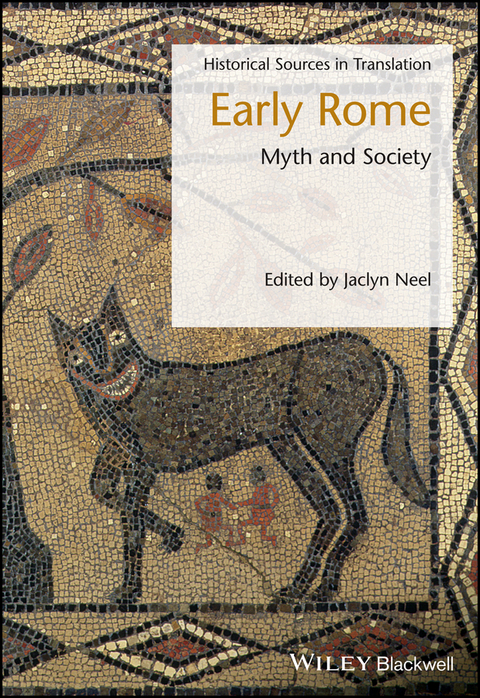
Early Rome (eBook)
John Wiley & Sons (Verlag)
978-1-119-08382-5 (ISBN)
The scholarly community has become increasingly aware of the differences between Roman myths and the more familiar myths of Greece. Early Rome: Myth and Society steps in to provide much-needed modern and accessible translations and commentaries on Italian legends.
This work examines the tales of Roman pre-and legendary history, discusses relevant cultural and contextual information, and presents author biographies. This book offers updated translations of key texts, including authors who are often absent from classical mythology textbooks, such as Dionysius of Halicarnassus and Servius. Editor Jaclyn Neel debunks the idea that Romans were unimaginative copyists by spotlighting the vitality and flexibility of Italian myth - particularly those parts that are less closely connected to Greek tales, such as the story of Caeculus of Praeneste. Finally, by calling attention to the Italian rather than Roman nature of the collection, this book suggests that Roman culture was broader than the city itself. This important work offers:
- Up-to-date and accessible translations of Roman and Italic legends from authors throughout antiquity
- Examination of compelling tales that involve the Roman equivalent of Greek 'heroes'
- Unique view of the strength and plasticity of Roman and Italic myth, particularly the parts less closely connected to familiar Greek tales
- Intelligent discussion of relevant cultural and contextual information
- Argument that Roman culture reached far beyond the city of Rome
Fresh and readable, Early Rome: Myth and Society offers essential reading for students of ancient Rome as well as those interested in Roman and Greek mythology.
Jaclyn Neel, PhD (2012) University of Toronto, is currently a Visiting Assistant Professor at York University. She has published in Classical Quarterly (forthcoming 2015) and Vetus Testamentum (2012). Jackie received her BA in Classics from Columbia University and her PhD in classics and ancient history from the Collaborative Program in Ancient History at the University of Toronto. Her research centers around questions of competition and kingship in Rome, with a specific focus on foundation figures. Her first book analyzed themes of competition in the myths of Rome, and her second will translate key texts on Roman mythology. In the next few years, she will focus more closely on Cicero. She also runs blog on resources for the study of antiquity.
Jaclyn Neel, PhD (2012) University of Toronto, is currently a Visiting Assistant Professor at York University. She has published in Classical Quarterly (forthcoming 2015) and Vetus Testamentum (2012). Jackie received her BA in Classics from Columbia University and her PhD in classics and ancient history from the Collaborative Program in Ancient History at the University of Toronto. Her research centers around questions of competition and kingship in Rome, with a specific focus on foundation figures. Her first book analyzed themes of competition in the myths of Rome, and her second will translate key texts on Roman mythology. In the next few years, she will focus more closely on Cicero. She also runs blog on resources for the study of antiquity.
Preface xi
Abbreviations & Symbols xv
1 Introducing Early Rome 1
Introduction 1
1.1 What Is a "Myth"? 2
1.2 Types of Stories You Will Read in this Book 4
1.3 Literary Genres in this Book 7
1.4 Theoretical Approaches to Roman Myth 10
1.5 Chronology of Early Rome 11
Conclusion 14
Notes 14
References 14
Further Reading 15
2 Rome Before the City 17
Introduction 17
For Further Thought 20
2.1 The Earliest Italians 20
2.2 Inhabitants of the Site of Rome 26
2.3 Aeneas in Italy 32
2.4 Aeneas' Arrival in Latium 34
2.5 War in Italy 37
2.6 The Death of Aeneas and "Pater Indiges" 43
2.7 Ascanius, Silvius, and Lavinia: the Alban Dynasty 45
Conclusion 49
Notes 50
References 53
Further Reading 53
3 Founding Rome 55
Introduction 55
For Further Thought 58
3.1 Conception, Birth, and Exposure 58
3.2 Youth of Romulus and Remus 65
3.3 Rome's Foundation 69
3.4 The Death of Remus 74
3.5 Wars with the Sabines 78
3.6 Death of Titus Tatius 86
3.7 Death and Apotheosis of Romulus 88
Conclusion 91
Notes 92
References 95
Further Reading 95
4 Images and Text 97
Introduction 97
For Further Thought 99
4.1 Mlacuch 99
4.2 Hercules and Juno 101
4.3 Suckling Wolf 104
4.4 Prophets 108
4.5 Wolfman 111
4.6 The Vibenna Brothers 113
4.7 Vulca of Veii 119
Conclusion 121
Notes 122
References 122
Further Reading 123
5 Rome's Kings 125
Introduction 125
For Further Thought 128
5.1 The Interregnum (717-716) 129
5.2 Numa (716-674) 130
5.3 Tullus Hostilius (673-642) 138
5.4 Tarquinius Priscus (616-578) 145
5.5 Servius Tullius (578-535) 155
5.6 Tarquin the Proud (534-509) 162
Conclusion 173
Notes 174
References 177
Further Reading 177
6 Italy Outside Rome 179
Introduction 179
For Further Thought 181
6.1 Greek Founders in Italy 181
6.2 Hercules 185
6.3 Diomedes in Italy 187
6.4 Myths of Locri 190
6.5 The "Sacred Spring" 194
6.6 Caeculus of Praeneste 196
6.7 Pomona and Vertumnus 197
Conclusion 199
Notes 200
References 201
Further Reading 201
7 Rome's Women 203
Introduction 203
For Further Thought 205
7.1 The Bona Dea 206
7.2 Women of the Aeneid 209
7.3 Acca Larentia 213
7.4 Tarpeia 215
7.5 Horatia 219
7.6 Lucretia 220
7.7 Cloelia 226
7.8 Verginia 228
7.9 Slave-women and the Nonae Caprotinae 230
Conclusion 231
Notes 232
References 234
Further Reading 234
8 Rome's Heroes 237
Introduction 237
For Further Thought 240
8.1 Brutus 240
8.2 Publicola 244
8.3 The War with Porsenna 246
8.4. Porsenna Captures Rome? 249
8.5 The Battle at Lake Regillus 250
8.6 Stories of Self-sacrifice for Rome 252
8.7 The 306 Fabii 254
8.8 The Conflict of the Orders 257
8.9 Camillus and Veii 262
8.10 The Gallic Sack 265
Conclusion 273
Notes 274
References 276
Further Reading 276
9 Conclusion 279
References 281
Appendix 1 Author Biographies 283
Appendix 2 Greek Mythical Characters 291
Appendix 3 Greek and Roman Gods 297
Index 299
1
Introducing Early Rome
Introduction
In 44 BCE, graffiti appeared on the statue of Lucius Junius Brutus, the founder of the Roman Republic. It explicitly called on him for help against Julius Caesar, Rome's leader at the time, who had taken to wearing traditional royal symbols. This Brutus had received the nickname “The Liberator” for driving out Rome's kings (7.6, 8.1); by requesting his aid, the writer suggested that Caesar was a king too, and had to be eliminated.
Some men scrawled ‘If only you were alive!’ on the statue of Lucius Brutus. Similarly, on Caesar's own statue they wrote a ditty: ‘Brutus kicked out the kings and became the first consul; Caesar kicked out the consuls and then was made king.’ (Suetonius, Life of Julius Caesar 80)
Caesar's biographer Suetonius linked the graffiti to Caesar's assassination. If you know the quote et tu, Brute, you might too: Brutus' descendant Marcus Brutus, a friend of Caesar's, was one of the leaders of the conspiracy. By reminding fellow citizens of a past heroic act, the anonymous writer made a statement that was politically, socially, and culturally relevant to his own day. Nor was such historical modeling limited to periods of political strife.
Myths and legends held long-term significance in many aspects of Roman society. In fact, stories about the city's past formed a backbone of shared cultural knowledge. These tales taught men and women, natives and foreigners how to behave, what qualities were valuable, and how to make sense of the world and their community. In addition to teaching Romans about their past, these stories also gave advice about the future and helped create meaning for the entire Roman community. Modern scholars study Roman myth to learn about the city's culture, customs, history, and literature.
1.1 What Is a “Myth”?
You're probably familiar with the terms “myth” and “legend” from books, movies, or previous courses. Sometimes these words are used interchangeably, but often they refer to different types of traditional stories. These differences are sometimes defined by a spectrum of truth value (Calame 2003, 9–11). For example, a “myth” can be defined as a tale that explains the origin of natural features, such the formation of mountains or cities; it does not need to have a basis in scientific fact, but is rather a divine explanation for a visible phenomenon. In contrast, a “legend” is usually based on a factual event and has been exaggerated. The elaboration of these tales may include fantastic elements such as the use of magic or the possession of special powers by the hero or his companions – but the legend still must have a “kernel of truth.” A “folktale,” in contrast, may or may not have a basis in fact; it more often has a basis in social standing. Myth and legends tend to retell stories of extraordinary people, often of high status; folktales focus on the lives and deeds of ordinary people.
In studying the classical world, “myth” is usually applied to traditional Greek stories about gods and heroes. Similar stories from other parts of the ancient world are called “legends.” This distinction and definition are increasingly seen as problematic for a number of reasons. For one thing, we know about many Greek myths thanks to the works of Roman authors like Ovid. So “Greek” is not an exclusive category; in many ways, “Greco-Roman myth” is a better term.
But this term leads to a second problem: how do you pinpoint what is “Greek” or “Roman” about a given narrative? We do not have much information about Roman society before it had contact with Greece. Yet there are clearly traditional tales from Rome that do not appear in any surviving classical Greek evidence. Is this the best way to define “Roman” myth?
Another problem is that many Roman traditional tales do not involve gods or semi-divine humans, but rather ordinary people who do extraordinary things. This led early researchers to conclude that Romans did not have myths of their own. Instead of the anthropomorphic gods associated with Greek myth, these researchers found that early Romans believed in numina (divine powers). Because these powers did not necessarily have faces and names, like “Athena” or “Ares” in Greece, there was no need to develop stories about them. Later, Romans learned about Greek myths; they were captivated by the Greeks' creativity and adopted their gods and traditional tales as their own. As a result, Roman myths are simply copies of Greek mythology. This theory of Rome's “mythless society” was popular for many decades, and is now thought to be wrong.
Instead, scholars now realize that Roman traditional tales are quite different from Greek traditional tales. As Mary Beard (1993, 48) has written, “the observation (or complaint) that Rome has no myth is probably no more than an observation that it does not have Greek myth.” In other words, “myth” has been defined in such a way that only a limited number of story patterns will match it. Greece offers the gold standard for such tales; other societies, including Rome, inevitably fall short. In order to study Roman myths, we must first understand that not all myths match the Greek model of gods with human qualities who fall in love, misbehave, cause trouble, rescue men, or otherwise interfere in human affairs.
Together with this redefinition of Roman myth, classicists are coming to realize that even Greek myth is not unitary. Not only did Greeks recognize many variations of their “standard” tales, but they also retold narratives that we do not recognize as mythic in structure. As Claude Calame (2003) has argued, the Greeks did not recognize “myth” as a category distinct from “legend,” “folktale,” or “fiction.” These modern distinctions have been wrongly applied to the ancient material, confusing our understanding of how ancient narratives worked in context.
Some scholars have argued that Rome has a special type of mythology, which can be called “historical myth” (e.g., Fox 1996). They prefer this term to “legend,” which (as we saw above) implies that the tale contains a certain amount of truth. “Historical myth,” in contrast, shares the dubious reality of myth; it is true to the culture, but need not be true outside of that culture. Unlike the traditional category of “myth,” which tells stories from a timeless past, the tales of “historical myth” take place in a concrete and historically defined period. For those studying ancient Rome, that period is called “early Rome” (see 1.5). Roman myths take place in specific locations (in and around the city) and in specific eras. Although the dividing line between “myth” and “history” is intensely debated by modern scholars, many would agree that stories about the gods or their children are mythical, while stories that had contemporary documentary support are historical.
But there is substantial disagreement about what records were available to ancient authors. We aren't sure what records were kept before approximately 300 BCE; we also don't know how much Romans cared about preserving strict historical accuracy versus imagining the past. The debate about how to deal with the “memory” of the past through oral and visual means is ongoing in ancient history, as well as other fields. This book takes a broad view of “myth.” It includes stories about larger-than-life heroes, some of whom may have existed historically. They are “mythical” because their actions are unrealistically exaggerated. By including characters who would typically be considered “legendary,” this book suggests that the exact distinction between “myth” and “legend” may not be helpful for understanding Roman society. Rather, the myths that were told about early Rome can help us understand how Romans thought about their history. Myths tell us which stories were worth retelling; what degree of variance between different versions was acceptable; how authors decided that an event was believable (or not); and how authors expected or wanted their audiences to interpret the story's outcome.
An example of how one well-educated Roman understood the city's traditional tales can be found in Cicero, On the Laws 1.5. Discussing the material that's appropriate for history and poetry, Cicero distinguishes two types of tale: the fabula (more fictional) and the historia (more truthful). The criteria for determining what makes a fabula fictional are vague, suggesting that questions of veracity were left to individual discretion, at least to a certain degree. In reading narratives in this book, you'll come across the judgments of authors themselves. Livy, Dionysius of Halicarnassus, and Plutarch are particularly prone to reflect on the likelihood of various alternative narratives, and their judgments offer modern historians the best evidence for what was credible (or not) in antiquity. But be careful: these authors often disagree, leaving modern historians unsure about how their...
| Erscheint lt. Verlag | 3.4.2017 |
|---|---|
| Reihe/Serie | Blackwell Sourcebooks in Ancient History |
| Blackwell Sourcebooks in Ancient History | Blackwell Sourcebooks in Ancient History |
| Sprache | englisch |
| Themenwelt | Geschichte ► Allgemeine Geschichte ► Altertum / Antike |
| Geisteswissenschaften ► Geschichte ► Regional- / Ländergeschichte | |
| Geschichte ► Teilgebiete der Geschichte ► Kulturgeschichte | |
| Sozialwissenschaften ► Soziologie | |
| Schlagworte | Ancient & Classical History • ancient world map • Caeculus of Praeneste • Cicero’s The Republic • Classical Mythology • Classical Studies • Diodorus Siculus • Dionysius of Halicarnassus • Early Rome: Myth and Society • Ennius • etruscans • exemplary history • founding of rome • Geschichte • Geschichte des Altertums u. der klassischen Antike • Greek and Roman gods • Greek mythical characters • History • Humanistische Studien • Italian legends • Jaclyn Neel • Klassische Mythologie • Life of Romulus • livy • <p>Myths of Rome • Magna Graecia</p> • map of mythical locations • Myth and Roman culture • Myth and Roman customs • Myth and Roman history • Myth and Roman literature • Mythologie • NUMA • Plutarch • Rom /Alte Geschichte • Roman History • Roman mythical heroes • Roman myths and cultural • roman republic • Rome before city • Rome’s Kings • Römische Geschichte • scholarship of Roman myths • Suetonius • tales of Roman history • translations of Roman myths |
| ISBN-10 | 1-119-08382-6 / 1119083826 |
| ISBN-13 | 978-1-119-08382-5 / 9781119083825 |
| Informationen gemäß Produktsicherheitsverordnung (GPSR) | |
| Haben Sie eine Frage zum Produkt? |
 EPUB (Adobe DRM)
Kopierschutz: Adobe-DRM
Adobe-DRM ist ein Kopierschutz, der das eBook vor Mißbrauch schützen soll. Dabei wird das eBook bereits beim Download auf Ihre persönliche Adobe-ID autorisiert. Lesen können Sie das eBook dann nur auf den Geräten, welche ebenfalls auf Ihre Adobe-ID registriert sind.
Details zum Adobe-DRM
Dateiformat: EPUB (Electronic Publication)
EPUB ist ein offener Standard für eBooks und eignet sich besonders zur Darstellung von Belletristik und Sachbüchern. Der Fließtext wird dynamisch an die Display- und Schriftgröße angepasst. Auch für mobile Lesegeräte ist EPUB daher gut geeignet.
Systemvoraussetzungen:
PC/Mac: Mit einem PC oder Mac können Sie dieses eBook lesen. Sie benötigen eine
eReader: Dieses eBook kann mit (fast) allen eBook-Readern gelesen werden. Mit dem amazon-Kindle ist es aber nicht kompatibel.
Smartphone/Tablet: Egal ob Apple oder Android, dieses eBook können Sie lesen. Sie benötigen eine
Geräteliste und zusätzliche Hinweise
Buying eBooks from abroad
For tax law reasons we can sell eBooks just within Germany and Switzerland. Regrettably we cannot fulfill eBook-orders from other countries.
aus dem Bereich