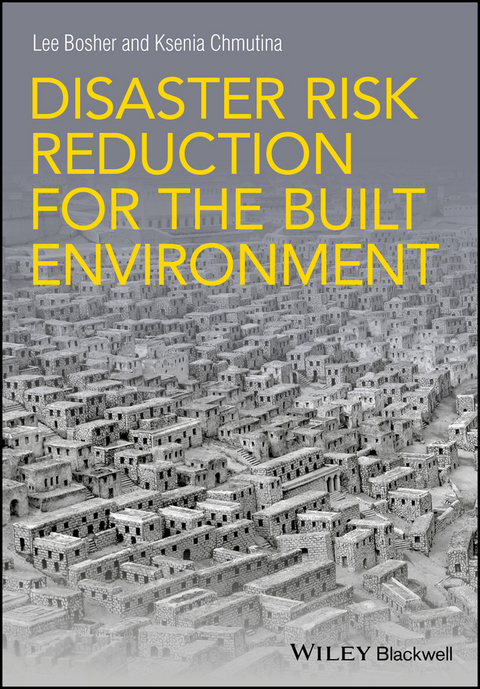
Disaster Risk Reduction for the Built Environment (eBook)
John Wiley & Sons (Verlag)
978-1-118-92150-0 (ISBN)
Disaster Risk Reduction for the Built Environment provides a multi-facetted introduction to how a wide range of risk reduction options can be mainstreamed into formal and informal construction decision making processes, so that Disaster Risk Reduction (DRR) can become part of the 'developmental DNA'. The contents highlight the positive roles that practitioners such as civil and structural engineers, urban planners and designers, and architects (to name just a few) can undertake to ensure that disaster risk is addressed when (re)developing the built environment. The book does not set out prescriptive ('context blind') solutions to complex problems because such solutions can invariably generate new problems. Instead it raises awareness, and in doing so, inspires a broad range of people to consider DRR in their work or everyday practices.
This highly-illustrated text book provides a broad range of examples, case studies and thinking points that can help the reader to consider how DRR approaches might be adapted for differing contexts.
About the Authors
Dr Lee Bosher is a Senior Lecturer in Disaster Risk Reduction in the Water, Engineering and Development Centre (WEDC) at Loughborough University, England. He has a background in disaster risk management and his research and teaching includes disaster risk reduction and the multidisciplinary integration of proactive hazard mitigation strategies into the decision-making processes of key stakeholders, involved with the planning, design, construction and operation of the built environment. Lee is coordinator of the International Council for Building's Working Commission W120 on 'Disasters and the Built Environment', a Fellow of the Royal Geographical Society and he has been involved in research projects that investigated how urban resilience can be increased in the UK, Haiti, India, Nigeria and across parts of Europe. Lee's previous books include 'Hazards and the Built Environment' (2008) and 'Social and Institutional Elements of Disaster Vulnerability' (2007).
Dr Ksenia Chmutina is a Lecturer in sustainable and resilient urbanism in the School of Civil and Building Engineering, Loughborough University. Her main research interest is in synergies of resilience and sustainability in the built environment, including holistic approaches to enhancing resilience to natural hazards and human-induced threats, and a better understanding of the systemic implications of sustainability and resilience under the pressures of urbanisation and climate change. She has extensive experience of working on RCUK and EU-funded projects that have focused on resilience and sustainability of urban spaces in Europe, China and the Caribbean.
Disaster Risk Reduction for the Built Environment provides a multi-facetted introduction to how a wide range of risk reduction options can be mainstreamed into formal and informal construction decision making processes, so that Disaster Risk Reduction (DRR) can become part of the developmental DNA . The contents highlight the positive roles that practitioners such as civil and structural engineers, urban planners and designers, and architects (to name just a few) can undertake to ensure that disaster risk is addressed when (re)developing the built environment. The book does not set out prescriptive ( context blind ) solutions to complex problems because such solutions can invariably generate new problems. Instead it raises awareness, and in doing so, inspires a broad range of people to consider DRR in their work or everyday practices. This highly-illustrated text book provides a broad range of examples, case studies and thinking points that can help the reader to consider how DRR approaches might be adapted for differing contexts.
About the Authors Dr Lee Bosher is a Senior Lecturer in Disaster Risk Reduction in the Water, Engineering and Development Centre (WEDC) at Loughborough University, England. He has a background in disaster risk management and his research and teaching includes disaster risk reduction and the multidisciplinary integration of proactive hazard mitigation strategies into the decision-making processes of key stakeholders, involved with the planning, design, construction and operation of the built environment. Lee is coordinator of the International Council for Building's Working Commission W120 on 'Disasters and the Built Environment', a Fellow of the Royal Geographical Society and he has been involved in research projects that investigated how urban resilience can be increased in the UK, Haiti, India, Nigeria and across parts of Europe. Lee's previous books include 'Hazards and the Built Environment' (2008) and 'Social and Institutional Elements of Disaster Vulnerability' (2007). Dr Ksenia Chmutina is a Lecturer in sustainable and resilient urbanism in the School of Civil and Building Engineering, Loughborough University. Her main research interest is in synergies of resilience and sustainability in the built environment, including holistic approaches to enhancing resilience to natural hazards and human-induced threats, and a better understanding of the systemic implications of sustainability and resilience under the pressures of urbanisation and climate change. She has extensive experience of working on RCUK and EU-funded projects that have focused on resilience and sustainability of urban spaces in Europe, China and the Caribbean.
Cover 1
Title Page 5
Copyright 6
Contents 7
List of Figures 13
List of Tables 21
Note on the Authors 23
Foreword 25
Acknowledgements 27
List of Acronyms 29
List of Case Studies 33
List of Thinking Points 35
Section I Introduction to Book and Concepts 37
Chapter 1 Introduction 39
1.1 So what is a Disaster? 40
1.2 What are the Hazards and Threats? 40
1.3 Climate Change and Disasters 41
1.4 Impacts of Disasters Globally 45
1.5 Trends in the Occurrence of Disasters 47
1.6 Economic Losses 49
1.7 The Potential Roles of the Construction Sector in DRR 52
1.8 Scope of the Book 52
1.9 Structure of the Book 53
References and Suggested Reading 53
Chapter 2 Disaster Risk Reduction 57
2.1 Learning Objectives 57
2.2 Key DRR Concepts and Terms 57
2.3 International Approaches to DRR 62
2.4 Community Resilience 68
2.5 Risk Management 70
2.6 Summary 79
Further Reading 79
Section II Hydro-Meteorological Hazards 81
Chapter 3 Flooding 83
3.1 Learning Objectives 83
3.2 Living with Water 83
3.3 Overview of the Typical Impacts of Floods 85
3.4 Causes of Flooding 86
3.5 Riverine Floods 87
3.6 Coastal Floods 88
3.7 Flash Floods 91
3.8 Urban (Pluvial) Floods 92
3.9 Risk Management 92
3.10 Hazard Identification 95
3.11 Assessment of the Vulnerabilities 97
3.12 Determination of the Risk 99
3.13 Identification and Prioritisation of Risk Reduction Options 102
3.14 Summary 121
Further Reading 122
Chapter 4 Windstorms 125
4.1 Learning Objectives 126
4.2 Living with Windstorms 126
4.3 Overview of the Typical Impacts of Windstorms 127
4.4 Causes of Windstorms 128
4.5 Tropical Windstorms 129
4.6 Tornadoes 134
4.7 Risk Management 137
4.8 Hazard Identification 140
4.9 Assessment of the Vulnerabilities 142
4.10 Determination of the Risk 147
4.11 Identification and Prioritisation of Risk Reduction Options 148
4.12 Summary 152
Further Reading 156
Section III Geological Hazards 159
Chapter 5 Earthquakes 161
5.1 Living with Earthquakes 162
5.2 Causes of Earthquakes 163
5.3 Seismic Activity 169
5.4 Risk Management 171
5.5 Hazard Identification 171
5.6 Assessment of the Vulnerabilities 172
5.7 Determination of the Risk 178
5.8 Identification and Prioritisation of Risk Reduction Options 180
5.9 Summary 188
Further Reading 190
Chapter 6 Volcanoes 191
6.1 Learning Objectives 191
6.2 Living with Volcanoes 191
6.3 Overview of the Typical Impacts of Volcanoes 193
6.4 Causes of Volcanoes 195
6.5 Volcanic Activity 197
6.6 Risk Management 205
6.7 Risk Management 208
6.8 Identification and Prioritisation of Risk Reduction Options 211
6.9 Summary 218
Further Reading 219
Chapter 7 Landslides 221
7.1 Learning Objectives 221
7.2 What are Landslides? 221
7.3 Statistics on Landslides 223
7.4 Causes and Impacts of Landslides 225
7.5 Risk Management 229
7.6 Summary 237
Further Reading 240
Section IV Key Considerations and Ways Forward 243
Chapter 8 Key Principles 245
8.1 Learning Objectives 245
8.2 Integrating DRR Measures into Construction Practice 245
8.3 Seven Key Principles 252
8.4 Summary 266
Further Reading 267
Chapter 9 DRR and Sustainability: An Integrated Approach 269
9.1 Learning Objectives 269
9.2 Integrating Resilience and Sustainability: Why is it Important? 269
9.3 What is Sustainability? 272
9.4 Can the Built Environment Be Sustainable and Resilient? 277
9.5 Summary 283
Further Reading 286
Chapter 10 Conclusions and Recommendations 287
10.1 Dynamic Factors (and Root Causes) 288
10.2 Moving away from Disaster Risk Creation 288
10.3 Moving towards a New Developmental DNA 293
10.4 Future Research and Educational Challenges 294
10.5 Final Thoughts for Construction Practitioners 294
Further Reading 297
Index 299
EULA 0
| Erscheint lt. Verlag | 3.4.2017 |
|---|---|
| Sprache | englisch |
| Themenwelt | Sozialwissenschaften ► Soziologie |
| Technik ► Bauwesen | |
| Schlagworte | Architects • Baubetrieb • Bauingenieur- u. Bauwesen • Building Codes • Building Design • building management • building operation • Building planning • Business & Management • Civil Engineering & Construction • Civil Engineers • climate change • construction decision making • construction decisions • Construction Management • construction managers • Cyclones • Designers • Developers • disaster risk reduction • Disaster Risks • DRR • earthquakes • environmental concerns • Geological Hazards • Human-induced Threats • hydro-meteorological hazards • Infrastructure Planning • multi-hazard adaptation issues • national development strategies • Natural Hazards • non-structural adaptions for risk reduction • non-structural elements of multi-hazard/threat adaptation • planners • reduce disaster impact • reduce disaster threat • regulatory controls • Risikomanagement • Risiko-, Notfall- u. Krisenmanagement • Risk, Contingency & Crisis Management • Risk reduction • structural adaptations for risk reduction • structural engineers • terrorism • threat adaptation issues • Tsunamis • unregulated urban planning • Urban Design • urban planning • Wirtschaft u. Management |
| ISBN-10 | 1-118-92150-X / 111892150X |
| ISBN-13 | 978-1-118-92150-0 / 9781118921500 |
| Informationen gemäß Produktsicherheitsverordnung (GPSR) | |
| Haben Sie eine Frage zum Produkt? |
 PDF (Adobe DRM)
Kopierschutz: Adobe-DRM
Adobe-DRM ist ein Kopierschutz, der das eBook vor Mißbrauch schützen soll. Dabei wird das eBook bereits beim Download auf Ihre persönliche Adobe-ID autorisiert. Lesen können Sie das eBook dann nur auf den Geräten, welche ebenfalls auf Ihre Adobe-ID registriert sind.
Details zum Adobe-DRM
Dateiformat: PDF (Portable Document Format)
Mit einem festen Seitenlayout eignet sich die PDF besonders für Fachbücher mit Spalten, Tabellen und Abbildungen. Eine PDF kann auf fast allen Geräten angezeigt werden, ist aber für kleine Displays (Smartphone, eReader) nur eingeschränkt geeignet.
Systemvoraussetzungen:
PC/Mac: Mit einem PC oder Mac können Sie dieses eBook lesen. Sie benötigen eine
eReader: Dieses eBook kann mit (fast) allen eBook-Readern gelesen werden. Mit dem amazon-Kindle ist es aber nicht kompatibel.
Smartphone/Tablet: Egal ob Apple oder Android, dieses eBook können Sie lesen. Sie benötigen eine
Geräteliste und zusätzliche Hinweise
Buying eBooks from abroad
For tax law reasons we can sell eBooks just within Germany and Switzerland. Regrettably we cannot fulfill eBook-orders from other countries.
aus dem Bereich