Communications Writing and Design (eBook)
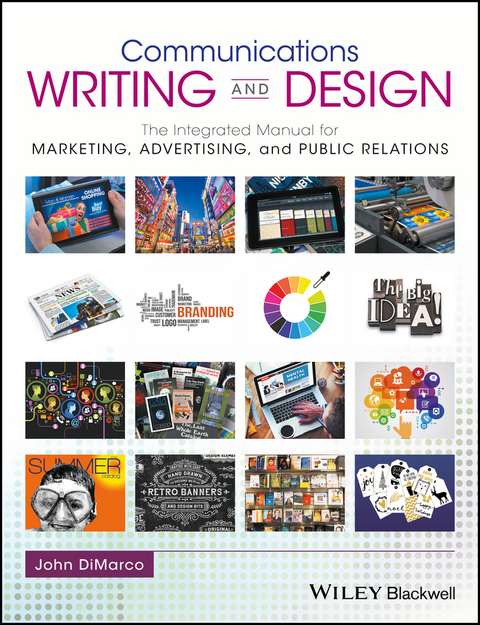
Communications Writing and Design is an integrated, project-based introduction to effective writing and design across the persuasive domains of communication.
- Build a strong foundation of core writing and design skills using professionally-designed examples that illustrate and reinforce key principles
- Readers learn and analyze techniques by creating 15 projects in marketing, advertising, PR, and social media with the help of strategy suggestions, practical tips, and professional production techniques
- Written by an experienced professional and teacher, with a focus on the cross-disciplinary nature of contemporary communication work
- Learning is reinforced through a variety of pedagogical features: learning objectives, helpful mnemonics, real-life projects and applications, chapter references for further study, and end-of-chapter summaries and exercises
John DiMarco, Ph.D, is Associate Professor of Communications at St. John's University in New York, USA, as well as creator and founder of PortfolioVillage.com. For over 20 years, he has provided technical writing, public relations, marketing, graphic design, instructional design, and training in his own firms, DiMarco Associates and PortfolioVillage, Inc.,and for organizations including Long Island University and CANON, USA. His research interests include digital media, design thinking, persuasion, and creativity. He has published numerous articles and chapters, as well as the books: Career Power Skills (2013), Digital Design for Print and Web (Wiley, 2010), Web Portfolio Design and Applications (2006), and Computer Graphics and Multimedia (2006).
Communications Writing and Design is an integrated, project-based introduction to effective writing and design across the persuasive domains of communication. Build a strong foundation of core writing and design skills using professionally-designed examples that illustrate and reinforce key principles Readers learn and analyze techniques by creating 15 projects in marketing, advertising, PR, and social media with the help of strategy suggestions, practical tips, and professional production techniques Written by an experienced professional and teacher, with a focus on the cross-disciplinary nature of contemporary communication work Learning is reinforced through a variety of pedagogical features: learning objectives, helpful mnemonics, real-life projects and applications, chapter references for further study, and end-of-chapter summaries and exercises A companion website with multimedia slides, exam questions, learning videos, and design guides provides additional learning tools for students and instructors
John DiMarco, Ph.D, is Associate Professor of Communications at St. John's University in New York, USA, as well as creator and founder of PortfolioVillage.com. For over 20 years, he has provided technical writing, public relations, marketing, graphic design, instructional design, and training in his own firms, DiMarco Associates and PortfolioVillage, Inc.,and for organizations including Long Island University and CANON, USA. His research interests include digital media, design thinking, persuasion, and creativity. He has published numerous articles and chapters, as well as the books: Career Power Skills (2013), Digital Design for Print and Web (Wiley, 2010), Web Portfolio Design and Applications (2006), and Computer Graphics and Multimedia (2006).
Acknowledgements vii
Foreword ix
Preface xi
1 The Connectivity between Research, Writing, and Design 1
2 Writing Technical, Persuasive, and News Communication 9
3 Communication Design 45
4 Creative Research Methods 83
5 Design Tools 103
6 Marketing Projects 123
7 Advertising Projects 145
8 Public Relations Projects 163
9 Social Media for Marketing, Advertising, and Public Relations 191
Index 199
1
The Connectivity between Research, Writing, and Design
By limiting and filtering the visible, structure enables it to be transcribed into language.
Michel Foucault 1994
Chapter objectives
After completing this chapter, you should be able to:
- understand differences and connections between a text, a document, and a work.
- analyze how research and writing unites with design.
- evaluate signs to determine their value on communication.
- create a semiotic sign system to communicate an idea.
1.1 The anatomy of a text, a document, and a work
Let us begin by establishing a simple view of how research, writing, and design collide in creating communication for mass audiences by relating the collective analytical thoughts of sociologists, linguists, writers, designers, information scientists, and philosophers.
French researcher, sociologist, and author Roland Barthes (Barthes and Miller 1975, 64) called text “tissue”, which he explains as “a product, a ready-made veil, behind which lies, more or less hidden meaning (truth)” and he purports that “text is made, is worked out in a perpetual interweaving”. The perpetual interweaving of text in modern mass communication represents the endless, interdependent relationship between research, writing, and design. In the information science world, three main items represent the things we research, write and design; they are a text, a document, and “a work”. The text is the sets of words that create writing. The document is the physical container where the text is recorded, and “a work” is the set of ideas embedded “into a document using text with the intention of being communicated to a receiver” (Smiraglia 2001, 3–4). In advertising, for example, we see this in writing lines of copy (text), that then go into individual advertisements (document), which then go into a campaign (a work). In book publishing, the lines of words become the text, while the text becomes the documents in the form of chapters and sidebars, and the chapters, front matter and indexes become the work in the form of a completed book that communicates a set of ideas.
Figure 1.1 From Complex to simple. Text, document, and work are the result of research, writing, and design. Illustration by John DiMarco.
1.2 Research
Research offers methods to perform inquiry and observation that yield questions, data, and theories. It becomes the starting point for making meaning about something and spawns a desire to define a problem, get ideas, and then ultimately create form (Lupton and Phillips 2011). Research can be formal (structured and systematic) or informal (loose and divergent) and scholarly, building knowledge for knowledge's sake, or corporate, building knowledge for commerce's sake. Regardless of the type of research we use, once we can make meaning and build data, then we can begin to represent our ideas in written form. Research offers more than just data gathering on a formal level. It ignites inspiration of new concepts or magnifies clarification of what we think we know, especially when ideas swirl around inside our heads. In communication design, research generates data (text) and data becomes food for generating content (document), thus designed into a final communication product (a work) for advertising, marketing, and public relations.
Figure 1.2 Data drives campaigns. The “Truth” campaign uses hard data in the form of statistics to persuade young adults to stop smoking. The website and ads encourage millennials to be the generation that disavows smoking by showing a statistical trend leaning to success and feasibility, thus empowering them as group to be seen as making a historical contribution to society. www.truth.com.
Data in action
Data generated by research and can be qualitative, which means that it is narrow, patterned, thematic, and represented by words or images. Alternatively, data can be quantitative, which is broad, statistical, generalized, and represented by numbers. Data is critical in public relations, advertising, and marketing as it drives business decisions and vital to creating targeted, persuasive content and messages. In these disciplines, the secondary research, survey methods, interviews, and the focus group become sources of hard data, which require numbers (quantitative), and patterned themes (qualitative) interpreted into meaning for communications. One example is the anti-smoking ads put out in the “TRUTH” campaign, which hammers the quantitative notion that only 7% of young adults smoke, and that this generation could be the one that can ensure that tobacco smoking disappears among that group.
1.3 Writing
When we write, whether it is an essay or advertisement copy, we are designing within a system. Writing uses either an ideographic system or a phonetic system (de Saussure et al. 2005). The ideographic writing system uses symbols. An example of this type of system is Chinese. The phonetic writing system is based on sounds, which occur in words built from letters in an alphabet that represent those sounds, such as with English. Both systems richly communicate ideas, generate stories, and persuade people.
The two writing systems differ in their basis. Ideographic systems such as Chinese rely sole on marks, whereas the phonetic system utilizes sounds.
Linguistic value
Graphic design authors Lupton and Miller (2008, 53) highlight Structuralism scholar Ferdinand de Saussure's principle of linguistic value as “the identity of a sign rests not in the sign itself, but on its relation to other signs in the system.” They cite the example of the sound cow. Saussure recognized that there is no link between sound and concepts, meaning that the signifier (the sound) does not adhere to the signified (the mental concept). The sign alone is empty; there is no natural meaning when we say cow in relationship to the image of a cow. Saussure distinguishes when we say the word cow, the sound only becomes recognizable within a system of the same words, like now, bow, chow, and so on. Alternatively, the concept becomes recognizable as opposition to other concepts within a system. Cow has meaning when it is opposite horse, chicken, and moose. The clear summary of this is when Saussure states (p. 118) “In the language itself, there are only differences,” which leads us to see writing, typography, and design with the connected ideas of research as structural components in yielding meaning.
Figure 1.3 Writing systems and symbols. Screenshot from Google Translate.
Figure 1.4 Linguistic value moves across image, text, and sound.
Understanding the concept of linguistic value provides an important takeaway for creative professionals. Lupton and Miller ’s essay on the modernist view of letters touts typography “as the endless manipulation of abstract elements.” So now, we know that characters have no meaning unless seen within the relationship to other characters across the alphabet, and words are abstract, gaining linguistic value when they are the system of the sentence. Using this same path of reason, when we write or design, we are assembling text and/or images to create linguistic value in the form of oppositions on a page or screen. These oppositions create meaningful content.
1.4 Design
Graphic communication and design thinking provide visual and applied methods to solving problems across education, persuasion, entertainment, and information domains (DiMarco 2010). In marketing, advertising, and public relations, the persuasion industries, we design “works,” which are initiated by “projects” on the job, in order to solve problems that contribute to things like sales figures, reputation, employees, customers, vendors, the government, charities, social causes, and other issues that need a voice. The relationship between type and image has ancient roots, but truly came to develop, as the natural world was classified and recorded in the late seventeenth century.
Form as meaning
Medieval manuscripts present rich detail and vivid connections between writing and design, showing great innovation between artists and designers in combining letters with images (Meggs 1989). In addition, the connection between research, writing, and design has a strong foundation in the classification of natural history. We see this described by Foucault (1994) as he explained the extension of the object in recording of nature. The recording of natural things systematically, was put forth as a way to move into the classical age, beyond the late 1600s in which descriptions were expressed in words by experiences, rather than by “undertaking meticulous examination of things and then of transcribing what it has gathered in smooth, neutralized, faithful words” (Foucault 1994, 131). The new approach was considering the proper object, image elements, and order, with consideration to the meaning it conveys in a language. Meaning can be affected by four variables: “the form of the elements, the quantity of the elements, the way they are...
| Erscheint lt. Verlag | 21.3.2017 |
|---|---|
| Sprache | englisch |
| Themenwelt | Naturwissenschaften |
| Sozialwissenschaften ► Kommunikation / Medien ► Kommunikationswissenschaft | |
| Sozialwissenschaften ► Politik / Verwaltung | |
| Sozialwissenschaften ► Soziologie | |
| Technik | |
| Wirtschaft ► Betriebswirtschaft / Management | |
| Schlagworte | Advertising Design • Business & Management • Communication & Media Studies • Integrated Marketing Communications • Kommunikation u. Medienforschung • Mass communication • Massenkommunikation • Öffentlichkeitsarbeit • Öffentlichkeitsarbeit u. Werbung • persuasive writing • PR • Public Relations & Advertising • social media writing • Strategic Marketing • Strategisches Marketing • Visual Design • Wirtschaft u. Management |
| ISBN-13 | 9781119118923 / 9781119118923 |
| Informationen gemäß Produktsicherheitsverordnung (GPSR) | |
| Haben Sie eine Frage zum Produkt? |
 EPUB (Adobe DRM)
Kopierschutz: Adobe-DRM
Adobe-DRM ist ein Kopierschutz, der das eBook vor Mißbrauch schützen soll. Dabei wird das eBook bereits beim Download auf Ihre persönliche Adobe-ID autorisiert. Lesen können Sie das eBook dann nur auf den Geräten, welche ebenfalls auf Ihre Adobe-ID registriert sind.
Details zum Adobe-DRM
Dateiformat: EPUB (Electronic Publication)
EPUB ist ein offener Standard für eBooks und eignet sich besonders zur Darstellung von Belletristik und Sachbüchern. Der Fließtext wird dynamisch an die Display- und Schriftgröße angepasst. Auch für mobile Lesegeräte ist EPUB daher gut geeignet.
Systemvoraussetzungen:
PC/Mac: Mit einem PC oder Mac können Sie dieses eBook lesen. Sie benötigen eine
eReader: Dieses eBook kann mit (fast) allen eBook-Readern gelesen werden. Mit dem amazon-Kindle ist es aber nicht kompatibel.
Smartphone/Tablet: Egal ob Apple oder Android, dieses eBook können Sie lesen. Sie benötigen eine
Geräteliste und zusätzliche Hinweise
Buying eBooks from abroad
For tax law reasons we can sell eBooks just within Germany and Switzerland. Regrettably we cannot fulfill eBook-orders from other countries.
aus dem Bereich