Communications Writing and Design (eBook)
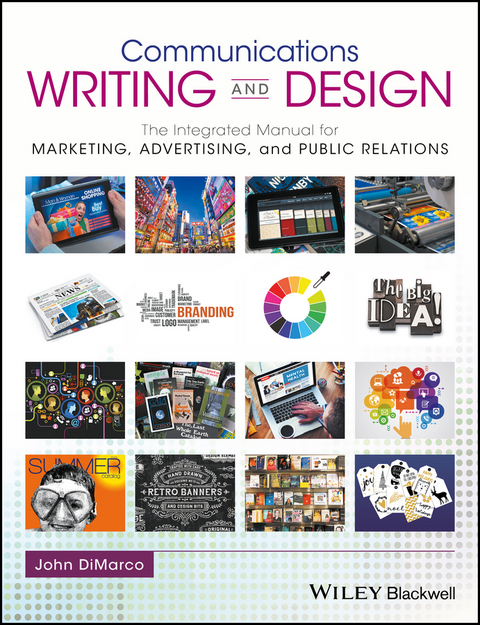
Communications Writing and Design is an integrated, project-based introduction to effective writing and design across the persuasive domains of communication.
- Build a strong foundation of core writing and design skills using professionally-designed examples that illustrate and reinforce key principles
- Readers learn and analyze techniques by creating 15 projects in marketing, advertising, PR, and social media with the help of strategy suggestions, practical tips, and professional production techniques
- Written by an experienced professional and teacher, with a focus on the cross-disciplinary nature of contemporary communication work
- Learning is reinforced through a variety of pedagogical features: learning objectives, helpful mnemonics, real-life projects and applications, chapter references for further study, and end-of-chapter summaries and exercises
John DiMarco, Ph.D, is Associate Professor of Communications at St. John's University in New York, USA, as well as creator and founder of PortfolioVillage.com. For over 20 years, he has provided technical writing, public relations, marketing, graphic design, instructional design, and training in his own firms, DiMarco Associates and PortfolioVillage, Inc.,and for organizations including Long Island University and CANON, USA. His research interests include digital media, design thinking, persuasion, and creativity. He has published numerous articles and chapters, as well as the books: Career Power Skills (2013), Digital Design for Print and Web (Wiley, 2010), Web Portfolio Design and Applications (2006), and Computer Graphics and Multimedia (2006).
Communications Writing and Design is an integrated, project-based introduction to effective writing and design across the persuasive domains of communication. Build a strong foundation of core writing and design skills using professionally-designed examples that illustrate and reinforce key principles Readers learn and analyze techniques by creating 15 projects in marketing, advertising, PR, and social media with the help of strategy suggestions, practical tips, and professional production techniques Written by an experienced professional and teacher, with a focus on the cross-disciplinary nature of contemporary communication work Learning is reinforced through a variety of pedagogical features: learning objectives, helpful mnemonics, real-life projects and applications, chapter references for further study, and end-of-chapter summaries and exercises A companion website with multimedia slides, exam questions, learning videos, and design guides provides additional learning tools for students and instructors
John DiMarco, Ph.D, is Associate Professor of Communications at St. John's University in New York, USA, as well as creator and founder of PortfolioVillage.com. For over 20 years, he has provided technical writing, public relations, marketing, graphic design, instructional design, and training in his own firms, DiMarco Associates and PortfolioVillage, Inc.,and for organizations including Long Island University and CANON, USA. His research interests include digital media, design thinking, persuasion, and creativity. He has published numerous articles and chapters, as well as the books: Career Power Skills (2013), Digital Design for Print and Web (Wiley, 2010), Web Portfolio Design and Applications (2006), and Computer Graphics and Multimedia (2006).
Communications Writing and Design 3
Contents 7
Acknowledgements 9
Foreword 11
Preface 13
Objectives 13
Method 13
1 The Connectivity between Research, Writing, and Design 15
1.1 The anatomy of a text, a document, and a work 15
1.2 Research 16
Data in action 17
1.3 Writing 17
Linguistic value 17
1.4 Design 18
Form as meaning 18
Icon, index, symbol 19
1.5 Summary 20
1.6 Chapter exercises 20
Chapter references 21
2 Writing Technical, Persuasive, and News Communication 23
2.1 Writing for “Marcom ” touchpoints 23
2.2 Effecting persuasion 24
2.3 Getting raw material for writing projects 26
2.4 Marketing communications writing: technical, persuasive, and news 27
2.5 Technical writing 27
Technical communication 27
Key rules in technical writing and technical communication 28
2.6 Persuasive copywriting 31
Writing to sell using FAB and USP 32
Key rules in persuasive copywriting 33
2.7 News writing 35
Identifying and defining news 36
Key rules in news writing 37
2.8 Writing tool belt — essential skills 39
Activation of verbs — voice and tense 39
Outlining and flowcharting 41
Chunking and progressive disclosure 41
“You” viewpoint 41
Expressing data 42
Crafting headlines and subheads 43
Editing and rewriting 44
2.9 Essential grammar rules 45
Usage and style for common punctuation marks 45
Parenthetical punctuation 45
The Comma 46
The Semicolon 48
The em dash 49
Quotation marks 50
Apostrophes 51
2.10 Five common writing mistakes to avoid 53
2.11 Five steps to find writing success 53
2.12 Chapter exercises 54
Technical writing 54
Persuasive copywriting 55
News writing 56
Chapter references 57
3 Communication Design 59
3.1 Communication design solves problems 59
Marketing communications problems 59
Communication design 60
Graphic and advertising design 60
3.2 Design direction 60
3.3 Communication design components 61
3.4 Layout 61
Grids — rule of thirds and the law of thirds 63
BANGPP — a visual layout rubric 63
3.5 Typography 68
Choosing fonts 69
Setting type 69
Two kinds of type: display type and body text 72
Hierarchy and consistency 77
Responsible typography in action 78
3.6 Images 80
Photographs 81
Illustrations 81
Motion graphics and animation 83
3.7 Color 85
Color sensation and attention 85
Understanding color terminology 86
Choosing color using wheel schemes 87
Color palettes and color harmony 92
3.8 Common design mistakes to avoid 93
Incorrect image proportions and resolution 93
Uncaring typography 93
Using color for the sake of color 94
3.9 Chapter exercises 94
Chapter references 95
4 Creative Research Methods 97
4.1 Understand, research, then execute 97
4.2 Design process—seven steps 98
4.3 Briefs: creative, design, and scope 98
Client creative brief 98
GACMIST design brief 99
Project scope document 100
4.4 Design and market research methods 102
Market research 103
Twenty questions to target your audience 104
Brainstorming 105
Concentric circle exercises (CC method) 106
Mind mapping 108
Design ethnography 109
4.5 Creating visual forms on paper 111
Sketching 111
Storyboards 113
Integrated sitemaps 114
4.6 Chapter exercises 115
Chapter references 115
5 Design Tools 117
5.1 Digital design tools for communication designers 117
Page layout and word-processing 118
Presentations and e-learning 118
Digital imaging 120
Digital illustration 122
5.2 Essential image production concepts 124
Opacity 125
Selections, alpha channels, and paths 125
Layers and compositing 126
5.3 Digital color spaces (RGB and CMYK) 128
Digital color rules 128
Pantone swatch books 129
RGB vs. web safe color on screen 130
Spot color vs. process color in print 131
Three important takeaways on color 132
5.4 Resolution, size, and output formats 132
Prepress overview 133
5.5 Chapter exercises 135
Chapter references 136
6 Marketing Projects 137
6.1 Logotype and brandmark 137
Logotype and brandmark — defined 137
Goal of the piece 137
Specifications and size 137
Research and conceptualization 138
Writing style 138
Logotype, brandmark, and signature design format 139
Logotype, brandmark, and signature checklist 139
Creative assignment 141
6.2 Business card, letterhead, envelope — company stationery 142
Company stationery defined 142
Goal of the piece 142
Specifications and size 142
Research and conceptualization 143
Writing style 143
Stationery design format 144
Business card and letterhead checklist 146
Creative assignment 146
6.3 Product packaging 147
Product packaging defined 147
Goal of the piece 147
Specifications and size 147
Research and conceptualization 147
Writing style 148
Packaging design format 148
Package design checklist 148
Creative assignment 150
6.4 Collateral brochures 151
Collateral brochures defined 151
Goal of the piece 151
Specifications and size 151
Research and conceptualization 151
Writing style 152
Collateral design format 153
Brochure design checklist 156
Creative assignment 157
Chapter references 157
7 Advertising Projects 159
7.1 The Ayers No. 1 ad defined 159
Goal of the piece 159
Specifications and size 159
Research and conceptualization 159
Writing style 161
Ayers No. 1 design format 161
Ayers No 1. advertisement checklist 161
Creative assignment 163
7.2 Posters and billboards 164
Posters and billboards defined 164
Goal of the piece 164
Specifications and size 164
Research and conceptualization 164
Writing style 164
Poster and billboard design format 165
Poster and billboard checklist 165
Creative assignment 165
7.3 Ad specialties 167
Advertising specialties defined 167
Goal of the piece 167
Specifications and size 167
Research and conceptualization 168
Writing style 168
Advertising specialty design format 168
Ad specialty checklist 168
Creative assignment 169
7.4 Postcards 170
Postcards defined 170
Goal of the piece 170
Specifications and size 170
Research and conceptualization 171
Writing style 171
Postcard design format 171
Postcard checklist 172
Creative assignment 173
7.5 Banner ads 173
Banner ads defined 173
Goal of the piece 173
Specifications and size 173
Research and conceptualization 174
Writing style 174
Banner ad design format 174
Banner ad checklist 174
Creative assignment 176
Chapter references 176
8 Public Relations Projects 177
8.1 Public relations / News release 177
The news release defined 177
Goal of the piece 177
Specifications and size 178
Research and conceptualization 178
Writing style 178
News release design 179
News release writing checklist 179
Creative assignment 179
8.2 Public relations / Fact sheet 182
The fact sheet defined 182
Goal of the piece 182
Specifications and size 182
Research and conceptualization 183
Writing style 183
Fact sheet design 183
Fact sheet writing checklist 183
Creative assignment 186
8.3 Public relations / Backgrounder 187
The backgrounder defined 187
Goal of the piece 187
Specifications and size 187
Research and conceptualization 187
Writing style 188
Backgrounder design 188
Backgrounder writing checklist 188
Creative assignment 191
8.4 Public relations / Annual report 191
The annual report defined 191
Goal of the piece 191
Specifications and size 191
Research and conceptualization 192
Writing style 192
Annual report design format 193
Annual report checklist 193
Creative assignment 196
8.5 Public relations / Infographic 196
The infographic defined 196
Goal of the piece 196
Specifications and size 196
Research and conceptualization 197
Writing style 197
Infographic design format 197
Infographic checklist 200
Creative assignment 202
Chapter references 203
9 Social Media for Marketing, Advertising, and Public Relations 205
9.1 Social media defined 205
9.2 Research for social media 206
9.3 Writing for social media 206
9.4 Social media design 207
9.5 Social media checklist 208
9.6 Social media examples 208
Social media for marketing 208
Social media for advertising 209
Social media for public relations 209
9.7 Chapter exercises 210
Chapter references 210
Index 213
EULA 216
| Erscheint lt. Verlag | 14.3.2017 |
|---|---|
| Sprache | englisch |
| Themenwelt | Naturwissenschaften |
| Sozialwissenschaften ► Kommunikation / Medien ► Kommunikationswissenschaft | |
| Sozialwissenschaften ► Politik / Verwaltung | |
| Sozialwissenschaften ► Soziologie | |
| Technik | |
| Wirtschaft ► Betriebswirtschaft / Management | |
| Schlagworte | Advertising Design • Business & Management • Communication & Media Studies • Integrated Marketing Communications • Kommunikation u. Medienforschung • Mass communication • Massenkommunikation • Öffentlichkeitsarbeit • Öffentlichkeitsarbeit u. Werbung • persuasive writing • PR • Public Relations & Advertising • social media writing • Strategic Marketing • Strategisches Marketing • Visual Design • Wirtschaft u. Management |
| ISBN-13 | 9781119118916 / 9781119118916 |
| Informationen gemäß Produktsicherheitsverordnung (GPSR) | |
| Haben Sie eine Frage zum Produkt? |
 PDF (Adobe DRM)
Kopierschutz: Adobe-DRM
Adobe-DRM ist ein Kopierschutz, der das eBook vor Mißbrauch schützen soll. Dabei wird das eBook bereits beim Download auf Ihre persönliche Adobe-ID autorisiert. Lesen können Sie das eBook dann nur auf den Geräten, welche ebenfalls auf Ihre Adobe-ID registriert sind.
Details zum Adobe-DRM
Dateiformat: PDF (Portable Document Format)
Mit einem festen Seitenlayout eignet sich die PDF besonders für Fachbücher mit Spalten, Tabellen und Abbildungen. Eine PDF kann auf fast allen Geräten angezeigt werden, ist aber für kleine Displays (Smartphone, eReader) nur eingeschränkt geeignet.
Systemvoraussetzungen:
PC/Mac: Mit einem PC oder Mac können Sie dieses eBook lesen. Sie benötigen eine
eReader: Dieses eBook kann mit (fast) allen eBook-Readern gelesen werden. Mit dem amazon-Kindle ist es aber nicht kompatibel.
Smartphone/Tablet: Egal ob Apple oder Android, dieses eBook können Sie lesen. Sie benötigen eine
Geräteliste und zusätzliche Hinweise
Buying eBooks from abroad
For tax law reasons we can sell eBooks just within Germany and Switzerland. Regrettably we cannot fulfill eBook-orders from other countries.
aus dem Bereich