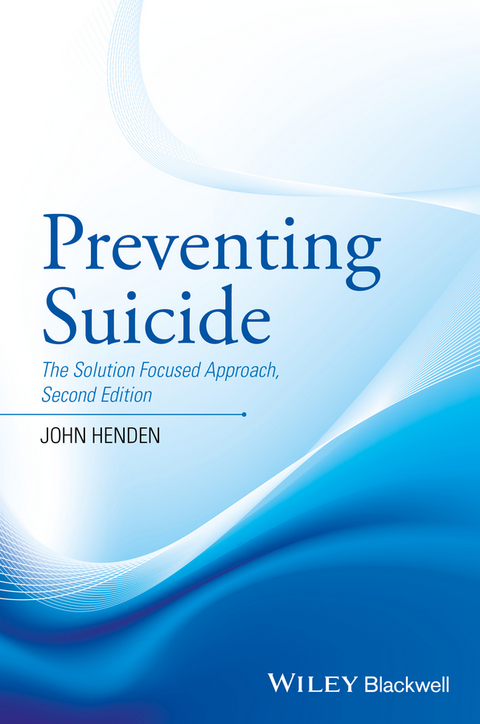
Preventing Suicide (eBook)
John Wiley & Sons (Verlag)
978-1-119-16293-3 (ISBN)
- Offers invaluable guidance for suicide prevention by showing 'what works' in treating those struggling with suicidal thoughts
- Provides straightforward ways to deal frankly with the subject of suicide, along with a range of tools and techniques that are helpful to clients
- Includes actual dialogue between practitioners and clients to allow readers to gain a better understanding of how to work with suicidal clients
- Compares and contrasts a ground-breaking approach to suicide prevention with more traditional approaches to risk assessment and management
- Features numerous updates and revisions along with brand new sections dealing with the international landscape, blaming the suicided person, Dr Alys Cole-King's 'Connecting with People', and telephone work with the suicidal, Human Givens Therapy, and zero suicide
John Henden is Managing Director of the John Henden Consultancy and an internationally acclaimed trainer, author, therapist and performance coach. He has more than 40 years of experience working within mental health services as both a practitioner and manager.
New edition of an acclaimed manual which uses the solution focused approach to take an empathetic and validating approach to working with individuals considering suicide. Offers invaluable guidance for suicide prevention by showing what works in treating those struggling with suicidal thoughts Provides straightforward ways to deal frankly with the subject of suicide, along with a range of tools and techniques that are helpful to clients Includes actual dialogue between practitioners and clients to allow readers to gain a better understanding of how to work with suicidal clients Compares and contrasts a ground-breaking approach to suicide prevention with more traditional approaches to risk assessment and management Features numerous updates and revisions along with brand new sections dealing with the international landscape, blaming the suicided person, Dr Alys Cole-King s Connecting with People , and telephone work with the suicidal, Human Givens Therapy, and zero suicide
John Henden is Managing Director of the John Henden Consultancy and an internationally acclaimed trainer, author, therapist and performance coach. He has more than 40 years of experience working within mental health services as both a practitioner and manager.
Title Page 5
Copyright Page 6
Contents 7
About the author 9
Foreword 11
Endnote 12
Acknowledgments 13
Chapter 1 How to use this book 15
Chapter 2 The book’s style and purpose 18
The book – in a nutshell 19
The book’s style 19
Reasons for writing 20
An approach which is effective 20
A shortage in the literature of effective brief therapy treatments for suicidal clients 20
Personal involvement in the territory 20
A How-to-do book 21
Practical guide 21
Help with ‘the jitters’ 22
Relationship is key 23
The search for an approach that works 24
Prevention in the form of health promotion 25
Prevention in the form of effective interventions 25
Which treatments are effective? 25
Financial considerations 27
UK health of nation and our healthier nation targets 29
The World Health Organisation (WHO) 31
Contact with health professionals 32
Feelings of isolation and being ignored 34
Assessments 35
Chapter 3 Defining suicide and self-injury 38
Definitions and clarification of terms 38
First, what do we mean by suicide? 38
How should we define treatment? 40
Deliberate self-injury (previously called self-harm) 42
Political suicide and suicide terrorism 43
Political suicide 43
Suicide bombers 44
Chapter 4 Current service provision: Risk assessment, management and medication 46
Introduction 46
Risk assessment 47
Risk factors 50
Assessing the level of intent 51
Risk management 53
Medication 55
The medical model 58
Chapter 5 Other approaches to helping the suicidal 63
Introduction 63
The models 64
Person-centred counselling 64
Cognitive behavioural therapy 67
Human givens 71
Dialectic behaviour therapy 74
Rational emotive behaviour therapy 76
Transactional analysis 78
Existential logotherapy 80
Concluding remarks 83
Chapter 6 What is Solution Focused Brief Therapy? 84
Foundations 84
The solution focused theory of change 85
Changing the doing or the viewing of the problem 87
Actions, thinking, and feelings 87
The approach 89
Basic assumptions, principles, and beliefs 89
Tools and techniques 92
Summary 119
SFBT – some common myths 119
Chapter 7 Suicide encounters: The crucial first ten minutes 126
The pre-session task 127
Client ‘radar’ 127
Non-verbal communication 128
How to start the session 129
The building of rapport, trust, and a strong therapeutic alliance 131
Trust 133
Acknowledgement, validation, and normalisation 133
Hope, optimism, and confidence 134
Hope 134
Optimism 134
Confidence 135
Conclusion 136
Chapter 8 The solution focused approach in working with the suicidal 137
Introduction 137
The specialised and adapted solution focused tools and techniques 138
Deep empathy and quick rapport 138
Assessing for incongruence 139
Questions to elicit suicidal ideation 144
Questions to ask, once suicidal ideation has been established 146
The questions 147
Normalisation 153
Hope 154
Empowerment 156
The miracle question (adapted) 157
Wise old you 159
Worst case (graveside or crematorium) scenario 159
Deathbed scenario 160
The solution focused feelings tank 162
The very, very small step 163
Key points to cover 164
When someone expresses suicidal ideas, key points to cover: 164
Summary 165
Chapter 9 Case study: Reg and ‘the demons calling from the deep’ 166
Presenting issue 166
Session 1 167
Session 2 170
Dual awareness exercise for dealing with flashbacks 171
Session 3 173
Session 4 174
Goals 174
Intervention 176
Session 5 176
The first letter 178
Session 6 182
Intervention 183
Intervention 183
Session 7 185
Session 8 185
Chapter 10 Some more case vignettes 189
Case study 1 – ‘Determined to do it’ 190
Barry (28) 190
Case study 2 – ‘Punchy and desperate’ 191
Peter (30) 191
Case study 3 – ‘Despairing over lost love’ 192
Alex (20) 192
Case study 4 – ‘Tired, hard-working carer’ 193
Josephine (49) 193
Case study 5 – ‘Everything’s busted’ 196
Simon (20) 196
Summary 198
Chapter 11 Connecting with people 199
Challenge of suicide 200
Role of non?mental health specialists 201
Lack of knowledge 202
Suicide mitigation 202
Importance of compassion 203
Importance of practitioner attitudes 205
The importance of a thorough assessment 207
Resources for people at risk of suicide 211
Acknowledgments 212
Chapter 12 Working on the phone with the suicidal person 213
Use of silence 214
The key qualities 216
Verbal vs non-verbal communication 217
Solution focused telephone counselling 218
Information giving 219
Reassuring statements 219
The (adapted) miracle question 220
Finishing a call with a suicidal caller 220
Chapter 13 Blaming those who took their lives 222
How do we blame those who takes their lives? 224
Suicide prevention researchers’ responsibilities 225
Families 227
Chapter 14 International solution focused applications to suicide prevention 229
Introduction 229
Canada 231
Religious and cultural considerations 232
Suicide prevention strategies at national level 232
Suicide prevention and solution focused practice 234
Australia 236
Suicide prevention strategies at national level 236
Suicide prevention and solution focused practice 236
Finland 238
Religious and cultural considerations 239
Suicide prevention strategies at national level 239
Suicide prevention and solution focused practice 239
Singapore 240
Religious and cultural considerations 240
Suicide prevention strategies at national level 241
Suicide prevention and solution focused practice 241
Denmark 242
Religious and cultural considerations 242
Suicide prevention and solution focused practice 243
Ireland 243
Religious and cultural considerations 243
Suicide prevention strategies at national level 244
Suicide prevention and solution focused practice 245
Japan 245
Religious and cultural considerations 246
Suicide prevention strategies at the national level 246
Suicide prevention and solution focused practice 247
Poland 248
Religious and cultural considerations 249
Suicide prevention and solution focused practice 249
The Russian Federation 250
Suicide prevention strategies at national level 251
Suicide prevention and solution focused practice 251
Religious and cultural considerations 251
The Philippines 252
Suicide prevention strategies at national level 252
Religious and cultural considerations 253
Suicide prevention and solution focused practice 253
The United States 254
Suicide prevention strategies at national level 255
Suicide prevention and solution focused practice 256
Other countries – in brief 257
Hong Kong 257
Belgium 257
Sweden 257
China 257
Spain 258
Chapter 15 Zero suicide: Should this be our goal? 259
Psychotropic medication 260
Is zero zuicide achievable? 260
The drive to zero suicide in Northern Ireland 261
UK zero suicide discussions 262
The Zero Suicide Movement and the Zero Suicide Ambition 264
Sweden’s ‘vision?zero’ approach 264
Detroit service 265
Coroners’ courts 265
The future 266
Chapter 16 Where do we go from here? 267
Access points for the suicidal 268
Quality of services 269
Better training 270
A concentration on ‘depression’? 272
National programmes and targets 273
Problem focus vs. solution focus 274
The evidence?base 274
Towards a manualised approach to solution focused suicide prevention 275
Final thoughts 276
Appendix 1 Flow diagram for an episode of treatment 278
Appendix 2 Specialist solution focused training workshops 282
Appendix 3 Evidence base for solution?focused working 284
Solution-focused therapy evaluation list – 15 June 2016 update 284
Meta-analyses (a few listed studies here, only) 285
Systematic reviews (a few listed studies here, only) 286
Published follow-up studies (245) 287
Randomised controlled studies (100) (a few listed studies here, only) 287
Comparison studies (73) (a few listed studies here, only) 289
Naturalistic studies (72) (a few listed studies here, only) 290
Other resources (a few listed studies here, only) 291
References 292
Index 328
EULA 339
John Henden's approach to suicide prevention marks a pivotal moment in the treatment of suicidal clients and, by extension, of depressed clients in general. Full of practical, ready-to-use advice, it should be read by every practitioner who wants to help these clients turn despair into hope. Preventing Suicide is a hands-on guide for the practitioner who is confronted with a depressed and suicidal client and who despairs of finding the right words, the right attitude to turn their heart and their mind towards renewed hope and a life worth living. If ever you have felt, like I did many times, as hopeless as the client before you who has attempted suicide and was saved, and who still sees no other way out but to end their lives, this is the book for you. Scientifically sound and eminently practical, this book will guide you through what in my experience are the most challenging moments a practitioner has to go through. --Dr. Luc Isebaert, Honorary Head of Department of Psychiatry, Sint-Jan Brugge-Oostende Hospital
This extensively revised second edition is a worthy successor to the original version. It addresses the place of counselling and psychological therapies in the attempt to reduce suicidal behaviours. After a clear and logical description of the problem, the text describes the solution-focused method of working, including case examples and a discussion of effectiveness. There is an excellent review of suicide around the world, quoting from the author's personal knowledge of many countries. Finally, it summarises the progress so far of the Zero Suicide programme as presented in the United Kingdom. --Dr. Alasdair MacDonald, MB ChB, Consultant Psychiatrist and author of Solution-focused Therapy: Theory, Research and Practice
John's ground-breaking book is a must have for practitioners who work with suicide. It has international appeal as a practical guide and offers a collection of best practices in the field, case vignettes, tools and tips, and a compelling case for the "zero suicide" initiative. --Debbie Hogan, MS, Therapist, Trainer, Director, Academy of Solution Focused Training, Singapore
Solution Focused Therapy is a radical and vital non-pathologizing approach for helping people who are suicidal, giving them hope, a positive caring relationship and a set of tools for moving onward. In this new, expanded edition, John Henden looks at wider issues concerning suicide and presents Solution Focused Therapy in the context of other recognised approaches, including a review of all the latest evidence of effectiveness. Strongly recommended. --Harry Procter, Professor of Clinical Psychology, University of Hertfordshire, UK
| Erscheint lt. Verlag | 30.1.2017 |
|---|---|
| Sprache | englisch |
| Themenwelt | Geisteswissenschaften ► Psychologie ► Persönlichkeitsstörungen |
| Medizin / Pharmazie ► Medizinische Fachgebiete | |
| Sozialwissenschaften ► Pädagogik ► Sozialpädagogik | |
| Sozialwissenschaften ► Soziologie | |
| Schlagworte | Clinical psychology • Klinische Psychologie • <p>Suicide, suicide prevention, suicide mitigation, preventing suicide, suicide therapy, depression, depression therapy, psychotherapy, solution-focused brief therapy, SFBT</p> • Medical Science • Medizin • Psychiatrie • Psychiatry • Psychologie • Psychology • Psychotherapie • Psychotherapie u. Beratung • Psychotherapy & Counseling • Selbstmord • Selbsttötung • Selbsttötung • Suizid • Suizidprävention • Suizidprävention |
| ISBN-10 | 1-119-16293-9 / 1119162939 |
| ISBN-13 | 978-1-119-16293-3 / 9781119162933 |
| Informationen gemäß Produktsicherheitsverordnung (GPSR) | |
| Haben Sie eine Frage zum Produkt? |
 PDF (Adobe DRM)
Kopierschutz: Adobe-DRM
Adobe-DRM ist ein Kopierschutz, der das eBook vor Mißbrauch schützen soll. Dabei wird das eBook bereits beim Download auf Ihre persönliche Adobe-ID autorisiert. Lesen können Sie das eBook dann nur auf den Geräten, welche ebenfalls auf Ihre Adobe-ID registriert sind.
Details zum Adobe-DRM
Dateiformat: PDF (Portable Document Format)
Mit einem festen Seitenlayout eignet sich die PDF besonders für Fachbücher mit Spalten, Tabellen und Abbildungen. Eine PDF kann auf fast allen Geräten angezeigt werden, ist aber für kleine Displays (Smartphone, eReader) nur eingeschränkt geeignet.
Systemvoraussetzungen:
PC/Mac: Mit einem PC oder Mac können Sie dieses eBook lesen. Sie benötigen eine
eReader: Dieses eBook kann mit (fast) allen eBook-Readern gelesen werden. Mit dem amazon-Kindle ist es aber nicht kompatibel.
Smartphone/Tablet: Egal ob Apple oder Android, dieses eBook können Sie lesen. Sie benötigen eine
Geräteliste und zusätzliche Hinweise
Buying eBooks from abroad
For tax law reasons we can sell eBooks just within Germany and Switzerland. Regrettably we cannot fulfill eBook-orders from other countries.
aus dem Bereich