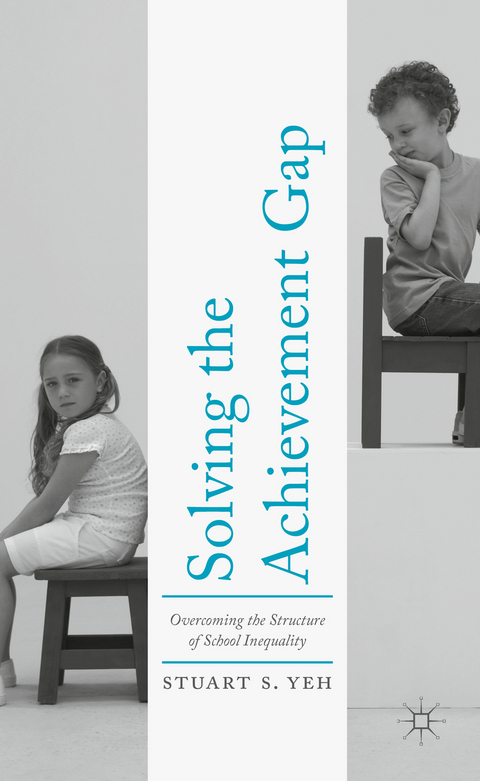
Solving the Achievement Gap (eBook)
240 Seiten
Palgrave Macmillan US (Verlag)
978-1-137-58767-1 (ISBN)
Stuart S. Yeh is Associate Professor of Evaluation Studies at the University of Minnesota, USA. He has published numerous scholarly articles and two books regarding promising strategies for addressing the achievement gap, and has served as an invited expert at the Organisation for Economic Co-operation and Development.
This book examines the cause of the student achievement gap, suggesting that the prevailing emphasis on socioeconomic factors, sociocultural influences, and teacher quality is misplaced. The cause of the achievement gap is not differences in parenting styles, or the economic advantages of middle-class parents, or differences in the quality of teachers. Instead, schools present learning tasks and award grades in ways that inadvertently undermine the self-efficacy, engagement, and effort of low-performing students, causing demoralization and exacerbating differences in achievement that are seen to exist as early as kindergarten. This process systematically maintains and widens initial gaps in achievement that might otherwise be expected to disappear over the K-12 years. Misdiagnosis of the nature of the achievement gap has led to misguided solutions. The author draws upon a range of research studies to support this view and to offer recommendations for improvement.
Stuart S. Yeh is Associate Professor of Evaluation Studies at the University of Minnesota, USA. He has published numerous scholarly articles and two books regarding promising strategies for addressing the achievement gap, and has served as an invited expert at the Organisation for Economic Co-operation and Development.
Acknowledgements
Introduction
Chapter 1: Hypotheses
Chapter 2: A Fresh View
Chapter 3: Evidence from Three National Studies
Chapter 4: A New Model of Learning
Chapter 5: Contradictions Resolved
Chapter 6: Consequences for Minorities
Chapter 7: No-Excuses Charter Schools
Chapter 8: Better Teachers
Chapter 9: 22 Strategies
Chapter 10: Solving the Achievement Gap
Conclusion
| Erscheint lt. Verlag | 21.12.2016 |
|---|---|
| Zusatzinfo | XII, 240 p. |
| Verlagsort | New York |
| Sprache | englisch |
| Themenwelt | Geisteswissenschaften |
| Sozialwissenschaften ► Pädagogik ► Bildungstheorie | |
| Sozialwissenschaften ► Soziologie | |
| Schlagworte | achievement • Charter Schools • Inequality • Policy • Race • Reform • Teacher quality |
| ISBN-10 | 1-137-58767-9 / 1137587679 |
| ISBN-13 | 978-1-137-58767-1 / 9781137587671 |
| Informationen gemäß Produktsicherheitsverordnung (GPSR) | |
| Haben Sie eine Frage zum Produkt? |
 PDF (Wasserzeichen)
DRM: Digitales Wasserzeichen
Dieses eBook enthält ein digitales Wasserzeichen und ist damit für Sie personalisiert. Bei einer missbräuchlichen Weitergabe des eBooks an Dritte ist eine Rückverfolgung an die Quelle möglich.
Dateiformat: PDF (Portable Document Format)
Mit einem festen Seitenlayout eignet sich die PDF besonders für Fachbücher mit Spalten, Tabellen und Abbildungen. Eine PDF kann auf fast allen Geräten angezeigt werden, ist aber für kleine Displays (Smartphone, eReader) nur eingeschränkt geeignet.
Systemvoraussetzungen:
PC/Mac: Mit einem PC oder Mac können Sie dieses eBook lesen. Sie benötigen dafür einen PDF-Viewer - z.B. den Adobe Reader oder Adobe Digital Editions.
eReader: Dieses eBook kann mit (fast) allen eBook-Readern gelesen werden. Mit dem amazon-Kindle ist es aber nicht kompatibel.
Smartphone/Tablet: Egal ob Apple oder Android, dieses eBook können Sie lesen. Sie benötigen dafür einen PDF-Viewer - z.B. die kostenlose Adobe Digital Editions-App.
Buying eBooks from abroad
For tax law reasons we can sell eBooks just within Germany and Switzerland. Regrettably we cannot fulfill eBook-orders from other countries.
aus dem Bereich