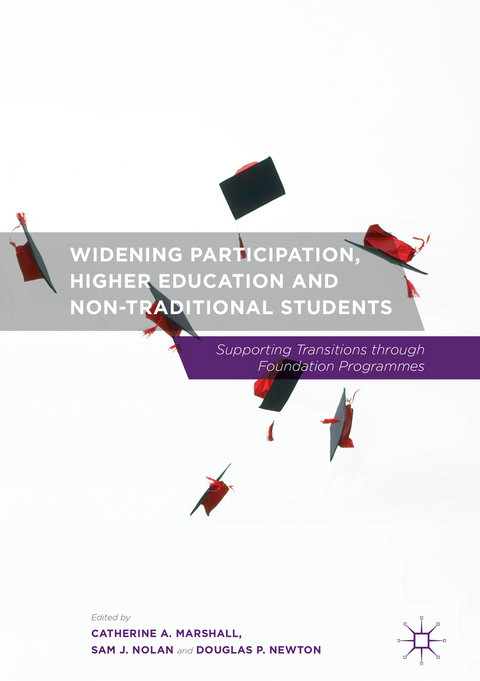
Widening Participation, Higher Education and Non-Traditional Students (eBook)
XIX, 198 Seiten
Palgrave Macmillan UK (Verlag)
978-1-349-94969-4 (ISBN)
This book highlights the problems that have developed as students lack either the social or cultural capital to take the opportunity of Higher Education through conventional routes. This might be due to leaving school early, lacking entry qualifications or wanting to further their education and prospects after entering the workplace. Foundation courses help to widen participation and create a route towards higher education. This book offers tried and tested practical solutions, from the notion of widening participation, to recruitment of students and to ways of helping them to make the most of themselves and develop the skills they need to progress on degree courses of their choice.
Catherine A. Marshall is the Director of the Foundation Centre at Durham University, UK where she promotes the development of an evidenced-based body of scholarly activity to underpin the delivery of programmes designed to provide a route into Higher Education for non-traditional students. She is the Chair of the National Foundation Year Network.Douglas P. Newton is Professor in the School of Education at Durham University, UK. His books and articles attract international interest. Recent successes include Teaching for Understanding, and the much acclaimed Thinking with Feeling, described as a Copernican shift in the notion of teaching. Sam J. Nolan is the Assistant Director of the Centre for Academic, Researcher and Organisation Development at Durham University, UK. From 2010-2015 Sam worked as a Physics Teaching Fellow, then Head of Scholarship at the Foundation Centre, where he supported the Centre in developing and promoting its scholarly profile.
Foreword.- Preface.- Chapter 1. Barriers to Accessing Higher Education; Catherine Marshall.- Chapter 2. Understanding Foundation Year Provision; Steve Leech, Catherine Marshall and Geoff Wren .- Chapter 3. Language Issues Facing Non-Traditional Students: Some Problems and Solutions; Megan Bruce, Simon Rees and Julie Wilson.- Chapter 4. Teaching Mathematics to Adults: Integrating New and Old Knowledge; Mary Dodd, Jean Mathias and Sam Nolan.- Chapter 5. Breaking Barriers: Overcoming Anxieties in Practical Science; Sam Nolan, Simon Rees and Carole Rushall.- Chapter 6. Selecting Mature Learners: A Toolkit for Admissions Tutors; Ian Moreton.- Chapter 7. Challenges and Opportunities in Using Facebook to Build a Community for Students at a UK University; Nick Pearce and Sarah Learmonth.- Chapter 8. Engendering an Online Community: Supporting Students on the Transition into University Life; Sam Nolan, Megan Bruce & Steve Leech.- Chapter 9. Culture Shock: Applying the Lessons from International Student Acculturation to Non-Traditional Students; Catherine Marshall and Jean Mathias.- Chapter 10. Students’ Academic Emotions, Their Effects and Some Suggestions for Teaching Practices; Douglas P. Newton.- Chapter 11.Adjusting Teaching Practices for Mature Adults to Incorporate Understandings of Affective Processes and Self-Efficacy in Mathematics; Mary D. Dodd.- Chapter 12. Upwards Trajectories; Catherine Marshall.
| Erscheint lt. Verlag | 21.9.2016 |
|---|---|
| Zusatzinfo | XIX, 198 p. 14 illus. |
| Verlagsort | London |
| Sprache | englisch |
| Themenwelt | Geisteswissenschaften |
| Sozialwissenschaften ► Pädagogik ► Bildungstheorie | |
| Sozialwissenschaften ► Pädagogik ► Erwachsenenbildung | |
| Sozialwissenschaften ► Politik / Verwaltung | |
| Sozialwissenschaften ► Soziologie | |
| Schlagworte | Change • Foundation Year • learning • Social mobility • Support • University |
| ISBN-10 | 1-349-94969-8 / 1349949698 |
| ISBN-13 | 978-1-349-94969-4 / 9781349949694 |
| Informationen gemäß Produktsicherheitsverordnung (GPSR) | |
| Haben Sie eine Frage zum Produkt? |
 PDF (Wasserzeichen)
DRM: Digitales Wasserzeichen
Dieses eBook enthält ein digitales Wasserzeichen und ist damit für Sie personalisiert. Bei einer missbräuchlichen Weitergabe des eBooks an Dritte ist eine Rückverfolgung an die Quelle möglich.
Dateiformat: PDF (Portable Document Format)
Mit einem festen Seitenlayout eignet sich die PDF besonders für Fachbücher mit Spalten, Tabellen und Abbildungen. Eine PDF kann auf fast allen Geräten angezeigt werden, ist aber für kleine Displays (Smartphone, eReader) nur eingeschränkt geeignet.
Systemvoraussetzungen:
PC/Mac: Mit einem PC oder Mac können Sie dieses eBook lesen. Sie benötigen dafür einen PDF-Viewer - z.B. den Adobe Reader oder Adobe Digital Editions.
eReader: Dieses eBook kann mit (fast) allen eBook-Readern gelesen werden. Mit dem amazon-Kindle ist es aber nicht kompatibel.
Smartphone/Tablet: Egal ob Apple oder Android, dieses eBook können Sie lesen. Sie benötigen dafür einen PDF-Viewer - z.B. die kostenlose Adobe Digital Editions-App.
Buying eBooks from abroad
For tax law reasons we can sell eBooks just within Germany and Switzerland. Regrettably we cannot fulfill eBook-orders from other countries.
aus dem Bereich