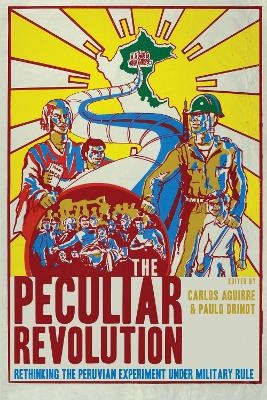
The Peculiar Revolution
University of Texas Press (Verlag)
978-1-4773-1212-4 (ISBN)
The Peculiar Revolution revisits this fascinating and idiosyncratic period of Latin American history. The book is organized into three sections that examine the era’s cultural politics, including not just developments directed by the Velasco regime but also those that it engendered but did not necessarily control; its specific policies and key institutions; and the local and regional dimensions of the social reforms it promoted. In a series of innovative chapters written by both prominent and rising historians, this volume illuminates the cultural dimensions of the revolutionary project and its legacies, the impact of structural reforms at the local level (including previously understudied areas of the country such as Piura, Chimbote, and the Amazonia), and the effects of state policies on ordinary citizens and labor and peasant organizations.
Carlos Aguirre is a professor of history at the University of Oregon. He is the author of The Criminals of Lima and Their Worlds and other books on the history of crime, punishment, slavery, and intellectuals. Paulo Drinot is a senior lecturer in Latin American history at the Institute of the Americas, University College London. He is the author of The Allure of Labor: Workers, Race, and the Making of the Peruvian State.
Introduction (Carlos Aguirre and Paulo Drinot)
Part I. Symbols, Icons, and Contested Memories: Cultural Approaches to the Peruvian Revolution
1. The Second Liberation? Military Nationalism and the Sesquicentennial Commemoration of Peruvian Independence, 1821–1971 (Carlos Aguirre)
2. The General and His Rebel: Juan Velasco Alvarado and the Reinvention of TÚpac Amaru II (Charles F. Walker)
3. Who Drove the Revolution’s Hearse? The Funeral of Juan Velasco Alvarado (AdriÁn Lerner)
4. Remembering Velasco: Contested Memories of the Revolutionary Government of the Armed Forces (Paulo Drinot)
Part II. Teachers, Peasants, Generals: Military Nationalism and Its Agents
5. Politicizing Education: The 1972 Reform in Peru (Patricia Oliart)
6. Through Fire and Blood: The Peruvian Peasant Confederation and the Velasco Regime (Jaymie Patricia Heilman)
7. Velasco, Nationalist Rhetoric, and Military Culture in Cold War Peru (Lourdes Hurtado)
8. Velasco and the Military: The Politics of Decline, 1973–1975 (George Philip)
Part III. Decentering the Revolution: Regional Approaches to Velasco’s Peru
9. Promoting the Revolution: SINAMOS in Three Different Regions of Peru (Anna Cant)
10. Watering the Desert, Feeding the Revolution: Velasco’s Influence on Water Law and Agriculture on Peru’s North-Central Coast (Chavimochic) (Mark Carey)
11. Chimbotazo: The Peruvian Revolution and Labor in Chimbote, 1968–1973 (Nathan Clarke)
12. Generals, Hotels, and Hippies: Velasco-Era Tourism Development and Conflict in Cuzco (Mark Rice)
13. From Repression to Revolution: Velasquismo in Amazonia, 1968–1975 (Stefano Varese)
Notes on the Contributors
Index
| Erscheinungsdatum | 16.06.2017 |
|---|---|
| Verlagsort | Austin, TX |
| Sprache | englisch |
| Maße | 152 x 229 mm |
| Gewicht | 567 g |
| Themenwelt | Sachbuch/Ratgeber ► Geschichte / Politik ► Allgemeines / Lexika |
| Geschichte ► Allgemeine Geschichte ► Zeitgeschichte | |
| Geisteswissenschaften ► Geschichte ► Regional- / Ländergeschichte | |
| Sozialwissenschaften ► Politik / Verwaltung | |
| ISBN-10 | 1-4773-1212-9 / 1477312129 |
| ISBN-13 | 978-1-4773-1212-4 / 9781477312124 |
| Zustand | Neuware |
| Informationen gemäß Produktsicherheitsverordnung (GPSR) | |
| Haben Sie eine Frage zum Produkt? |
aus dem Bereich