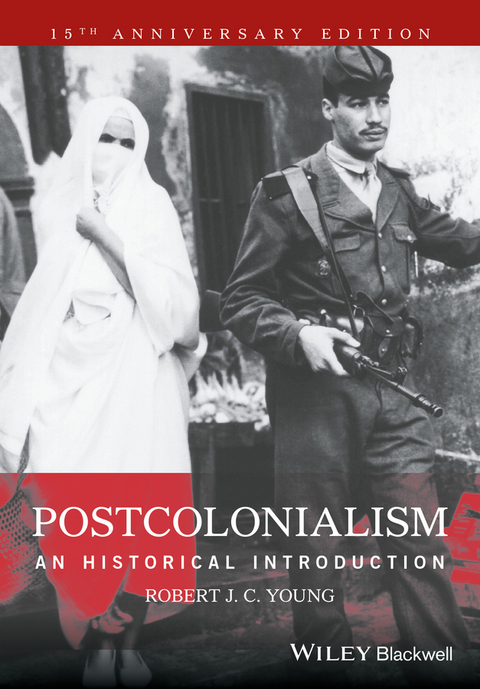
Postcolonialism (eBook)
John Wiley & Sons (Verlag)
978-1-118-89685-3 (ISBN)
This seminal work-now available in a 15th anniversary edition with a new preface-is a thorough introduction to the historical and theoretical origins of postcolonial theory.
- Provides a clearly written and wide-ranging account of postcolonialism, empire, imperialism, and colonialism, written by one of the leading scholars on the topic
- Details the history of anti-colonial movements and their leaders around the world, from Europe and Latin America to Africa and Asia
- Analyzes the ways in which freedom struggles contributed to postcolonial discourse by producing fundamental ideas about the relationship between non-western and western societies and cultures
- Offers an engaging yet accessible style that will appeal to scholars as well as introductory students
Robert J. C. Young is Julius Silver Professor of English and Comparative Literature at New York University, USA. A Fellow of the British Academy, he is one of the pioneers of the study of postcolonial literatures and their cultures, founded on an abiding interest in marginalized peoples and occluded histories. He is the Editor of Interventions: International Journal of Postcolonial Studies, and the author of many books, including Empire, Colony, Postcolony (Wiley Blackwell, 2015), The Idea of English Ethnicity (Wiley Blackwell, 2008), Colonial Desire: Hybridity in Theory, Culture and Race (1995), and White Mythologies (1990).
This seminal work now available in a 15th anniversary edition with a new preface is a thorough introduction to the historical and theoretical origins of postcolonial theory. Provides a clearly written and wide-ranging account of postcolonialism, empire, imperialism, and colonialism, written by one of the leading scholars on the topic Details the history of anti-colonial movements and their leaders around the world, from Europe and Latin America to Africa and Asia Analyzes the ways in which freedom struggles contributed to postcolonial discourse by producing fundamental ideas about the relationship between non-western and western societies and cultures Offers an engaging yet accessible style that will appeal to scholars as well as introductory students
Robert J. C. Young is Julius Silver Professor of English and Comparative Literature at New York University, USA. A Fellow of the British Academy, he is one of the pioneers of the study of postcolonial literatures and their cultures, founded on an abiding interest in marginalized peoples and occluded histories. He is the Editor of Interventions: International Journal of Postcolonial Studies, and the author of many books, including Empire, Colony, Postcolony (Wiley Blackwell, 2015), The Idea of English Ethnicity (Wiley Blackwell, 2008), Colonial Desire: Hybridity in Theory, Culture and Race (1995), and White Mythologies (1990).
Title Page 5
Copyright Page 6
Contents 9
Preface to the Anniversary Edition 11
Preface to the First Edition 28
Acknowledgements 31
Chapter 1 Colonialism and the Politics of Postcolonial Critique 33
Part I Concepts in History 45
Chapter 2 Colonialism 47
1 Colonialism and Imperialism: Defining the Terms 47
2 Colonization and Domination 51
Chapter 3 Imperialism 57
1 The French Invention of Imperialism 61
2 Differences in Imperial Ideologies and Colonial Systems 62
3 British Imperialism 66
4 Greater Britain 68
5 American Imperialism 73
Chapter 4 Neocolonialism 76
1 Neocolonialism: The Last Stage of Imperialism 78
2 Development and Dependency Theory 81
3 Critical Development Theory 84
Chapter 5 Postcolonialism 89
1 States 90
2 Location 93
3 Knowledge 95
4 Language 99
Part II European Anti-colonialism 103
Chapter 6 Las Casas to Bentham 105
1 The Humanitarian Objection 107
2 The Economic Objection 114
Chapter 7 Nineteenth-Century Liberalism 120
1 Nineteenth-century Anti-colonialism in France: Algeria and the mission civilisatrice 120
2 Nineteenth-century Anti-colonialism in Britain 122
3 India 127
4 Ireland 128
5 J. A. Hobson’s Imperialism: A Study 130
Chapter 8 Marx on Colonialism and Imperialism 133
1 Colonialism and Imperialism in Marx 133
2 Marxist Theories of Imperialism 141
Part III The Internationals 145
Chapter 9 Socialism and Nationalism: The First International to the Russian Revolution 147
1 The First and Second Internationals 147
2 ‘Bin gar keine Russin, stamm’ aus Litauen, echt deutsch’: Socialism and Nationalism 149
3 The Russian Revolution: Marxism and the National Question 152
Chapter 10 The Third International, to the Baku Congress of the Peoples of the East 159
1 The Formation of the Third International 159
2 The Second Congress, July–August 1920 161
3 The Baku Congress, September 1920 166
Chapter 11 The Women’s International, the Third and the Fourth Internationals 172
1 The Internationals and the Communist Women’s Movement 172
2 The Third Congress of the Comintern, June–July 1921 175
3 The Fourth Congress of the Comintern, November–December 1922 177
4 The Fifth Congress of the Comintern, July 1924 181
5 The Sixth and Seventh Congresses of the Comintern, 1928 and 1935 184
6 Trotsky and the Fourth International 187
Part IV Theoretical Practices of the Freedom Struggles 191
Chapter 12 The National Liberation Movements: introduction 193
Chapter 13 Marxism and the National Liberation Movements 199
1 Abdel-Malek on Marxism and the Liberation Movements 201
2 Period One: To 1928 206
3 Period Two: 1928–1945 207
4 Period 3: After 1945 210
Chapter 14 China, Egypt, Bandung 214
1 Mao and the Chinese Revolution 214
2 Contradiction in Mao 216
3 The Cultural Revolution 218
4 Egypt 220
5 Nasser 221
6 The Bandung Conference of 1955 223
Chapter 15 Latin America I: Mariátegui, Transculturation and Cultural Dependency 225
1 Marxism in Latin America 227
2 Mexico 1910 228
3 Mariátegui 229
4 Cultural Dependency 232
Chapter 16 Latin America II: Cuba: Guevara, Castro and the Tricontinental 236
1 Compañero: Che Guevara 237
2 New Man 241
3 The Tricontinental 243
Chapter 17 Africa I: Anglophone African Socialism 249
1 Pre-communist African Anti-colonialism 249
2 The Influence of African-American and African-Caribbean Radicals 251
3 Communist Activity in Africa 258
4 South Africa 262
5 Padmore and James 264
Chapter 18 Africa II: Nkrumah and Pan-africanism 268
1 The 1945 Manchester Pan-African Congress 270
2 African Socialism 271
3 Nkrumah 274
4 Nyerere 278
5 From ‘Positive Action’ to Violence 280
Chapter 19 Africa III: The Senghors and Francophone African Socialism 285
1 France Between the Wars 287
2 Anti-colonial Activists: Houénou, Senghor and Garan Kouyaté 289
3 Tovalou Houénou and the Ligue Universelle de Défense de la Race Noire (LDRN) 290
4 Lamine Senghor and the Comité de Défense de la Race Nègre (CDRN) 291
5 Tiémoho Garan Kouyaté and the Ligue de Défense de la Race Nègre (LDRN) 295
6 The Cultural Turn: Négritude 297
7 Léopold Senghor 301
Chapter 20 Africa IV: Fanon/cabral 306
1 Frantz Fanon 306
2 Fanon and Francophone African Political Thought 308
3 Fanon and Algeria 309
4 Fanon and Violence 312
5 Cabral: Culture as Resistance and Liberation 315
6 The Weapon of Theory 317
7 The Role of Culture 320
Chapter 21 The Subject of Violence: Algeria, Ireland 325
1 Subject, Subjection 326
2 Violence, Violation 327
3 Nervous Conditions 328
4 Ireland: Assimilation and Violence 331
5 Ireland and Postcolonial Theory 333
6 ‘Ireland Lost, the British “Empire” is Gone’: James Connolly and the Easter Rebellion of 1916 335
Chapter 22 India I: Marxism in India 340
1 The Uniqueness of the Indian Independence Movement 340
2 Indian Socialism: From Socialism to Sarvodaya 341
3 Marxism in India 343
Chapter 23 India II: Gandhi’s Counter-Modernity 349
1 Cultural Nationalism 349
2 Ahimsa: Violence and Non-violence 355
3 Gandhi’s Alternative Political Strategies 357
4 The Dandi March 363
5 Gandhi in Lancashire 365
Part V Formations of Postcolonial Theory 367
Chapter 24 India III: Hybridity and Subaltern Agency 369
1 Gandhi’s Invisibility 369
2 Intimate Enemy 371
3 Derivative Discourse 375
4 Hybridity: As Form and Strategy 377
5 Samas and Hybridity 380
6 The Historical Strategy of Indian Postcolonial Theorists 381
7 Subaltern Studies 384
8 Subalterns of the Subalterns: Engendering New Kinds of History and Politics 388
Chapter 25 Women, Gender and Anti-colonialism 392
1 The Role of Women in the Anti-colonial Movements 394
2 The Relations of Feminisms to the Ideologies of the Freedom Struggle 401
3 Socialism 404
4 Modernity 406
5 Cultural Nationalism 410
6 The Problems for Feminist Politics after Independence 412
Chapter 26 Edward Said and Colonial Discourse 415
1 Discourse and Power in Said 417
2 The Objections to ‘Colonial Discourse’ 421
3 Discourse in Linguistics 424
Chapter 27 Foucault in Tunisia 427
1 Foucault’s Silence: Sidi-Bou-Saïd and the Context of The Archaeology 427
2 Discourse in Foucault 430
3 The Discursive Formation 432
4 The Statement 433
5 The Regularities, the Enunciative Modalities and Formation of Objects 435
6 The Heterogeneity of Discourse 436
7 Discourse and Power in The History of Sexuality 438
8 A Foucauldian Model of Colonial Discourse 440
Chapter 28 Subjectivity and History: Derrida in Algeria 443
1 White Mythologies Revisited 443
2 Make the Old Shell Crack 449
3 Structuralism, ‘Primitive’ Rationality and Deconstruction 451
4 Pillar of Salt 453
5 The Marrano: ‘A Little Black and Very Arab Jew Who Understood Nothing About It’ 456
Epilogue: Tricontinentalism, for a Transnational Social Justice 459
Letter in Response from Jacques Derrida 461
Bibliography 464
Index 508
EULA 533
| Erscheint lt. Verlag | 12.10.2016 |
|---|---|
| Sprache | englisch |
| Themenwelt | Geschichte ► Teilgebiete der Geschichte ► Wirtschaftsgeschichte |
| Geisteswissenschaften ► Sprach- / Literaturwissenschaft ► Anglistik / Amerikanistik | |
| Geisteswissenschaften ► Sprach- / Literaturwissenschaft ► Literaturwissenschaft | |
| Sozialwissenschaften | |
| Schlagworte | anti-colonialism • colonial discourse • Colonialism • Cultural Studies • imperialism • Kulturwissenschaften • Literary criticism • Literary Theory • Literature • Literaturwissenschaft • National liberation movement • Neocolonialism • postcolonial theory • Social Identity • Sociology • Soziale Identität • Soziale Identität • Soziologie • Theorie der Postkolonialzeit • transnational social justice |
| ISBN-10 | 1-118-89685-8 / 1118896858 |
| ISBN-13 | 978-1-118-89685-3 / 9781118896853 |
| Informationen gemäß Produktsicherheitsverordnung (GPSR) | |
| Haben Sie eine Frage zum Produkt? |
 PDF (Adobe DRM)
Kopierschutz: Adobe-DRM
Adobe-DRM ist ein Kopierschutz, der das eBook vor Mißbrauch schützen soll. Dabei wird das eBook bereits beim Download auf Ihre persönliche Adobe-ID autorisiert. Lesen können Sie das eBook dann nur auf den Geräten, welche ebenfalls auf Ihre Adobe-ID registriert sind.
Details zum Adobe-DRM
Dateiformat: PDF (Portable Document Format)
Mit einem festen Seitenlayout eignet sich die PDF besonders für Fachbücher mit Spalten, Tabellen und Abbildungen. Eine PDF kann auf fast allen Geräten angezeigt werden, ist aber für kleine Displays (Smartphone, eReader) nur eingeschränkt geeignet.
Systemvoraussetzungen:
PC/Mac: Mit einem PC oder Mac können Sie dieses eBook lesen. Sie benötigen eine
eReader: Dieses eBook kann mit (fast) allen eBook-Readern gelesen werden. Mit dem amazon-Kindle ist es aber nicht kompatibel.
Smartphone/Tablet: Egal ob Apple oder Android, dieses eBook können Sie lesen. Sie benötigen eine
Geräteliste und zusätzliche Hinweise
Buying eBooks from abroad
For tax law reasons we can sell eBooks just within Germany and Switzerland. Regrettably we cannot fulfill eBook-orders from other countries.
aus dem Bereich