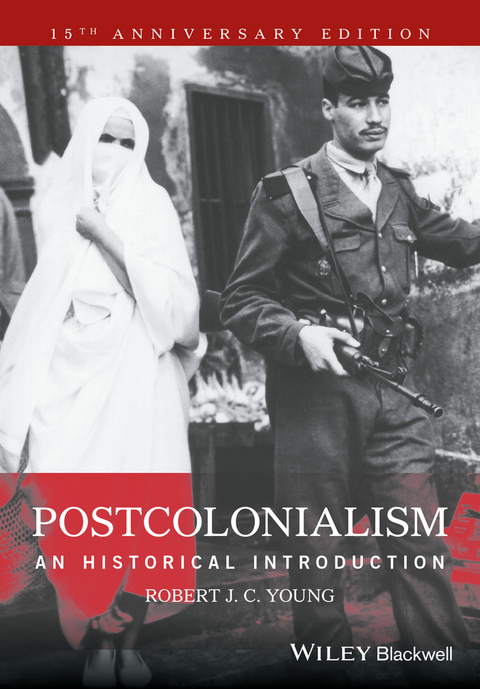
Postcolonialism (eBook)
John Wiley & Sons (Verlag)
978-1-118-89686-0 (ISBN)

This seminal work-now available in a 15th anniversary edition with a new preface-is a thorough introduction to the historical and theoretical origins of postcolonial theory.
- Provides a clearly written and wide-ranging account of postcolonialism, empire, imperialism, and colonialism, written by one of the leading scholars on the topic
- Details the history of anti-colonial movements and their leaders around the world, from Europe and Latin America to Africa and Asia
- Analyzes the ways in which freedom struggles contributed to postcolonial discourse by producing fundamental ideas about the relationship between non-western and western societies and cultures
- Offers an engaging yet accessible style that will appeal to scholars as well as introductory students
Robert J. C. Young is Julius Silver Professor of English and Comparative Literature at New York University, USA. A Fellow of the British Academy, he is one of the pioneers of the study of postcolonial literatures and their cultures, founded on an abiding interest in marginalized peoples and occluded histories. He is the Editor of Interventions: International Journal of Postcolonial Studies, and the author of many books, including Empire, Colony, Postcolony (Wiley Blackwell, 2015), The Idea of English Ethnicity (Wiley Blackwell, 2008), Colonial Desire: Hybridity in Theory, Culture and Race (1995), and White Mythologies (1990).
Robert J. C. Young is Julius Silver Professor of English and Comparative Literature at New York University, USA. A Fellow of the British Academy, he is one of the pioneers of the study of postcolonial literatures and their cultures, founded on an abiding interest in marginalized peoples and occluded histories. He is the Editor of Interventions: International Journal of Postcolonial Studies, and the author of many books, including Empire, Colony, Postcolony (Wiley Blackwell, 2015), The Idea of English Ethnicity (Wiley Blackwell, 2008), Colonial Desire: Hybridity in Theory, Culture and Race (1995), and White Mythologies (1990).
Preface to the Anniversary Edition ix
Preface to the First Edition xxvi
Acknowledgements xxix
1 Colonialism and the Politics of Postcolonial Critique 1
Part I Concepts in History 13
2 Colonialism 15
3 Imperialism 25
4 Neocolonialism 44
5 Postcolonialism 57
Part II European Anti-colonialism 71
6 Las Casas to Bentham 73
7 Nineteenth-Century Liberalism 88
8 Marx on Colonialism and Imperialism 101
Part III The Internationals 113
9 Socialism and Nationalism: The First International to the Russian Revolution 115
10 The Third International, to the Baku Congress of the Peoples of the East 127
11 The Women's International, the Third and the Fourth Internationals 140
Part IV Theoretical Practices of the Freedom Struggles 159
12 The National Liberation Movements: Introduction 161
13 Marxism and the National Liberation Movements 167
14 China, Egypt, Bandung 182
15 Latin America I: Mariátegui, Transculturation and Cultural Dependency 193
16 Latin America II: Cuba: Guevara, Castro and the Tricontinental 204
17 Africa I: Anglophone African Socialism 217
18 Africa II: Nkrumah and Pan-Africanism 236
19 Africa III: The Senghors and Francophone African Socialism 253
20 Africa IV: Fanon/Cabral 274
21 The Subject of Violence: Algeria, Ireland 293
22 India I: Marxism in India 308
23 India II: Gandhi's Counter-modernity 317
Part V Formations of Postcolonial Theory 335
24 India III: Hybridity and Subaltern Agency 337
25 Women, Gender and Anti-colonialism 360
26 Edward Said and Colonial Discourse 383
27 Foucault in Tunisia 395
28 Subjectivity and History: Derrida in Algeria 411
Epilogue: Tricontinentalism, for a Transnational Social Justice 427
Letter in Response from Jacques Derrida 429
Bibliography 432
Index 476
Preface to the Anniversary Edition
I THE NOMOS OF POSTCOLONIALITY
This book is concerned with the revolutionary history of the non‐Western world and its centuries‐long struggle to overthrow Western imperialism: from slow beginnings in the eighteenth century, the last half of the twentieth century witnessed more than a quarter of the world’s population win their freedom.1 It was written before the momentous political events of the twenty‐first century: published two months before the 9/11 attacks in 2001, and ten years before the Arab revolutions that erupted across the Arab world in 2011.2 It had been originally commissioned as an introduction to postcolonialism at a time when “postcolonial theory” formed an innovative body of thinking that was making waves beyond its own disciplinary location. That interest was the mark of a new phase within many Western societies in which immigrants from the global South had begun to emerge as influential cultural voices challenging the basis of the manner in which European and North American societies represented themselves and their own histories. The late Edward Said and Stuart Hall both symbolized the ways in which intellectuals who had been born in former colonies became spokespersons for a popular radical re‐evaluation of contemporary culture: a profound transformation of society and its values was underway. That revolution involved the consensus of an equality amongst different people and cultures rather than the hierarchy that had been developed since the beginning of the nineteenth century as a central feature of Western imperialism. Postcolonial critique has been so successful that by the beginning of the twenty‐first century the concepts and values of postcolonial thought have become established as one of the dominant ways in which Western and to some extent non‐Western societies see and represent themselves.
Although the basis for such arguments was generally the colonial experience, it has also been argued that such postcolonial critiques were also preparing the way for the transformation of society that was being produced by the demands of globalization.3 The celebration of difference became the activity of corporations as well as university professors. What this critique misses, however, is the possibility of different forms of difference: whereas state ideologies of multiculturalism employed traditional ideas of identity as a positive category in order to accommodate diversity, postcolonial intellectuals were rather spearheading a critique of the propagation of multiculturalism as an official ideology, employing a concept of difference as a non‐positive term whose value was inherently translational to challenge the very concept of fixed identities. Multiculturalism was a product of continued nationalist thinking, whereas postcolonial difference emerged as a critique of both.
Postcolonialism, however, goes well beyond the elaboration of issues of identity and difference. In this book, rather than introduce the topic by giving a summary of the ideas and concepts identified with postcolonial “theory”, I chose a different approach: to look at the genealogy of postcolonial theory in terms of its relations to earlier political and intellectual movements resisting imperialism and the cultural dominance of the West, tracing its origins in the struggles against colonialism in the past. Contemporary postcolonial theory was grounded in the inspiration of the work of earlier activists such as Frantz Fanon, Aimé Césaire, CLR James, Albert Memmi, or even in those who were viewed more critically, such as Léopold Sédar Senghor or Marcus Garvey. As soon as I went back to consider that earlier generation and its very active relation to anticolonialism and decolonization, the vastness of the task opened up before me. For how could one analyse the context of imperialism in the twentieth century without also considering its formation, and the development of resistance to it, in earlier periods? Although there were many books on imperialism, both from a general as well as particular perspectives, and even more books on specific histories of decolonization, there were very few that looked at imperialism and the pressure for decolonization from the colonized’s point of view. Above all, there was no history of anticolonialism—historical or intellectual. In this book I attempted therefore the first history of anticolonialism that would provide the context of centuries of active, political struggle. In order to do that, I made a number of decisions. First, I would offer not a blow‐by‐blow narrative of the historical military and political struggles but rather focus on the intellectual and cultural production that was developed to support and promote anticolonial activism; secondly, instead of attempting an encyclopaedic history of all empires and of resistance to them, I would concentrate on the British and French empires not only because they were the largest in recent history but because together they embodied what might be called the two dominant western models of empire, of indirect rule and assimilation; third, that I would emphasize the constructive nature of the cultural and intellectual movements that accompanied the political processes of decolonization, and would not extend discussion to the subsequent history of the various countries after independence. This last choice was made partly pragmatically for reasons of space, but also because I wanted to present a different emphasis and perspective on the anticolonial movements than the commonly‐voiced criticisms of postcolonial countries (usually made by people from the former colonizing countries) for not living up to the challenges of independence. Perhaps some did not, but that was a separate story. What I wanted to convey instead was the excitement of the intellectual productivity of the time, the sense of its radical potential and its dynamic political aspirations for transformation that could continue to offer political inspiration into the future.
In a book that attempted such a comprehensive history even within those limited terms, inevitably much is missing, or receives less emphasis than I might now wish. One argument that is certainly represented but which could be made more strongly throughout is the simple fact that Western imperialism, as it was developed systematically in the course of the nineteenth century, was a race imperialism. First advanced as an ideological justification for slavery, the claimed racial superiority of those of European origin then came to underlie both the assumptions and justifications for imperial rule. In that context, Nazi Germany operated as a more extreme and systematic form of the fundamental racialism of all imperial powers; the difference was that it was applied to Europeans. Although racialism as state ideology was discredited after the Second World War, it was not until the 1980s that it was challenged at a broad cultural as well as a social level. By that time most empires had been disbanded, most colonies abandoned. Postcolonialism was then to effect the death‐knoll of still surviving imperialist ways of thinking about racial and cultural difference in Europe and North America. In all but one domain, it might be argued: while society changed, international politics continued according to the old assumptions. The mark of that split was the war on Iraq, carried out in the face of the widespread opposition of the populations of those countries that initiated it, and whose aftermath we are still suffering today. Even there though, that war demonstrated a significant change: whereas when British Indian troops invaded Iraq in 1919, they were more or less able to control the country in a few weeks, today Iraq is scarcely a single country anymore and will probably never return to its former national identity. In the latter half of the twentieth century, and the opening of the twenty‐first, dominating states that invade or occupy the territory of other peoples have found it almost impossible to generate a culture of consent to being ruled: whereas in earlier times, there would be a pragmatic form of acceptance interrupted by periodic rebellions, today occupied countries are typically almost uncontrollable.
While physical resistance to the violence of colonial invasion was there from the beginning and continued to the very end, indigenous people developed many other forms of resistance to established imperial rule through political organization and cultural empowerment. It was this political and intellectual tradition that provided the resources for the development of postcolonial thought. The object of this book was in part to document and demonstrate the richness and diversity of that intellectual production, to be found in almost all colonies on earth. The most influential in terms of today’s thinking came from the French tradition in the work of the Senghors, Césaire, Memmi, and above all Frantz Fanon. As in all anti‐colonial thought, this was developed in dialogue with dissenting Western intellectuals, creating the basis of a global culture of dissent.
In writing the complex and multifarious political history of empires and anticolonialism the major challenge for me, apart from researching such a vast range of material, was how to organize it. It was only some time into the writing of the book that it became clear to me the degree to which the Bolshevik Revolution had functioned as a fulcrum for the development of anticolonial politics. After 1917, most activists, with the notable exception of Gandhi, turned to a secular Marxism for inspiration and strength, without,...
| Erscheint lt. Verlag | 12.10.2016 |
|---|---|
| Sprache | englisch |
| Themenwelt | Geschichte ► Teilgebiete der Geschichte ► Wirtschaftsgeschichte |
| Geisteswissenschaften ► Sprach- / Literaturwissenschaft ► Anglistik / Amerikanistik | |
| Geisteswissenschaften ► Sprach- / Literaturwissenschaft ► Literaturwissenschaft | |
| Sozialwissenschaften | |
| Schlagworte | anti-colonialism • colonial discourse • Colonialism • Cultural Studies • imperialism • Kulturwissenschaften • Literary criticism • Literary Theory • Literature • Literaturwissenschaft • National liberation movement • Neocolonialism • postcolonial theory • Social Identity • Sociology • Soziale Identität • Soziale Identität • Soziologie • Theorie der Postkolonialzeit • transnational social justice |
| ISBN-10 | 1-118-89686-6 / 1118896866 |
| ISBN-13 | 978-1-118-89686-0 / 9781118896860 |
| Informationen gemäß Produktsicherheitsverordnung (GPSR) | |
| Haben Sie eine Frage zum Produkt? |
 EPUB (Adobe DRM)
Kopierschutz: Adobe-DRM
Adobe-DRM ist ein Kopierschutz, der das eBook vor Mißbrauch schützen soll. Dabei wird das eBook bereits beim Download auf Ihre persönliche Adobe-ID autorisiert. Lesen können Sie das eBook dann nur auf den Geräten, welche ebenfalls auf Ihre Adobe-ID registriert sind.
Details zum Adobe-DRM
Dateiformat: EPUB (Electronic Publication)
EPUB ist ein offener Standard für eBooks und eignet sich besonders zur Darstellung von Belletristik und Sachbüchern. Der Fließtext wird dynamisch an die Display- und Schriftgröße angepasst. Auch für mobile Lesegeräte ist EPUB daher gut geeignet.
Systemvoraussetzungen:
PC/Mac: Mit einem PC oder Mac können Sie dieses eBook lesen. Sie benötigen eine
eReader: Dieses eBook kann mit (fast) allen eBook-Readern gelesen werden. Mit dem amazon-Kindle ist es aber nicht kompatibel.
Smartphone/Tablet: Egal ob Apple oder Android, dieses eBook können Sie lesen. Sie benötigen eine
Geräteliste und zusätzliche Hinweise
Buying eBooks from abroad
For tax law reasons we can sell eBooks just within Germany and Switzerland. Regrettably we cannot fulfill eBook-orders from other countries.
aus dem Bereich