


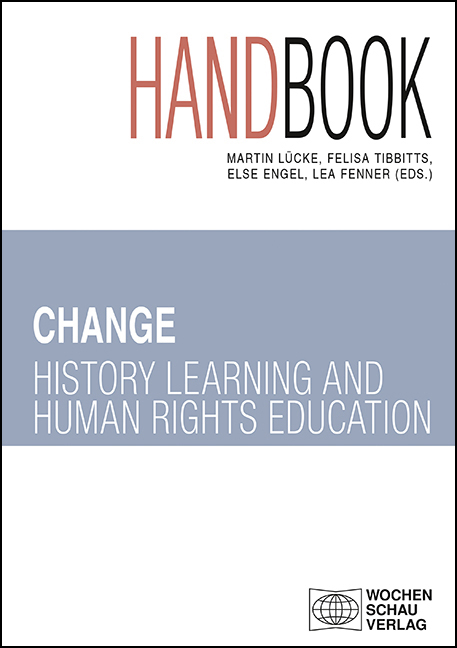
CHANGE
Wochenschau Verlag
978-3-7344-0390-3 (ISBN)
The handbook provides ideas and answers for educators in formal and non-formal education as well as in university level teacher training from theoretical and practice perspectives. The Change approach links exploring change connected to human rights in the past with contributing to change in the present.
Dr Jolanta Ambrosewicz-Jacobs Director of the Centre for Holocaust Studies and lecturer at the UNESCO Chair for Education about the Holocaust, Jagiellonian University, Krakow, Poland Else Engel Research associate, Freie Universität Berlin, Germany and Co-founder, right now Human Rights Consultancy & Training, Germany Lea Fenner Co-founder, right now Human Rights Consultancy & Training, Germany Dr Martin Lücke Professor for History Education, Freie Universität Berlin, Germany Dr Felisa Tibbitts Lecturer, Teachers College of Columbia University, USA and Founder and Senior Advisor, Human Rights Education Associates (HREA), USA
Introduction
1 The Change Project and Handbook
Part I: Educational Concepts
2 State of the Art of Combining History Learning and Human Rights Education
By Else Engel, Lea Fenner and Martin Lücke
2.1 International Perspectives on History Learning and Human Rights Education
History Learning
Human Rights Education
2.2 Concepts for Combining History Learning and Human Rights Education
Concepts of Combined Approaches
Arguments for and Benefits of Combined Approaches
Challenges of Combined Approaches
Strategies for Meaningfully Combined Approaches
2.3 Practices of Combining History Learning and Human Rights Education
Who Combines History Learning and Human Rights Education?
What are the Programmes and for Whom are they Intended?
Why was the Decision for a Combined Approach Made?
How are Combined Approaches Conceptualised?
What are the Learning Contents?
What are the Educational Objectives?
2.4 Concluding Remarks: Commonalities of History Learning and Human Rights Education
3 The Change Approach for Combining History Learning and Human Rights Education
By Martin Lücke
3.1 Introduction
3.2 Being Able to Narrate: History Learning as an Individual Acquisition of History
3.3 Criticising and Analysing Society: The Societal Dimension of History Learning
3.4 Being Competent for Change: Approaches of Human Rights Education and their Connections with History Learning
3.5 Human Rights Education, History Learning and Inclusion
3.6 Contents for a Combined Approach
Part II: Educational Practice
4 Practical Tools for Combining History Learning and Human Rights Education
By Else Engel, Lea Fenner and Martin Lücke
4.1 Guidance to the Practice Chapters
4.2 Core History Learning Elements in a Combined Approach
History, History Learning and Historical Narration
Why History Learning?
Basic Standards of Historical Narration and Deconstruction
How to Teach History: Didactic Analysis
4.3 Core Human Rights Education Elements in a Combined Approach
Human Dignity and Human Rights Standards as the Basis for Human Rights Education
Why Human Rights Education?
What are the Objectives of Human Rights Education?
How to Implement Human Rights Education?
Human Rights-Based Approach to Education
4.4 Core Elements of a Combined Change Approach
4.5 Benefits of and Strategies for a Combined Approach
4.6 Preparing as an Educator for a Combined Programme
Recommended Core Resources
Further Education
Co-teaching and Team Teaching
By Felisa Tibbitts
4.7 Evaluation of Combined Educational Programmes
Human Rights-Based Approach and Evaluation
Learner Assessment
Educator Assessment
Programme Evaluation
Impact Assessment
5 Combining History Learning and Human Rights Education in Secondary School Education
By Felisa Tibbitts
5.1 Introduction
Structure of this Chapter
Linking with School Curricula
Working with Students
Cosmopolitan Approaches to History and Civics Education
Organising Combined Lessons in Your Own School
5.2 Developing a Combined Curriculum or Activity
Learner Goals – the Why?
Theme – the What?
Methodologies of the Lesson – the How?
Praxis – the Change?
5.3 Inspiring Examples
Power and Governance
Discrimination
Citizenship and Exclusion
Mass Violence and Society
Human Rights and the International Justice System
6 Combining History Learning and Human Rights Education in Higher Education and Teacher Training
By Martin Lücke
6.1 Introduction
6.2 The ‘Human Rights Education and History Learning’ Seminar at Freie Universität Berlin
6.3 Analysis of a Practical Example of University Student Work
6.4 Final Points
7 Combining History Learning and Human Rights Education at Museums and Memorial Sites
By Jolanta Ambrosewicz-Jacobs
7.1 Introduction
7.2 Human Rights Education at Museums and Memorial Sites
Key Aspects of Education at Museums and Memorial Sites in the Context of this Handbook
Strategies for Dealing with Challenges when Implementing Combined Programmes
7.3 Developing a Combined Programme
Preparing a Combined Programme
Developing an Outline for a Combined Programme
Guidelines for Developing Combined Programmes
Formats for Combined Programmes
Themes for a Combined Programme
Methods and Outputs of Combined Programmes
7.4 Inspiring Examples Adapted to the Change Approach
7.5 Concluding Remarks
8 Combining History Learning and Human Rights Education in Non-formal Education
By Else Engel
8.1 Key Features of the Learning Environment
Non-formal Education in the Context of this Handbook
Organisers of Non-formal Education on History Learning and Human Rights Education
Educators in Non-formal Education
Learners in Non-Formal Education
A Learner-centred Approach
8.2 Drafting a Change Programme Outline
Context Analysis
Identifying the Intended Group of Learners
Choosing and Adopting the Content
Defining Intended Learning Objectives
Composing the Team of Educators
Planning the Evaluation of the Programme
8.3 Developing Change Methods and Outputs
Levels of Change
Methods and Outputs for Personal Change
Methods and Outputs for Societal Change
Methods and Outputs for Structural Change
| Erscheinungsdatum | 26.09.2016 |
|---|---|
| Reihe/Serie | Praxishandbuch |
| Verlagsort | Schwalbach am Taunus |
| Sprache | englisch |
| Maße | 148 x 210 mm |
| Gewicht | 314 g |
| Einbandart | Paperback |
| Themenwelt | Geisteswissenschaften ► Geschichte ► Allgemeines / Lexika |
| Sozialwissenschaften ► Pädagogik ► Erwachsenenbildung | |
| Schlagworte | Außerschulische Bildung • Change • Erwachsenenbildung, lebenslanges Lernen • Fachspezifischer Unterricht • Geschichtsdidaktik • Geschichtsunterricht • historisch-politische Bildung • History learning • Hochschulbildung, Fort- und Weiterbildung • Menschenrechte • Menschenrechte, Bürgerrechte • Menschenrechte (MenschR) • Menschenrechtsbildung • Non-formale Bildung • Unterricht und Didaktik: Geschichte • Unterricht und Didaktik: Politische Bildung, Sozia |
| ISBN-10 | 3-7344-0390-1 / 3734403901 |
| ISBN-13 | 978-3-7344-0390-3 / 9783734403903 |
| Zustand | Neuware |
| Informationen gemäß Produktsicherheitsverordnung (GPSR) | |
| Haben Sie eine Frage zum Produkt? |
aus dem Bereich


