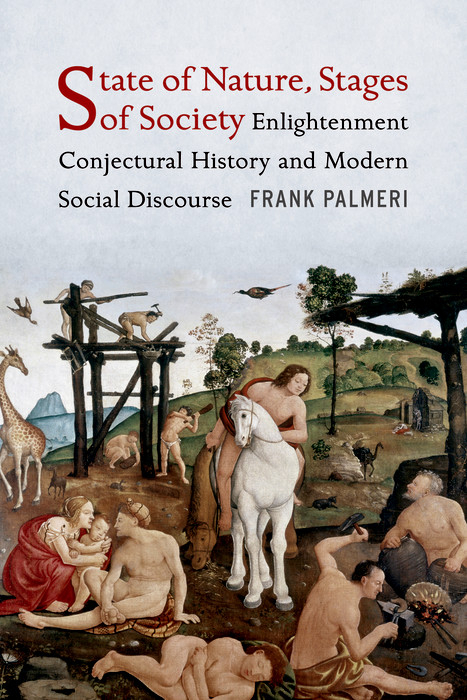
State of Nature, Stages of Society (eBook)
Columbia University Press (Verlag)
978-0-231-54128-2 (ISBN)
Frank Palmeri is a professor of English at the University of Miami. He is the author of Satire in Narrative: Petronius, Swift, Gibbon, Melville, Pynchon (1990) and Satire, History, Novel: Narrative Forms, 1665-1815 (2003), and the editor of Humans and Other Animals in Eighteenth-Century British Culture: Representation, Hybridity, Ethics (2006).
Frank Palmeri sees the conjectural histories of Rousseau, Hume, Herder, and other Enlightenment philosophers as a template for the development of the social sciences in the nineteenth and early twentieth centuries. Without documents or memorials, these thinkers, he argues, employed conjecture to formulate a naturalistic account of society's commercial and secular progression. Palmeri finds evidence of speculative frameworks in the political economy of Malthus, Martineau, Mill, and Marx. He traces the influence of speculative thought in the development of anthropology and ethnography in the 1860s, the foundational sociology of Comte and Spencer, and the sociology of religion pioneered by Weber, Durkheim, and Freud. Conjectural histories reveal a surprising ambivalence toward progress, modernity, and secularization among leading thinkers of the time, an attitude that affected texts as varied as Darwin's Descent of Man, Nietzsche's Genealogy of Morality, and the novels of Walter Scott, George Eliot, and H.G. Wells. Establishing the critical value of conjectural thinking in the study of modern forms of knowledge, Palmeri concludes his investigation with its return in the work of Foucault and in recent histories on early religion, political organization, and material life.
Frank Palmeri is a professor of English at the University of Miami. He is the author of Satire in Narrative: Petronius, Swift, Gibbon, Melville, Pynchon (1990) and Satire, History, Novel: Narrative Forms, 1665-1815 (2003), and the editor of Humans and Other Animals in Eighteenth-Century British Culture: Representation, Hybridity, Ethics (2006).
Foreword, by Dick HowardAcknowledgmentsIntroduction: Conjectural History, the Form, and Its Afterlife1. Conjectural History: The Enlightenment Form2. Political Economy and the Question of Progress3. Comte, Spencer, and the Science of Society4. The Origins of Culture and of Anthropology5. Darwin, Nietzsche, and the Prehistory of the Human6. The Social Psychology of Religion7. Novels as Conjectural HistoriesConclusion: Conjecturalism NowAppendix 1. Enlightenment Conjectural HistoriesAppendix 2. Hegel, History, and ConjectureAppendix 3. Were Conjectural Histories Racist?NotesIndex
| Erscheint lt. Verlag | 29.3.2016 |
|---|---|
| Reihe/Serie | Columbia Studies in Political Thought / Political History | Columbia Studies in Political Thought / Political History |
| Verlagsort | New York |
| Sprache | englisch |
| Themenwelt | Geisteswissenschaften ► Geschichte ► Regional- / Ländergeschichte |
| Geisteswissenschaften ► Philosophie ► Allgemeines / Lexika | |
| Geisteswissenschaften ► Philosophie ► Geschichte der Philosophie | |
| Geisteswissenschaften ► Philosophie ► Philosophie der Neuzeit | |
| Sozialwissenschaften ► Ethnologie | |
| Sozialwissenschaften ► Politik / Verwaltung ► Politische Theorie | |
| Sozialwissenschaften ► Soziologie | |
| ISBN-10 | 0-231-54128-7 / 0231541287 |
| ISBN-13 | 978-0-231-54128-2 / 9780231541282 |
| Informationen gemäß Produktsicherheitsverordnung (GPSR) | |
| Haben Sie eine Frage zum Produkt? |
 PDF (Wasserzeichen)
Größe: 2,1 MB
DRM: Digitales Wasserzeichen
Dieses eBook enthält ein digitales Wasserzeichen und ist damit für Sie personalisiert. Bei einer missbräuchlichen Weitergabe des eBooks an Dritte ist eine Rückverfolgung an die Quelle möglich.
Dateiformat: PDF (Portable Document Format)
Mit einem festen Seitenlayout eignet sich die PDF besonders für Fachbücher mit Spalten, Tabellen und Abbildungen. Eine PDF kann auf fast allen Geräten angezeigt werden, ist aber für kleine Displays (Smartphone, eReader) nur eingeschränkt geeignet.
Systemvoraussetzungen:
PC/Mac: Mit einem PC oder Mac können Sie dieses eBook lesen. Sie benötigen dafür einen PDF-Viewer - z.B. den Adobe Reader oder Adobe Digital Editions.
eReader: Dieses eBook kann mit (fast) allen eBook-Readern gelesen werden. Mit dem amazon-Kindle ist es aber nicht kompatibel.
Smartphone/Tablet: Egal ob Apple oder Android, dieses eBook können Sie lesen. Sie benötigen dafür einen PDF-Viewer - z.B. die kostenlose Adobe Digital Editions-App.
Buying eBooks from abroad
For tax law reasons we can sell eBooks just within Germany and Switzerland. Regrettably we cannot fulfill eBook-orders from other countries.
 EPUB (Adobe DRM)
Kopierschutz: Adobe-DRM
Adobe-DRM ist ein Kopierschutz, der das eBook vor Mißbrauch schützen soll. Dabei wird das eBook bereits beim Download auf Ihre persönliche Adobe-ID autorisiert. Lesen können Sie das eBook dann nur auf den Geräten, welche ebenfalls auf Ihre Adobe-ID registriert sind.
Details zum Adobe-DRM
Dateiformat: EPUB (Electronic Publication)
EPUB ist ein offener Standard für eBooks und eignet sich besonders zur Darstellung von Belletristik und Sachbüchern. Der Fließtext wird dynamisch an die Display- und Schriftgröße angepasst. Auch für mobile Lesegeräte ist EPUB daher gut geeignet.
Systemvoraussetzungen:
PC/Mac: Mit einem PC oder Mac können Sie dieses eBook lesen. Sie benötigen eine
eReader: Dieses eBook kann mit (fast) allen eBook-Readern gelesen werden. Mit dem amazon-Kindle ist es aber nicht kompatibel.
Smartphone/Tablet: Egal ob Apple oder Android, dieses eBook können Sie lesen. Sie benötigen eine
Geräteliste und zusätzliche Hinweise
Buying eBooks from abroad
For tax law reasons we can sell eBooks just within Germany and Switzerland. Regrettably we cannot fulfill eBook-orders from other countries.
aus dem Bereich