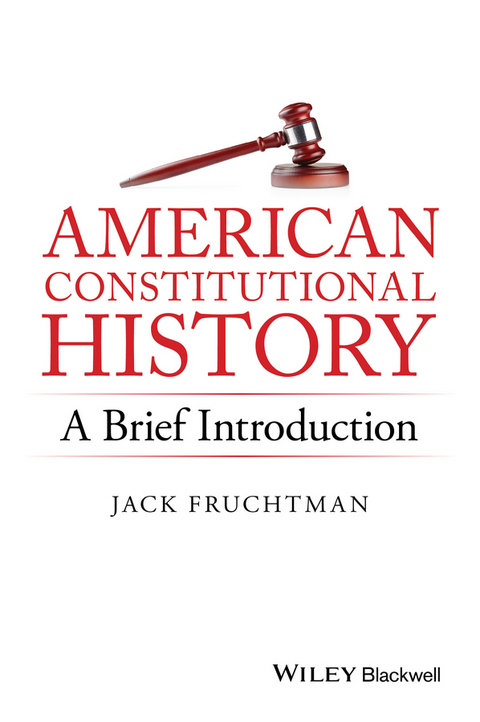
American Constitutional History (eBook)
John Wiley & Sons (Verlag)
978-1-119-14177-8 (ISBN)
- Presents readers with a brief and accessible introduction to more than two centuries of U.S. constitutional history
- Explores constitutional history chronologically, breaking U.S. history into five distinct periods
- Reveals the full sweep of constitutional changes through a focus on issues relating to economic developments, civil rights and civil liberties, and executive power
- Reflects the evolution of constitutional changes all the way up to the conclusion of the June 2015 Supreme Court term
Jack Fruchtman is Professor of Political Science and Director of the Program in Law and American Civilization at Towson University, Maryland. His most recent books include The Political Philosophy of Thomas Paine (2009) and The Supreme Court: Rulings on American Government and Society (2nd Edition, 2014).
Jack Fruchtman is Professor of Political Science and Director of the Program in Law and American Civilization at Towson University, Maryland. His most recent books include The Political Philosophy of Thomas Paine (2009) and The Supreme Court: Rulings on American Government and Society (2nd Edition, 2014).
Acknowledgments xi
Prologue xiii
Structure of the Book xvii
Part 1 The New Republic, 1781-1828 1
John Locke, Deism, and Religious Liberty 5
1 Ideological Origins of the New Republic 9
The Articles of Confederation and the Constitutional Convention 10
Ratification and the Bill of Rights 21
2 Representative and Constitutional Democracy 28
Judicial Review, Judicial Duty 31
Economic Policy in the New Republic 35
3 Nationalization of the Constitution and Executive Power 45
Part 2 The Slave Republic, 1789-1877 53
Constitutional Amendments 56
4 Commerce, Nullification, and Slavery 59
Other Economic Rulings 60
The Nullification Controversy 62
Dred Scott 65
5 Civil War and Reconstruction 70
Lincoln and War 71
Reconstruction 78
6 Rights and Privileges 84
Privileges and Immunities 86
Women's Rights 89
Persecution of Newly Freed Slaves 91
Part 3 The Free Market Republic, 1877-1937 95
Constitutional Amendments 96
7 The Development of Substantive Due Process 99
Procedural Due Process 100
Substantive Due Process 101
Restraint of Trade in the Free Market Era 105
Liberty of Contract 107
Regulating Industry 111
The Great Depression 113
8 Civil Rights After Reconstruction 115
Equality and African-Americans 115
Parents and Educational Rights 123
The Right to be Let Alone 125
9 The Re-emergence of Executive Power 126
Leadership and the Presidency 126
America and World War I 128
Criminal Anarchy and Criminal Syndicalism in the 1920s 137
Part 4 The Welfare State Republic, 1937-1995 143
Constitutional Amendments 144
10 Advocates and Enemies of Social Welfare 147
The Court Changes 149
New Social Welfare Programs 153
11 The Growth of Civil Liberties 154
Free Expression 154
Free Press 158
Religious Establishments 160
Criminal Suspects and Capital Punishment 164
Privacy 167
12 The Civil Rights Movement 172
School Desegregation 172
Civil and Voting Rights 175
Strict Scrutiny and Affirmative Action in Higher Education 177
Affirmative Action in Government Contracts 181
Women's Rights and Affirmative Action 182
13 Expanding Presidential Power 186
Presidential Power and Japanese Internments 187
Military Tribunals 191
Vietnam and its Aftermath 192
Re-emergence of a Powerful Executive 195
Part 5 The Contemporary Republic, 1995-2013 199
14 Federal Commerce Power and Economic Regulation 201
Narrowing Federal Commerce Power 202
Health-care Reform 205
15 Rights, Liberties, and Judicial Doctrines 209
Affirmative Action and Education 209
Campaign Finance 212
The Right to Bear Arms 213
Capital Punishment 216
The Right to Privacy 218
Religious Establishments 220
16 Executive Authority and Terrorism 224
Protecting America in an Era of Terrorism 224
Wars in Afghanistan and Iraq 229
Executive Power Under Barack Obama 233
Epilogue 239
Government and the Economy 241
Government and Individual and Civil Rights 243
Executive Power 254
A Republic if you can Keep it 257
Bibliography 260
Prologue 261
Part 1: The New Republic, 1781-1828 262
Part 2: The Slave Republic, 1789-1877 263
Part 3: The Free Market Republic, 1877-1937 263
Part 4: The Welfare State Republic, 1937-1995 264
Part 5: The Contemporary Republic, 1995-2013 265
Epilogue 267
Index 268
Prologue
The United States Constitution is the oldest, continuous, national republican document in existence today. It was not the first. Republics, or mixed regimes as they are also known, existed long before the Americans crafted theirs in 1787. Most did not last very long. In the ancient world, the Roman republic collapsed when it degenerated into empire. During the Renaissance, the Florentine republic in Italy survived a mere 14 years, from 1498 to 1512. It dissolved when the powerful Medici family, which had once ruled Florence, re-established a dictatorship. According to the classical republican tradition, republics were fragile political organizations, because the critical balance between the various branches of government could easily crumble when one or two dominated the others. The Americans modeled their constitution on the British government with its one-person executive and two-part legislature. The British failed to create a true republic, because a hereditary monarch led the executive branch and hereditary aristocrats controlled the upper house, the unelected House of Lords. Large landowners controlled the House of Commons and only a few men possessed the right to vote. Americans believed that after separating from the British Empire, they could create a true republican structure where citizens participated in decision-making and enjoyed peaceful transitions of power.
The Constitution created a democratic republic, not a democracy. In a democracy, citizens vote directly on government policies, while in a republic, they elect representatives to develop policies on their behalf. Vestiges of democracy remain in America. They include the New England town meeting when residents directly vote on issues, such as whether the town should purchase a new police cruiser. The ballot initiative, also called the referendum, exists in over 40 states, allowing voters to make specific policies, such as whether a state should repeal its capital punishment law. Most laws in the United States today, however, are passed by representatives elected by the citizens. This system comprises the republic.
Americans wanted their new government to represent every person, including those ineligible to vote, such as women, making it a democratic republic. The Constitution addresses “persons,” not “citizens” or “voters” when it guarantees a structure, rights, and liberties. It reserves direct elections only for the House of Representatives, because many delegates to the constitutional convention, including James Madison, believed that ordinary citizens failed to have the requisite education, intelligence, or common sense to decide who should be a senator or president. They initially devised a system of indirect election for those offices. The people elected state legislators who then chose US senators, a procedure that changed only in 1913 when the states ratified the Seventeenth Amendment. In presidential elections, the people vote for a special group of people, known as Electors. They alone vote directly for the president. Today, Electors still choose the president.
Since the Constitution’s ratification 225 years ago, Americans have formally added only 27 amendments. Congress still makes the laws, the president enforces them, and the courts interpret their constitutional validity. Formal changes to the document have typically occurred during or just after political or social crises. A few examples will suffice. The first 10 amendments, known collectively as the Bill of Rights, emerged in 1791 as a direct reaction to the Constitution’s ratification process. Many state ratifying conventions made the addition of a bill of rights contingent on their ratification. They declared that if the first Congress declined to amend the original document to protect basic civil liberties, their ratification vote was void.
The Twelfth Amendment in 1804 resulted from the highly contested 1800 presidential election. The Constitution provided for candidates for president and vice president to run separately for office. The candidate with the highest number of electoral votes became president, the second highest vice president. This arrangement worked in the first three elections, despite the outcome in 1796 when men from different parties became president: John Adams, a Federalist, and vice president, Thomas Jefferson, a Republican. However, when Jefferson ran for president in 1800 with Aaron Burr as his vice presidential running mate, the electoral vote ended in a tie between the two men. The Twelfth Amendment allowed presidential and vice presidential candidates to run together on the same ticket.
The most striking examples materialized during and after the Civil War: the Thirteenth Amendment in 1865 ended slavery; the Fourteenth in 1868 ensured the equal protection of the laws; and the Fifteenth in 1870 guaranteed the right to vote for the newly freed black slaves. The Nineteenth Amendment in 1920 extended the vote to women in national elections, a consequence of many years of contentious advocacy for the right. With the adoption of the Twenty-Second Amendment in 1951, the states created a two-term limit for presidents after Franklin D. Roosevelt won four presidential elections from 1932 to 1944. Years later, the war in Vietnam paved the way for lowering the national voting age to 18.
The Constitution is notoriously difficult to amend. Over the years, members of Congress have proposed tens of thousands of amendments, but few have passed the stringent requirements set out in Article V: two-thirds of both houses of Congress must approve an amendment or the same two-thirds could call a constitutional convention to propose one, and then three-quarters of the states must ratify it. Among the failed amendments are those guaranteeing equal rights to women, balanced federal budgets, term limits for members of Congress, prayer in the public schools, as well as those outlawing abortion and flag desecration. While 27 amendments have altered several constitutional provisions, the document has in reality changed only 13 times since 1804. The founders modified and tinkered with their work as the new government was becoming settled, first in New York City, then Philadelphia, and finally Washington, DC. The founding generation added the first 12 amendments within 15 years after the document was ratified: the Bill of Rights in 1791; the Eleventh Amendment in 1795, overruling a decision by the Supreme Court to forbid citizens of one state to sue another state; and the Twelfth Amendment in 1804.
While American constitutional history comprises the story of these formal alterations, it is even more an account of informal changes. This is where constitutional interpretation comes in. The wording of the document is vague and imprecise. It demands that people interpret the meaning of its words, like due process of law, equal protection, and cruel and unusual punishments. The First Amendment declares that “Congress shall make no law … abridging the freedom of speech.” Was it left only to Congress to protect free speech? Did this mean the states could abolish it? What does “no law” mean: literally no law whatsoever, so that free speech is an absolute value that must be protected at all cost? What does “abridge” mean? No universal agreement has ever been reached when it comes to any provision – by the justices of the Supreme Court, the members of Congress, or the president.
This is why it is important to learn how the branches of government have interpreted the Constitution’s words and spirit. Numerous informal changes have been due to a president’s decisions, especially in military affairs and national security, to Congress in the realm of lawmaking, or to the Supreme Court in deciding cases. Differing interpretative approaches have sometimes been a matter of partisan politics and political ideology, but more importantly it has been the result of competing values among liberals and conservatives in response to various events. When can the president act alone without congressional or judicial oversight? What is the appropriate relationship between the federal and state governments? What is the proper balance between liberty and security in a democratic order? What is the best way to pursue equality? How does religious faith figure in American society and government? These and other questions like them have faced all three branches over the past 225 years.
The president, Congress, and the Supreme Court have all changed the Constitution’s meaning as they make public policy. Presidents issue executive orders, sign executive agreements, and claim unilateral authority, especially in matters of national security and military affairs. They have used “signing statements” to set forth their reasons for not enforcing a law even after they have signed it. While Congress may not delegate its authority to another branch of the government, it possesses the authority to change or repeal existing laws. Finally, Supreme Court justices have long held that precedent, known formally as the doctrine of stare decisis (“let the decision stand”), is an important principle to ensure legal continuity and stability. They have also held that it is not an inexorable command whenever they overrule earlier decisions. Congress and the states too may overrule Supreme Court decisions by adding a constitutional amendment to the Constitution as they did when the states adopted the Eleventh Amendment in 1795.
Structure of the Book
The American republic today reflects the constitutional changes that have taken place formally and informally...
| Erscheint lt. Verlag | 25.2.2016 |
|---|---|
| Sprache | englisch |
| Themenwelt | Geisteswissenschaften ► Geschichte ► Regional- / Ländergeschichte |
| Recht / Steuern ► Allgemeines / Lexika | |
| Recht / Steuern ► EU / Internationales Recht | |
| Recht / Steuern ► Öffentliches Recht | |
| Sozialwissenschaften ► Politik / Verwaltung ► Staat / Verwaltung | |
| Schlagworte | American constitution • Articles of Confederation • Bill of rights • Constitutional History • constitutional law • Constitution, Government & the State • continental congress • Geschichte • Geschichte der USA • History • Law • legal • Legal History • Political Science • Politikwissenschaft • Rechtswissenschaft • Separation of Powers • USA /Geschichte, Politik 1945 ff • U.S. Constitution • us history • Verfassung • Verfassung, Regierung, Staatswesen |
| ISBN-10 | 1-119-14177-X / 111914177X |
| ISBN-13 | 978-1-119-14177-8 / 9781119141778 |
| Informationen gemäß Produktsicherheitsverordnung (GPSR) | |
| Haben Sie eine Frage zum Produkt? |
 EPUB (Adobe DRM)
Kopierschutz: Adobe-DRM
Adobe-DRM ist ein Kopierschutz, der das eBook vor Mißbrauch schützen soll. Dabei wird das eBook bereits beim Download auf Ihre persönliche Adobe-ID autorisiert. Lesen können Sie das eBook dann nur auf den Geräten, welche ebenfalls auf Ihre Adobe-ID registriert sind.
Details zum Adobe-DRM
Dateiformat: EPUB (Electronic Publication)
EPUB ist ein offener Standard für eBooks und eignet sich besonders zur Darstellung von Belletristik und Sachbüchern. Der Fließtext wird dynamisch an die Display- und Schriftgröße angepasst. Auch für mobile Lesegeräte ist EPUB daher gut geeignet.
Systemvoraussetzungen:
PC/Mac: Mit einem PC oder Mac können Sie dieses eBook lesen. Sie benötigen eine
eReader: Dieses eBook kann mit (fast) allen eBook-Readern gelesen werden. Mit dem amazon-Kindle ist es aber nicht kompatibel.
Smartphone/Tablet: Egal ob Apple oder Android, dieses eBook können Sie lesen. Sie benötigen eine
Geräteliste und zusätzliche Hinweise
Buying eBooks from abroad
For tax law reasons we can sell eBooks just within Germany and Switzerland. Regrettably we cannot fulfill eBook-orders from other countries.
aus dem Bereich