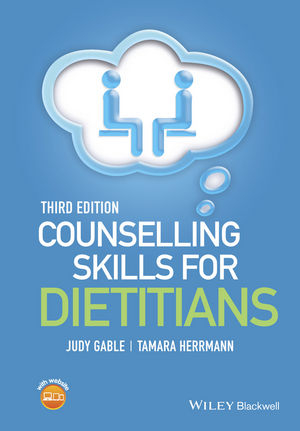
Counselling Skills for Dietitians (eBook)
John Wiley & Sons (Verlag)
978-1-118-94378-6 (ISBN)
- Includes examples from daily practice to illustrate the difficulties encountered by dietitians and demonstrate the application of counselling skills
- Clearly explains theoretical models of accepted counselling practice underpinning the skills described
- Has been updated to include additional information on topics such as assertiveness skills and eating distress
- Addresses practical and psychological issues faced by dietitians and patients
- Includes the latest research evidence for counselling skills in dietetic practice
- Draws upon research evidence, theory and experience from the fields of psychotherapy and counselling
- Now provides access to a range of supportive online material including videos of consultations, case studies and resources for trainers
Judy Gable worked as a dietitian for many years, specialising in paediatrics in the 1970s and diabetes research in the 1980s. In the early 1990s she established the course in communication skills for dietetic students at King's College and during the next ten years also facilitated introductory courses in counselling skills and assertiveness for dietitians. She continued to work as a counsellor in primary care until 2010.
Tamara Herrmann has worked for many years as a GP/Community dietitian and during this time developed her interest in obesity, eating disorders and communication skills. Tamara now works in private practice as a registered dietitian and registered psychotherapist.
The third edition Counselling Skills for Dieticians has been fully revised and updated to reflect the recent developments, research and interests in the field. It explores the skills required for dietetic counselling, and includes frequent examples of dialogue from patient consultations, as well as exercises and activities so that the reader can undergo experiential learning relevant to their practice. Includes examples from daily practice to illustrate the difficulties encountered by dietitians and demonstrate the application of counselling skills Clearly explains theoretical models of accepted counselling practice underpinning the skills described Has been updated to include additional information on topics such as assertiveness skills and eating distress Addresses practical and psychological issues faced by dietitians and patients Includes the latest research evidence for counselling skills in dietetic practice Draws upon research evidence, theory and experience from the fields of psychotherapy and counselling Now provides access to a range of supportive online material including videos of consultations, case studies and resources for trainers
Judy Gable worked as a dietitian for many years, specialising in paediatrics in the 1970s and diabetes research in the 1980s. In the early 1990s she established the course in communication skills for dietetic students at King's College and during the next ten years also facilitated introductory courses in counselling skills and assertiveness for dietitians. She continued to work as a counsellor in primary care until 2010. Tamara Herrmann has worked for many years as a GP/Community dietitian and during this time developed her interest in obesity, eating disorders and communication skills. Tamara now works in private practice as a registered dietitian and registered psychotherapist.
Foreword
Acknowledgements
Introduction
Part 1 Using a Counselling Approach in Patient-Centred Practice
1 The Dietitian
2 The Patient
3 The Relationship Between Dietitian and Patient
4 Aspects of the Helping Process
5 Conducting a Structured Interview
Part 2The Skills
6 Active Listening
7 Ways of Responding
8 Making Helpful Interventions
9 Conveying a Clear Message: Assertiveness in Action
Part 3 Putting Skills into Practice: Further Considerations
10 Working with More Than One Person
11 Coping with Loss and Bereavement
12 Developing Cultural Awareness
13 Working with Parents and Children
14 Working with Difficulties in Physical and Mental Health
Part 4 Areas for Personal and Professional Development
15 Developing Self Awareness
16 Giving and Receiving Support
Index
The following additional material to accompany this book is available online at www.wiley.com
A Video Demonstrating Counselling Skills for Dietitians in Action
Case Studies: Examples from Dietetic Practice
Assessing Your Knowledge - a tool for self assessment
Resources for Trainers
Suggestions for Further Reading
Useful Contacts
Introduction
‘The manner in which the dietitian communicates is crucial to the outcome.’
We believe this statement merits careful consideration and encourage you to read it again as it forms the key premise upon which this book is based.
In the course of their work, dietitians are required to draw on their understanding and knowledge of the sciences of nutrition and of medicine, and on their ability to interpret this into lay-person’s terms. They need to keep up to date with nutrition research and to follow best practice in their particular speciality, which includes a responsibility not to cause harm and, of course, ideally, to help people. In order to do this effectively, they need the emotional intelligence and skills to communicate effectively with a hugely diverse range of people. This involves both a knowledge of psychology and competency in a range of communication skills, as well as an understanding of the process of behavioural change.
With each patient, dietitians need to bear in mind the appropriate tailored nutritional information to convey and, at the same time, the best way to communicate this. In theory, all interactions have the potential to be rewarding and challenging, and can provide opportunities for reflection. This may result in significant learning and add greatly to a sense of fulfilment and job satisfaction, whatever the dietitian’s level of experience and competence. But how to do this in practice? This process is not as simple as it may first appear.
As with previous editions, this book is concerned with helping dietitians to develop the approach and communication skills most effective in helping others. Some may say, ‘but hasn’t this always been the case?’ It is true that dietitians have always rightly been concerned with communicating correct information based on sound scientific research and have concentrated on what should be said. With the expansion of their work into the community in the 1980s, they also paid attention to different ways of communicating (e.g. working with groups, leading healthy eating campaigns and disseminating information through the media). In the 1990s, some dietitians, aware of patients’ difficulties in changing food habits, began to explore how behavioural modification techniques could help. Some were also asking about the use of counselling skills. The first edition of this book, published in 1997, was written to address this question. By the time the second edition was published in 2007, a general awareness of counselling as a means of getting help had arisen in Britain. At this time, a more patient-centred approach was becoming widely adopted in the health professions, with more opportunities for training in the necessary skills. This move away from the traditional prescriptive approach represented a major shift within the National Health Service (NHS) and the dietetic profession.
Since then, there have been many changes. Working in partnership with patients and in multidisciplinary teams with colleagues has meant a change in attitude and approach, with more attention being paid to communication skills. The establishment of criteria for best practice and indicators of performance has resulted in opportunities for research into evidence-based practice. In dietetics, communication skills have only recently become an area for research, which partly explains the paucity of evidence in this field. Nevertheless, existing studies indicate that the way in which dietitians approach patients, the quality of their interaction and their competence in using effective communication skills contribute greatly to good rapport. This, in turn, influences satisfaction, motivation, the meeting of agreed dietary targets and uptake of the next appointment. This evidence, reviewed in chapter 1, supports our statement that it is the manner in which dietitians communicate with patients that is crucial.
Although research into the communication skills used in dietetic practice is at an embryonic stage, there is a wealth of information regarding the therapeutic relationship in the fields of counselling and psychotherapy. Even though these professions are distinctly different to nutrition counselling, they do contain nuggets of wisdom which can be relevant and useful to dietitians. We have drawn upon our own knowledge and experience in counselling and psychotherapy, as well as dietetics, and highlighted some specific findings from evidence-based practices and research that we consider to be relevant. Additional information can be found in the list of Further Reading material on the companion Web site (www.wiley.com/go/gable).
Adopting a different approach to patient care within an organisation as large as a national health service is easier said than done. Old habits die hard, as dietitians know well from helping people change their eating behaviour. Changing habitual patterns of communication can be just as difficult without adequate support and training. The need for communication skills training is now recognised in the training guidelines produced by the National Institute for Health and Care Excellence (NICE) and in the British Dietetic Association’s (BDA’s) curriculum framework (see Chapters 1 and 16). We believe all dietitians, whatever their level of training and experience, can add to their existing understanding, knowledge and awareness and refresh the skills they have already learned.
In order to become confident and competent in applying any skill, including effective communication, four elements are essential. These are: (i) gaining more knowledge (K); (ii) increasing awareness (A); and (iii) practising new skills (S) until (iv) they become habitual (H). These elements, known as the KASH model, are recognised as key determinants of performance (Sparrow 2006 ). In this book, we address each element by offering information, sharing our experience and the knowledge of others and providing examples related to dietetic practice, as well as encouraging participation in the interactive material. At the end of the day, however, it is only dietitians themselves who, with the help of skilled support, are able to accumulate enough KASH to acquire increased competence.
Although written with British dietitians in mind, we are aware that the book is also used by dietitians in other countries. While intended for both dietetic students and qualified dietitians, whether or not they have completed some training in counselling skills, we think that other health practitioners who give dietary advice (e.g. practice nurses, health visitors, doctors, registered nutritionists and other clinicians involved in nutrition counselling) could also find this book useful. It is being increasingly recognised that many diseases are closely connected with our modern lifestyle. In the light of this, the focus of the NHS may shift even more towards health education in the future. This means that all health professionals may find themselves increasingly in the position of providing lifestyle advice to patients, including nutrition advice. Helping others to make healthier changes to their diet involves more than just giving information and advice. As addressed in this book, it requires that such advice be given in a manner that is likely to produce a satisfactory outcome for the recipient.
Throughout our many years of teaching both undergraduates and postgraduates at King’s College London, students have raised similar concerns about using counselling skills. This new edition of the book, with its accompanying Web site (www.wiley.com/go/gable), has given us far greater scope in which to address these issues. Far from being evangelical in any way about the use of counselling skills (something of which we have on occasion been accused!), we have tried to provide a balanced approach and to fairly discuss the pros and the cons of being more or less prescriptive.
There has been much enthusiasm within the NHS and the dietetic profession for using specific skills and techniques to enable behaviour change, such as cognitive behavioural therapy (CBT) and motivational interviewing (MI), and doubtless over time other models will be developed. We have briefly covered some of these approaches within the book to show how they can be integrated with counselling skills. However, it is our belief that it is only when these useful tools and approaches are incorporated within a person-centred approach that their true benefit can be realised. We believe that the importance of effective counselling skills has often been (or can easily be) overlooked. The aim of this book is essentially to provide a solid grounding in patient-centred counselling skills and to encourage the ongoing development and monitoring of these skills.
We realise that the wealth of information presented may seem overwhelming at first. The reader might say, ‘How will I ever remember it all?’, or, ‘I will forget everything when I’m with a patient’. We believe what matters most is our willingness to learn and to become better listeners, both to others and to ourselves. This involves being more skilful in the way we respond to what we hear. The skills demonstrated throughout are valuable life skills, as well as professional skills. Developing, honing, polishing and applying our listening and responding skills leads to greater understanding and opportunities for negotiation, cooperation and change. We hope this new edition will prove thought-provoking, relevant and useful, and will be widely used by dietitians, other health professionals, students and trainers...
| Erscheint lt. Verlag | 22.12.2015 |
|---|---|
| Sprache | englisch |
| Themenwelt | Medizin / Pharmazie ► Gesundheitsfachberufe ► Diätassistenz / Ernährungsberatung |
| Medizin / Pharmazie ► Medizinische Fachgebiete | |
| Sozialwissenschaften ► Pädagogik ► Sozialpädagogik | |
| Sozialwissenschaften ► Soziologie | |
| Schlagworte | clients diet lifestyle • consultations patients • Counselling skills dieticians • Diätetik • dialogue communication • Diätetik • Dietetics • dietetics nutrition • Ernährung • Ernährung u. Diätetik • Ernährung • Ernährung u. Diätetik • Gesundheits- u. Sozialwesen • Health & Social Care • Nutrition & Dietetics General • Psychologie • Psychology • Psychotherapie • Psychotherapie u. Beratung • Psychotherapy & Counseling |
| ISBN-10 | 1-118-94378-3 / 1118943783 |
| ISBN-13 | 978-1-118-94378-6 / 9781118943786 |
| Informationen gemäß Produktsicherheitsverordnung (GPSR) | |
| Haben Sie eine Frage zum Produkt? |
 EPUB (Adobe DRM)
Kopierschutz: Adobe-DRM
Adobe-DRM ist ein Kopierschutz, der das eBook vor Mißbrauch schützen soll. Dabei wird das eBook bereits beim Download auf Ihre persönliche Adobe-ID autorisiert. Lesen können Sie das eBook dann nur auf den Geräten, welche ebenfalls auf Ihre Adobe-ID registriert sind.
Details zum Adobe-DRM
Dateiformat: EPUB (Electronic Publication)
EPUB ist ein offener Standard für eBooks und eignet sich besonders zur Darstellung von Belletristik und Sachbüchern. Der Fließtext wird dynamisch an die Display- und Schriftgröße angepasst. Auch für mobile Lesegeräte ist EPUB daher gut geeignet.
Systemvoraussetzungen:
PC/Mac: Mit einem PC oder Mac können Sie dieses eBook lesen. Sie benötigen eine
eReader: Dieses eBook kann mit (fast) allen eBook-Readern gelesen werden. Mit dem amazon-Kindle ist es aber nicht kompatibel.
Smartphone/Tablet: Egal ob Apple oder Android, dieses eBook können Sie lesen. Sie benötigen eine
Geräteliste und zusätzliche Hinweise
Buying eBooks from abroad
For tax law reasons we can sell eBooks just within Germany and Switzerland. Regrettably we cannot fulfill eBook-orders from other countries.
aus dem Bereich