


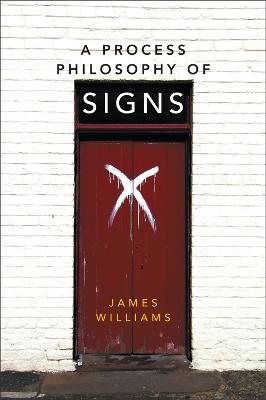
A Process Philosophy of Signs
Seiten
2016
Edinburgh University Press (Verlag)
978-0-7486-9500-3 (ISBN)
Edinburgh University Press (Verlag)
978-0-7486-9500-3 (ISBN)
In his bold new book, James Williams develops a new process philosophy of signs through a formal model, in contrast to earlier structuralist definitions. He draws on the philosophies of Deleuze and Whitehead, criticises Jakob von Uexküll's work on the sign in biology and connects to John Dupré's process philosophy of biology
We usually think of signs as fixed relations: a red light signifies ‘Stop’. In his bold new book, James Williams argues that signs are processes: you see the red light and think 'should I stop?', triggering a creative response. Williams develops this new process philosophy of signs through a formal model , in contrast to earlier structuralist definitions. He draws on the philosophies of Deleuze and Whitehead, criticises earlier work on the sign in biology by Jakob von Uexküll, and connects to contemporary work on process in the philosophy of biology by John Dupré. The process model has wide applications in the arts, humanities and social sciences, and informs their critical debates with science. In defining the sign as essentially political, this radical definition of the sign opens up new possibilities for social and political critique.
We usually think of signs as fixed relations: a red light signifies ‘Stop’. In his bold new book, James Williams argues that signs are processes: you see the red light and think 'should I stop?', triggering a creative response. Williams develops this new process philosophy of signs through a formal model , in contrast to earlier structuralist definitions. He draws on the philosophies of Deleuze and Whitehead, criticises earlier work on the sign in biology by Jakob von Uexküll, and connects to contemporary work on process in the philosophy of biology by John Dupré. The process model has wide applications in the arts, humanities and social sciences, and informs their critical debates with science. In defining the sign as essentially political, this radical definition of the sign opens up new possibilities for social and political critique.
James Williams is Honorary Professor of Philosophy and member of the Alfred Deakin Institute for Citizenship and Globalization at Deakin University. He has published widely on contemporary French philosophy and is currently working on a critique of the idea of extended mind from the point of view of process philosophy.
Acknowledgements
1. Introduction: The Process Sign
2. The Independent Life of Signs
3. Biology and the Design of Signs
4. Process Signs and the Process Philosophy of Biology
5. The Sign
6. The Process Sign, Structuralism and Semiology
7. The Process Sign After Deleuze and Whitehead
8. The Process Sign is Political
9. Conclusion
Notes
Index
| Erscheint lt. Verlag | 28.2.2016 |
|---|---|
| Verlagsort | Edinburgh |
| Sprache | englisch |
| Maße | 156 x 234 mm |
| Themenwelt | Geisteswissenschaften ► Philosophie ► Metaphysik / Ontologie |
| Geisteswissenschaften ► Philosophie ► Sprachphilosophie | |
| Sozialwissenschaften ► Kommunikation / Medien ► Kommunikationswissenschaft | |
| ISBN-10 | 0-7486-9500-1 / 0748695001 |
| ISBN-13 | 978-0-7486-9500-3 / 9780748695003 |
| Zustand | Neuware |
| Informationen gemäß Produktsicherheitsverordnung (GPSR) | |
| Haben Sie eine Frage zum Produkt? |
Mehr entdecken
aus dem Bereich


aus dem Bereich
eine philosophische Reise
Buch | Softcover (2024)
Goldmann (Verlag)
CHF 21,90


