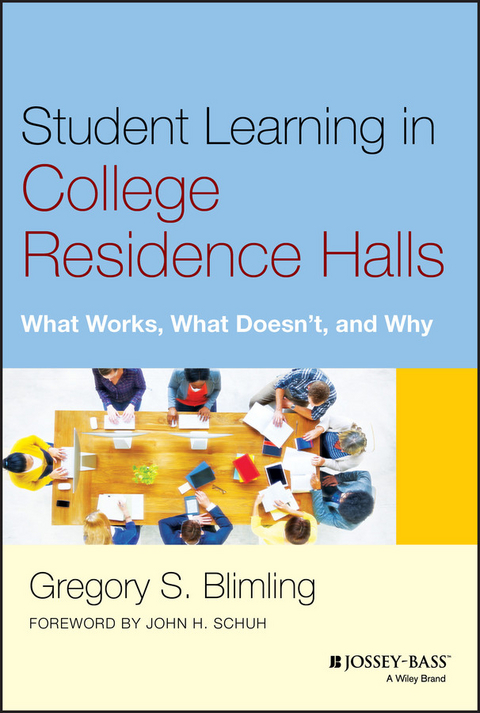
Student Learning in College Residence Halls (eBook)
416 Seiten
John Wiley & Sons (Verlag)
978-1-118-99239-5 (ISBN)
programs
Grounded in current research and practical experience,
Student Learning in College Residence Halls: What Works, What
Doesn't, and Why shows how to structure the peer environment in
residence halls to advance student learning. Focusing on the
application of student learning principles, the book examines how
neurobiological and psychosocial development influences how
students learn in residence halls. The book is filled with
examples, useful strategies, practical advice, and best practices
for building community and shaping residential environments that
produce measureable learning outcomes. Readers will find models for
a curriculum-based approach to programming and for developing
student staff competencies, as well as an analysis of what types of
residential experiences influence student learning. An examination
of how to assess student learning in residence halls and of the
challenges residence halls face provide readers with insight into
how to strategically plan for the future of residence halls as
learning centers.
The lack of recent literature on student learning in college
residence halls belies the changes that have taken place. More
traditional-age students are enrolled in college than ever before,
and universities are building more residence halls to meet the
increased demand for student housing. This book addresses these
developments, reviews contemporary research, and provides
up-to-date advice for creating residence hall environments that
achieve educationally purposeful outcomes.
* Discover which educational benefits are associated with living
in residence halls
* Learn how residential environments influence student
behavior
* Create residence hall environments that produce measureable
learning outcomes
* Monitor effectiveness with a process of systematic
assessment
Residence halls are an integral part of the college experience;
with the right programs in place they can become dynamic centers of
student learning. Student Learning in College Residence
Halls is a comprehensive resource for residence hall
professionals and others interested in improving students' learning
experience.
GREGORY S. BLIMLING is a professor in the Rutgers University Graduate School of Education where he teaches college student affairs administration. For twenty-two years he served as a senior student affairs officer and for nine years as the editor of the Journal of College Student Development. A former ACPA president, he is the author, coauthor, or editor of many scholarly publications and books including Good Practices in Student Affairs: Principles to Foster Student Learning (Jossey-Bass, 1999).
List of Tables and Figures ix
Foreword xi
Preface xv
Acknowledgments xxi
About the Author xxiii
1. The Historical and Philosophical Foundations of Student Learning in Residence Halls 1
2. How Biological and Psychological Development Influence Student Learning and Behavior 29
3. How Students Learn in Residence Halls 59
4. How to Create Learning Environments in Residence Halls 89
5. Selecting and Developing Residence Life Staff to Advance Student Learning 135
6. How Residential Environments Influence Student Learning 179
7. How to Shape the Peer Environment in Residence Halls to Advance Student Learning 201
8. Managing Student Life in Residence Halls to Support Student Learning 231
9. Assessing and Improving Residence Life Programs 257
10. The Future of Residence Halls 275
References 307
Name Index 353
Subject Index 365
| Erscheint lt. Verlag | 20.11.2014 |
|---|---|
| Sprache | englisch |
| Themenwelt | Geisteswissenschaften |
| Sozialwissenschaften ► Pädagogik ► Bildungstheorie | |
| Sozialwissenschaften ► Pädagogik ► Erwachsenenbildung | |
| Schlagworte | Bildungswesen • Education • Hochschulen / Dienstleistungen f. Studenten • Student Affairs & Development (Higher Education) |
| ISBN-10 | 1-118-99239-3 / 1118992393 |
| ISBN-13 | 978-1-118-99239-5 / 9781118992395 |
| Informationen gemäß Produktsicherheitsverordnung (GPSR) | |
| Haben Sie eine Frage zum Produkt? |
 PDF (Adobe DRM)
Kopierschutz: Adobe-DRM
Adobe-DRM ist ein Kopierschutz, der das eBook vor Mißbrauch schützen soll. Dabei wird das eBook bereits beim Download auf Ihre persönliche Adobe-ID autorisiert. Lesen können Sie das eBook dann nur auf den Geräten, welche ebenfalls auf Ihre Adobe-ID registriert sind.
Details zum Adobe-DRM
Dateiformat: PDF (Portable Document Format)
Mit einem festen Seitenlayout eignet sich die PDF besonders für Fachbücher mit Spalten, Tabellen und Abbildungen. Eine PDF kann auf fast allen Geräten angezeigt werden, ist aber für kleine Displays (Smartphone, eReader) nur eingeschränkt geeignet.
Systemvoraussetzungen:
PC/Mac: Mit einem PC oder Mac können Sie dieses eBook lesen. Sie benötigen eine
eReader: Dieses eBook kann mit (fast) allen eBook-Readern gelesen werden. Mit dem amazon-Kindle ist es aber nicht kompatibel.
Smartphone/Tablet: Egal ob Apple oder Android, dieses eBook können Sie lesen. Sie benötigen eine
Geräteliste und zusätzliche Hinweise
Buying eBooks from abroad
For tax law reasons we can sell eBooks just within Germany and Switzerland. Regrettably we cannot fulfill eBook-orders from other countries.
aus dem Bereich