


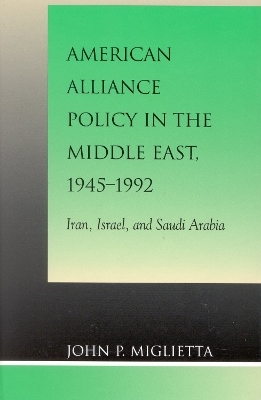
American Alliance Policy in the Middle East, 1945-1992
Iran, Israel, and Saudi Arabia
Seiten
2002
Lexington Books (Verlag)
978-0-7391-0304-3 (ISBN)
Lexington Books (Verlag)
978-0-7391-0304-3 (ISBN)
A look at US Cold War diplomacy, examining a policy compromised by the demands of anti-communist ideology. Through case studies of America's relationships with Iran, Israel and Saudi Arabia, it reveals how the fear of communism led to the over-commitment of US security in the region.
American Alliance Policy in the Middle East provides a stimulating, new look at a U.S. Cold War foreign policy gripped by anticommunist paranoia. Through case studies of America's relationships with Iran, Israel, and Saudi Arabia, John P. Miglietta reveals how an overriding fear of global communism led to the overcommitment of U.S. security resources to the region. The perceived need to preserve Middle East stability rendered U.S. policy ineffectual and unresponsive to changing local conditions, drastically altering the patron-client paradigm to the detriment of American strategic interests. This superb analysis of American foreign policymaking illustrates how Cold War anticommunist ideology prevented the evolution of traditional military alliances into broader-based relationships and perpetuated authoritarian regimes that mired the Middle East in a cycle of poverty and despotism.
American Alliance Policy in the Middle East provides a stimulating, new look at a U.S. Cold War foreign policy gripped by anticommunist paranoia. Through case studies of America's relationships with Iran, Israel, and Saudi Arabia, John P. Miglietta reveals how an overriding fear of global communism led to the overcommitment of U.S. security resources to the region. The perceived need to preserve Middle East stability rendered U.S. policy ineffectual and unresponsive to changing local conditions, drastically altering the patron-client paradigm to the detriment of American strategic interests. This superb analysis of American foreign policymaking illustrates how Cold War anticommunist ideology prevented the evolution of traditional military alliances into broader-based relationships and perpetuated authoritarian regimes that mired the Middle East in a cycle of poverty and despotism.
John P. Miglietta is Assistant Professor of Political Science at Tennessee State University.
Chapter 1 Alliances, American Foreign Policy, and International Relations Theory
Chapter 2 The United States and Iran: The Forging of an Alliance
Chapter 3 The United States and Iran: The Implications of the New Persian Empire
Chapter 4 The Origins of the American-Israeli Alliance: 1948-1960
Chapter 5 The Establishment and Implications of the U.S.-Israel Alliance
Chapter 6 The Origins of the U.S.-Saudi Alliance
Chapter 7 The Strategic Implications of the American-Saudi Alliance
Chapter 8 Conclusions
| Erscheint lt. Verlag | 15.8.2002 |
|---|---|
| Sprache | englisch |
| Maße | 161 x 234 mm |
| Gewicht | 662 g |
| Themenwelt | Geschichte ► Allgemeine Geschichte ► Zeitgeschichte |
| Geisteswissenschaften ► Geschichte ► Regional- / Ländergeschichte | |
| Sozialwissenschaften ► Politik / Verwaltung ► Staat / Verwaltung | |
| ISBN-10 | 0-7391-0304-0 / 0739103040 |
| ISBN-13 | 978-0-7391-0304-3 / 9780739103043 |
| Zustand | Neuware |
| Informationen gemäß Produktsicherheitsverordnung (GPSR) | |
| Haben Sie eine Frage zum Produkt? |
Mehr entdecken
aus dem Bereich



aus dem Bereich
die großen Jahre der Soziologie 1949-1969
Buch | Hardcover (2025)
Klett-Cotta (Verlag)
CHF 39,20
eine Deutschlandreise im Jahr 1958
Buch | Hardcover (2024)
C.H.Beck (Verlag)
CHF 29,90


