


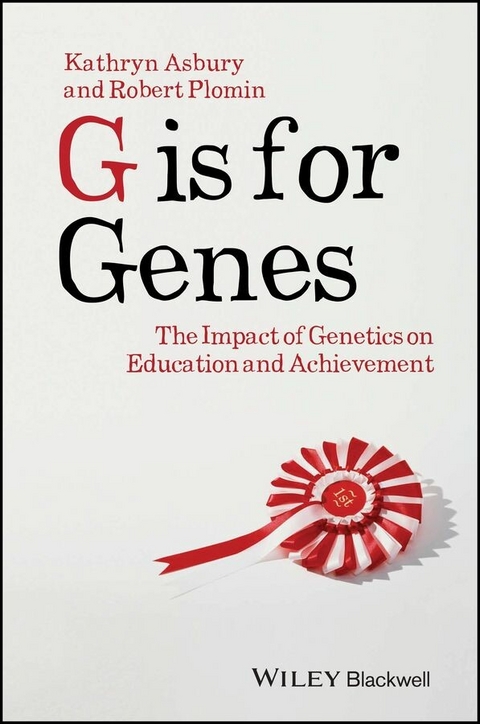
G is for Genes (eBook)
John Wiley & Sons (Verlag)
978-1-118-48280-3 (ISBN)
G is for Genes shows how a dialogue between geneticists and educationalists can have beneficial results for the education of all children-and can also benefit schools, teachers, and society at large.
- Draws on behavioral genetic research from around the world, including the UK-based Twins' Early Development Study (TEDS), one of the largest twin studies in the world
- Offers a unique viewpoint by bringing together genetics and education, disciplines with a historically difficult relationship
- Shows that genetic influence is not the same as genetic determinism and that the environment matters at least as much as genes
- Designed to spark a public debate about what naturally-occurring individual differences mean for education and equality
Kathryn Asbury is a Lecturer in the Centre for Psychology in Education at the University of York, UK. She has published widely on the influence of home and school environments on children's achievement, behavior, and wellbeing.
Robert Plomin is the Professor of Behavioural Genetics at the MRC Social, Genetic and Developmental Psychiatry Centre, King's College London, UK. He is the founder and principal investigator of the Twins' Early Development Study (TEDS), and has published more than 500 papers and a dozen books on behavior genetics.
G is for Genes shows how a dialogue between geneticists and educationalists can have beneficial results for the education of all children and can also benefit schools, teachers, and society at large. Draws on behavioral genetic research from around the world, including the UK-based Twins Early Development Study (TEDS), one of the largest twin studies in the world Offers a unique viewpoint by bringing together genetics and education, disciplines with a historically difficult relationship Shows that genetic influence is not the same as genetic determinism and that the environment matters at least as much as genes Designed to spark a public debate about what naturally-occurring individual differences mean for education and equality
Kathryn Asbury is a Lecturer in the Centre for Psychology in Education at the University of York, UK. She has published widely on the influence of home and school environments on children's achievement, behavior, and wellbeing. Robert Plomin is the Professor of Behavioural Genetics at the MRC Social, Genetic and Developmental Psychiatry Centre, King's College London, UK. He is the founder and principal investigator of the Twins' Early Development Study (TEDS), and has published more than 500 papers and a dozen books on behavior genetics.
Acknowledgements xi
Part One In Theory 1
Chapter 1 Genetics, Schools, and Learning 3
The Aims and Assumptions of Education 4
Diverse Opportunities to Draw Out Individual Potential 8
DNA in the Classroom 10
In Summary . . . 11
Chapter 2 How We Know What We Know 14
Twins: A Natural Experiment 15
DNA Sequencing 18
Chapter 3 The 3Rs: Reading, wRiting . . . 22
From DNA to ABC 24
Environmental Influences on Reading Ability 31
Struggling Readers 34
The Genetics of Writing Ability 38
Chapter 4 . . . and 'Rithmetic 42
So, Why are Some People Better at Math than Others? 43
How does Nurture Affect Mathematical Ability? 52
Chapter 5 Physical Education: Who, What, Why, Where, and How? 57
Genes, Sports, and Smoking 62
Obesity, Genes, and Environment 64
The Heritability of Fitness 67
Gym Class Heroes 69
In Summary . . . 74
Chapter 6 Science: A Different Way of Thinking? 78
Differences Between the Sexes 85
In Summary . . . 87
Chapter 7 How do IQ and Motivation Fit In? 89
IQ + Genetics = Controversy (and Name-calling) 95
Self-Confidence and Motivation 98
Improving Confidence and Cognition in the Classroom 100
Chapter 8 Special Educational Needs: Ideas and Inspiration 105
The Expansion of Special Educational Needs 110
Personalized Learning in Action 113
In Summary . . . 114
Chapter 9 ''Clones'' in the Classroom 115
Positivity and Achievement 122
Clones in the Classroom 122
Chapter 10 Mind the Gap: Social Status and School Quality 126
Low SES: What Does It Look Like? 129
What Does the Heritability of SES Mean? 133
School Quality 136
Chapter 11 Genetics and Learning: The Big Ideas 141
Big Idea #1: Achievement and Ability Vary, Partly for Genetic Reasons 141
Big Idea #2: The Abnormal is Normal 142
Big Idea #3: Continuity is Genetic and Change is Environmental 143
Big Idea #4: Genes are Generalists and Environments are Specialists 144
Big Idea #5: Environments are Influenced by Genes 144
Big Idea #6: The Environments that Matter Most are Unique to Individuals 145
Big Idea #7: Equality of Opportunity Requires Diversity of Opportunity 146
Part Two In Practice 147
Chapter 12 Personalization in Practice 149
So, What Can Be Done to Make Teaching and Learning More Personalized? 150
A Good ''Mindset'' for Learning 153
Other Ways to Personalize Learning 158
In Summary . . . 159
Chapter 13 Eleven Policy Ideas 161
1. Minimize the Core Curriculum and Test Basic Skills 161
2. Increase Choice 163
3. Forget About Labels 165
4. Teach the Child, As Well As the Class 166
5. Teach Children How To Succeed 168
6. Promote Equal Opportunities from an Early Age as a Foundation for Social Mobility in the Future 170
7. Equalize Extracurricular Opportunities at School 172
8. Create a Two Stage PE Program 172
9. Change the Destination 173
10. Train New Teachers in Genetics and Give Them the Tools to Put it Into Practice 175
11. Big is Beautiful 177
Chapter 14 Education Secretary for a Day 178
Index 189
"G is for Genes is a controversial book and this is exactly why it certainly makes an interesting reading." (Birth Defects Research Part A: Clinical And Molecular Teratology, 15 December 2014)
"This is a most important book for educationists, teachers, psychologists, parents and learners." (South West Review, 1 June 2014
"G is for Genes is an easy-to read book for a general audience, providing an extensive overview of findings from behavioral genetic studies related to education and achievement." (Twin Research and Human Genetics, 1 May 2014)
"In sum, G Is for Genesis an admirable effort by two authors who are excellent translational scholars. It alights on a number of important educational issues and does so in a reasoned and constructive manner." (PsycCRITIQUES, 7 April 2014)
"This book breaks down complex science in an engaging and accessible way so that the wider audience can enjoy reading about genetic research, molecular biology, genome screening and most relevantly the implications for education." (Early Years Educator, 1 February 2014)
"This book breaks down complex science in an engaging and accessible way so that the wider audience can enjoy reading about genetic research, moelecular biology, genome screening and, most relevantly, the implications for education." (Early Years Educator, February 2014)
"G is for Genes opened my eyes to how genes influence, but not determine, the academic pathways of our children. It should be mandatory reading for parents, teachers, and policy-makers. The book is engagingly well-written, never condescending, yet addresses the key findings from the last decades of genetics research."
--Professor Rob Klassen, Psychology in Education Research Centre, University of York
"The g-word has been a taboo in education. This defies both science and common sense, which tell us that children are not indistinguishable blank slates. Kathryn Asbury and Robert Plomin, one of the world's leading behavioral geneticists, show that an understanding of genes, far from being scary, is indispensable to sound educational policy, promising schools that are both more effective and more humane. This may be the most important book about educational theory and practice in the new millennium, giving educators, policy-makers, and parents much to think about."
--Steven Pinker, Johnstone Family Professor of Psychology, Harvard University, and the author of How the Mind Works and The Blank Slate
"Education has changed little over at least the last six centuries. Until everybody concerned with education - administrators, teachers, and parents - understand the material clearly presented in this book, education will not change. Understanding genetic differences and the effect of environments on them is an essential beginning for any revolution in education.
--Douglas K. Detterman, Louis D. Beaumont University Professor Emeritus, Case Western Reserve University
Chapter 1
Genetics, Schools, and Learning
The science of genetics is changing our world at an ever-increasing pace. We can now analyze and modify DNA to test for serious illnesses and treat them before they become life-threatening, to catch criminals and exonerate the innocent, and to create energy sources that will protect our planet. Geneticists have cast their nets far and wide to influence and inform medicine and public health, agriculture, energy and the environment, law, and social policy. Education, however, is glaringly absent from this list, and schools remain untouched by the lessons of genetics. This, we believe, needs to change.
One way of helping each and every child to fulfill their academic potential is to harness the lessons of genetic research. We now know a great deal—though not by any means everything—about the ways that genes influence learning, and about how children's DNA interacts with their experiences at home and school. It's time for educationalists and policy makers to sit down with geneticists to apply these findings to educational practice. It will make for better schools, thriving children, and, in the long run, a more fulfilled and effective population. That's what we want schools and education to achieve, isn't it?
The Aims and Assumptions of Education
Like most areas of public policy, education is a hotbed of disagreements and competing philosophies. Fundamentally, however, we can all agree that education should give everybody the basic tools they need to function in society. In most of the world right now these tools, or skills, consist of reading, writing, arithmetic, and an ability to interact with digital technologies. We can probably identify a secondary aim: only the most extreme libertarian would object to the notion that societies should benefit in tangible ways from providing education to their citizens. A recent OECD report for instance claimed that if all OECD countries could equal the average educational performance of the Finns the combined financial gain over the course of a single generation, the generation born in 2010, would be $115 trillion. By 2090 the gain would increase to $260 trillion. Both the United States and the United Kingdom would be among the nations to gain most in these economic terms, along with Mexico, Turkey, Italy, Germany, Spain and France. It is noteworthy that the Finnish education system puts a particularly high premium on basic skills and has a comparatively small gap between its most and least able pupils. Of course, education should not restrict itself to these two aims: the first is the bare minimum to which a society, a school, or a teacher should aspire, and the second is a by-product of the first. If these aims are not achieved then we may have icing but we have no cake.
The simple aims of learning to read, write, calculate, and use a computer are achievable by virtually every member of society regardless of their IQ. If even one child (not including those with profound disabilities but including those with, for instance, mild and moderate learning, emotional, or behavioral difficulties) leaves school without achieving an acceptable level of competence in these skills, then their school and the education system supporting it have failed them. This is entirely unacceptable.
Sadly these aims are not always met: young people sometimes do leave school insufficiently literate and numerate even after 11 years (15,000 hours) of full-time education. The prospect of these young people becoming happy, fulfilled, and useful members of society is bleak. When this happens everybody blames everybody else, with excuses running from fractured societies through inner city schools with jaded teachers, unsupportive parents, low ability, and poor behavior… impossible kids in impossible circumstances basically. This is a cop-out. There is something far more fundamental going on. The entire education system is predicated on the belief that children are “blank slates.” Behavioral genetics tells us that this is wrong.
This theory of education (and of human life in general) says that children are all born the same, with exactly the same potential, and become the product of their experiences. They are blank slates to be written upon by families, schools, and society. Many people believe that if their children behave well it is because they bring them up well; that if they are successful in school it is because they have excellent teachers and supportive parents. Conversely, they believe that if children play truant or display antisocial behavior their parents and teachers are at fault and should be held responsible, to the extent, in the case of parents, of being sentenced to terms of imprisonment. At a less extreme level this belief causes people doing a perfectly decent job of bringing up their children to torture themselves. Is he anxious because I mollycoddle him? Is she bossy because I give her too much attention? Is she two reading levels behind the neighbor's son because I didn't get her into the popular and over-subscribed school down the road? Should I have arranged a tutor to prepare him for selective school entrance exams? This kind of environmental determinism has become the norm, with all of the smugness and censure that it inevitably entails.
However, if you ask any parent of more than one child whether their babies were blank slates at birth or whether each child arrived with their own bundle of obvious traits—namely their temperament, appetites, needs, and preferences—you will hear the same reply. They were individuals from the moment they were born. If we took all babies from their families at birth and raised them in identical, government-sponsored rearing camps they would not resemble each other much more than they do now on school entry, and the resemblance would fade further as they grew and developed. People sometimes assume that environmental influence becomes more important as we develop and accumulate experiences. However, for traits such as cognitive development the reverse appears to be true. Genetic influence increases over time until, in later life, cognitive ability is almost as heritable as height.
The fact that individual differences are influenced by genes makes a lie of the blank slate philosophy. This in turn means that “more of the same” is unlikely to be the correct approach for children who are failing to stock up their toolkit of basic skills through ordinary means. A child who is not learning in the usual way can almost always be helped to learn, but their teachers may have to think outside the box and use their knowledge and experience of teaching and of the individual child to find the right buttons to push. They also need to be supported by policies that allow them to work this way.
To provide all children with a basic toolkit for life it is undoubtedly true that one vital focus of any education system has to be on making sure no child is left behind. Such a simple, clear aim has simple, clear policy implications: target resources at the children who struggle to equip themselves with basic academic tools and help them by whatever means work for them as individuals. The first funding priority for education should be to provide whatever is required to give every child enough facility with words, numbers, and computers to be able to live an independent life in the twenty-first century. Extra funding must be provided to help those children who struggle to meet these standards before they leave school, whatever the reason for their failure to progress. This may be one way in which we can start to tackle the challenge of improving social mobility in nations such as the United States and the United Kingdom. An emphasis on supporting those who need support to learn the basics is just a starting point, however.
In societies where education is freely available and compulsory for all children, pupils can be differentiated by the way in which they respond to instruction. The ability to learn from teachers is, we know, influenced more by genes than by experience. The influence of school on differences between children in how well they achieve is likely to be larger in societies where the availability of formal education is unequal. It is understandable, then, that in developed nations we find higher estimates of genetic influence, and lower estimates of the impact of schooling, on individual differences in achievement. If access to education is the same for everybody it cannot explain the differences between individuals. Formal education, standardized to be the same in all classrooms, can form the bedrock on which the bell curve of ability and achievement is based. It can influence whether a group has a high or a low average score but it does not influence how well individuals perform in relation to each other. This is where genes really matter, and this is where the biggest differences exist.
These are important issues, not least at a time when the world is working hard to bring education to every child. Under UNESCO's leadership most countries have committed to achieving universal enrolment in primary education by 2015, and in many countries the commitment is to make enrolment compulsory rather than optional. As a combined result of population growth and the proliferation of compulsory education, UNESCO estimates that over the next 30 years more people will receive a formal education than in the entirety of human history. Even though the 2015 target looks unlikely to be met in full this is a remarkable, wonderful achievement, and those who have found ways to bring educational opportunity to children of all backgrounds, in distant, poor, rural locations where the...
| Erscheint lt. Verlag | 4.9.2013 |
|---|---|
| Reihe/Serie | Understanding Children's Worlds |
| Understanding Children's Worlds | Understanding Children's Worlds |
| Sprache | englisch |
| Themenwelt | Geisteswissenschaften ► Psychologie ► Entwicklungspsychologie |
| Geisteswissenschaften ► Psychologie ► Pädagogische Psychologie | |
| Naturwissenschaften ► Biologie ► Genetik / Molekularbiologie | |
| Sozialwissenschaften ► Pädagogik | |
| Sozialwissenschaften ► Soziologie | |
| Schlagworte | Bildungswesen • Biowissenschaften • Education • Educational & School Psychology • Education & Public Policy • Education, genetic research, determinism, individual difference, genetics • Erziehungs- u. Schulpsychologie • Genetics & Society • Genetik u. Gesellschaft • Life Sciences • Pädagogik u. Politik • Pädagogik u. Politik • Psychologie • Psychology |
| ISBN-10 | 1-118-48280-8 / 1118482808 |
| ISBN-13 | 978-1-118-48280-3 / 9781118482803 |
| Informationen gemäß Produktsicherheitsverordnung (GPSR) | |
| Haben Sie eine Frage zum Produkt? |
 EPUB (Adobe DRM)
Kopierschutz: Adobe-DRM
Adobe-DRM ist ein Kopierschutz, der das eBook vor Mißbrauch schützen soll. Dabei wird das eBook bereits beim Download auf Ihre persönliche Adobe-ID autorisiert. Lesen können Sie das eBook dann nur auf den Geräten, welche ebenfalls auf Ihre Adobe-ID registriert sind.
Details zum Adobe-DRM
Dateiformat: EPUB (Electronic Publication)
EPUB ist ein offener Standard für eBooks und eignet sich besonders zur Darstellung von Belletristik und Sachbüchern. Der Fließtext wird dynamisch an die Display- und Schriftgröße angepasst. Auch für mobile Lesegeräte ist EPUB daher gut geeignet.
Systemvoraussetzungen:
PC/Mac: Mit einem PC oder Mac können Sie dieses eBook lesen. Sie benötigen eine
eReader: Dieses eBook kann mit (fast) allen eBook-Readern gelesen werden. Mit dem amazon-Kindle ist es aber nicht kompatibel.
Smartphone/Tablet: Egal ob Apple oder Android, dieses eBook können Sie lesen. Sie benötigen eine
Geräteliste und zusätzliche Hinweise
Buying eBooks from abroad
For tax law reasons we can sell eBooks just within Germany and Switzerland. Regrettably we cannot fulfill eBook-orders from other countries.
aus dem Bereich


