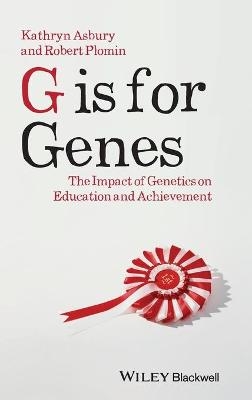
G is for Genes
Wiley-Blackwell (Verlag)
978-1-118-48278-0 (ISBN)
G is for Genes shows how a dialogue between geneticists and educationalists can have beneficial results for the education of all children—and can also benefit schools, teachers, and society at large.
Draws on behavioral genetic research from around the world, including the UK-based Twins’ Early Development Study (TEDS), one of the largest twin studies in the world
Offers a unique viewpoint by bringing together genetics and education, disciplines with a historically difficult relationship
Shows that genetic influence is not the same as genetic determinism and that the environment matters at least as much as genes
Designed to spark a public debate about what naturally-occurring individual differences mean for education and equality
Kathryn Asbury is a Lecturer in the Centre for Psychology in Education at the University of York, UK. She has published widely on the influence of home and school environments on children’s achievement, behavior, and wellbeing. Robert Plomin is the Professor of Behavioural Genetics at the MRC Social, Genetic and Developmental Psychiatry Centre, King’s College London, UK. He is the founder and principal investigator of the Twins’ Early Development Study (TEDS), and has published more than 500 papers and a dozen books on behavior genetics.
Acknowledgements
Part One In Theory 1
Chapter 1 Genetics, Schools, and Learning 3
The Aims and Assumptions of Education 4
Diverse Opportunities to Draw Out Individual Potential 8
DNA in the Classroom 10
In Summary 11
Chapter 2 How We Know What We Know 14
Twins: A Natural Experiment 15
DNA Sequencing 18
Chapter 3 The 3Rs: Reading, wRiting 22
From DNA to ABC 24
Environmental Influences on Reading Ability 31
Struggling Readers 34
The Genetics of Writing Ability 38
Chapter 4 and ’Rithmetic 42
So, Why are Some People Better at Math than Others? 43
How does Nurture Affect Mathematical Ability? 52
Chapter 5 Physical Education: Who, What, Why, Where, and How? 57
Genes, Sports, and Smoking 62
Obesity, Genes, and Environment 64
The Heritability of Fitness 67
Gym Class Heroes 69
In Summary 74
Chapter 6 Science: A Different Way of Thinking? 78
Differences Between the Sexes 85
In Summary 87
Chapter 7 How do IQ and Motivation Fit In? 89
IQ + Genetics = Controversy (and Name-calling) 95
Self-Confidence and Motivation 98
Improving Confidence and Cognition in the Classroom 100
Chapter 8 Special Educational Needs: Ideas and Inspiration 105
The Expansion of Special Educational Needs 110
Personalized Learning in Action 113
In Summary 114
Chapter 9 ‘‘Clones’’ in the Classroom 115
Positivity and Achievement 122
Clones in the Classroom 122
Chapter 10 Mind the Gap: Social Status and School Quality 126
Low SES: What Does It Look Like? 129
What Does the Heritability of SES Mean? 133
School Quality 136
Chapter 11 Genetics and Learning: The Big Ideas 141
Big Idea #1: Achievement and Ability Vary, Partly for Genetic Reasons 141
Big Idea #2: The Abnormal is Normal 142
Big Idea #3: Continuity is Genetic and Change is Environmental 143
Big Idea #4: Genes are Generalists and Environments are Specialists 144
Big Idea #5: Environments are Influenced by Genes 144
Big Idea #6: The Environments that Matter Most are Unique to Individuals 145
Big Idea #7: Equality of Opportunity Requires Diversity of Opportunity 146
Part Two In Practice 147
Chapter 12 Personalization in Practice 149
So, What Can Be Done to Make Teaching and Learning More Personalized? 150
A Good ‘‘Mindset’’ for Learning 153
Other Ways to Personalize Learning 158
In Summary 159
Chapter 13 Eleven Policy Ideas 161
1. Minimize the Core Curriculum and Test Basic Skills 161
2. Increase Choice 163
3. Forget About Labels 165
4. Teach the Child, As Well As the Class 166
5. Teach Children How To Succeed 168
6. Promote Equal Opportunities from an Early Age as a Foundation for Social Mobility in the Future 170
7. Equalize Extracurricular Opportunities at School 172
8. Create a Two Stage PE Program 172
9. Change the Destination 173
10. Train New Teachers in Genetics and Give Them the Tools to Put it Into Practice 175
11. Big Is Beautiful 177
Chapter 14 Education Secretary for a Day 178
Index 189
| Erscheint lt. Verlag | 22.11.2013 |
|---|---|
| Reihe/Serie | Understanding Children's Worlds |
| Verlagsort | Hoboken |
| Sprache | englisch |
| Maße | 160 x 237 mm |
| Gewicht | 417 g |
| Themenwelt | Geisteswissenschaften ► Psychologie ► Entwicklungspsychologie |
| Geisteswissenschaften ► Psychologie ► Pädagogische Psychologie | |
| Sozialwissenschaften ► Pädagogik | |
| Sozialwissenschaften ► Soziologie | |
| ISBN-10 | 1-118-48278-6 / 1118482786 |
| ISBN-13 | 978-1-118-48278-0 / 9781118482780 |
| Zustand | Neuware |
| Informationen gemäß Produktsicherheitsverordnung (GPSR) | |
| Haben Sie eine Frage zum Produkt? |
aus dem Bereich