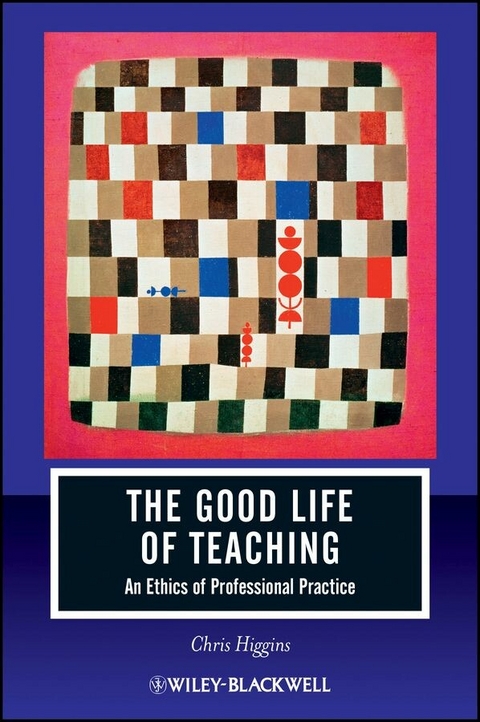

- Makes a significant contribution to the philosophy of teaching and also offers new insights into virtue theory and professional ethics
- Offers fresh and detailed readings of major figures in ethics, including Alasdair MacIntyre, Charles Taylor, and Bernard Williams and the practical philosophies of Hannah Arendt, John Dewey and Hans-Georg Gadamer
- Provides illustrations to assist the reader in visualizing major points, and integrates sources such as film, literature, and teaching memoirs to exemplify arguments in an engaging and accessible way
- Presents a compelling vision of teaching as a reflective practice showing how this requires us to prepare teachers differently
Chris Higgins is Assistant Professor in the Department of Educational Policy, Organization and Leadership at the University of Illinois at Urbana-Champaign, where he is also Associate Editor and Review Editor of Educational Theory. A philosopher of education, his work draws on virtue ethics, hermeneutics, and psychoanalysis. His scholarly interests include professional ethics and teacher identity, dialogue and the teacher-student relationship, liberal learning and the humanistic imagination, professional education and the philosophy of work.
Chris Higgins is Assistant Professor in the Department of Educational Policy, Organization and Leadership at the University of Illinois at Urbana-Champaign, where he is also Associate Editor and Review Editor of Educational Theory. A philosopher of education, his work draws on virtue ethics, hermeneutics, and psychoanalysis. His scholarly interests include professional ethics and teacher identity, dialogue and the teacher-student relationship, liberal learning and the humanistic imagination, professional education and the philosophy of work.
Foreword by Richard Smith vii
Acknowledgements ix
Introduction: Why We Need a Virtue Ethics of Teaching 1
Saints and scoundrels 1
A brief for teacherly self-cultivation 2
From the terrain of teaching to the definition of professional ethics 9
Outline of the argument 10
Part I The Virtues of Vocation: From Moral Professionalism to Practical Ethics
1 Work and Flourishing: Williams' Critique of Morality and its Implications for Professional Ethics 21
Retrieving Socrates' question 22
Modern moral myopia 25
What do moral agents want? 31
From moral professionalism to professional ethics 35
2 Worlds of Practice: MacIntyre's Challenge to Applied Ethics 47
The architecture of MacIntyre's moral theory 48
A closer look at internal goods 55
The practicality of ethical reflection 61
What counts as a practice: The proof, the pudding, and the recipe 63
Boundary conditions: Practitioners, managers, interpreters, and fans 69
3 Labour, Work, and Action: Arendt's Phenomenology of Practical Life 85
Arendt's singular project 87
Defining the deed 92
Hierarchy and interdependence in the vita activa 99
Praxis in the professions 101
4 A Question of Experience: Dewey and Gadamer on Practical Wisdom 111
The constant gardener 113
The existential and aesthetic dimensions of vocation 119
Our dominant vocation 125
Practical wisdom and the circle of experience 130
The open question 134
Part II a Virtue Ethics for Teachers: Problems and Prospects
5 The Hunger Artist: Pedagogy and the Paradox of Self-Interest 145
A blind spot in the educational imagination 145
The hunger artist 154
The very idea of a helping profession 161
This ripeness of self 170
6 Working Conditions: The Practice of Teaching and the Institution of School 177
A prima facie case for teaching as a practice 178
MacIntyre's objection 190
Schools as surroundings 198
7 The Classroom Drama: Teaching as Endless Rehearsal and Cultural Elaboration 205
Education as the drama of cultural renewal 208
A false lead 214
Teaching as labour, work, and action 217
Education, shelter, and mediation 223
Teaching as endless rehearsal 227
Teaching as cultural elaboration 233
8 Teaching as Experience: Toward a Hermeneutics of Teaching and Teacher Education 241
Teaching as vocational environment 241
Batch processing, kitsch culture, and other obstacles to teacher vocation 248
The syntax of educational claims 254
The shape of humanistic conversation 258
Horizons of educational inquiry 266
Teacher education for practical wisdom 273
References 283
Index 305
"The question of the ethical life of the teacher is as old as
philosophy; but in the contemporary world this has been transformed
into a question of professional ethics. In The Good Life of
Teaching, Chris Higgins brings this newer question of
professionalism back to its philosophical roots. Anyone who
experiences teaching as a vocation - in the sense of a calling -
but also wants to participate in the vocation of teaching - in the
sense of a profession - will want to read this book."
--Jonathan Lear, The University of Chicago
'This is an exemplary book in philosophy of education. It
combines intellectual rigour, ethical seriousness and imaginative
verve in a finely pitched exploration of the nature of teaching.
Philosophers will applaud how its argument for the pertinence to
education of a wisely chosen group of key thinkers creatively
extends our understanding of their work. More important, teachers
will be deeply confirmed or transformed by its sane vision of what
can make their work both noble and sustainable.'
--Joseph Dunne, Cregan Professor Emeritus in philosophy
of education, Dublin City University
Introduction
Why We Need a Virtue Ethics of Teaching
I believe the impulse to teach is fundamentally altruistic and represents a desire to share what you value and to empower others. Of course, all teachers are not altruistic. Some people teach in order to dominate others or to support work they’d rather do or simply to earn a living. But I am not talking about the job of teaching so much as the calling to teach. Most teachers I know, even the most demoralized ones, who drag themselves to oppressive and mean schools where their work is not respected and their presence not welcome, have felt that calling at some time in their lives (Kohl, 1984, p. 7).
SAINTS AND SCOUNDRELS
Open any text on teaching and you are likely to find the same formula. It is nicely captured in this passage from Herb Kohl’s well-known work, but there is no shortage of examples. Kohl tells us that teaching is altruistic, fundamentally so. If we find a non-altruist in the classroom then we have discovered an imposter to the role. From the point of view of working teachers, we all know there are days we live up to our ideals, and days that fall depressingly short of those hopes, and days that seem to dwell uncertainly in between. Yet in representations of teaching, we find instead a stark contrast of motivations: teachers are either serving students or using them. In the helping professions, it seems, one must not ‘help oneself’. As one teacher recruitment campaign succinctly put it: ‘You’ve made your own dreams come true. Isn’t it time you started on someone else’s?’1 In the educational imagination—from posters to policies, from monographs to movies—we find more and less restrained versions of the same Noh drama. Enter stage left—the selfless saints, devoted to nothing but the welfare of their students and martyred for the cause. Enter stage right—the selfish scoundrels: narcissists, lechers, and petty dictators of their classroom worlds.
What seems clear is that these two characters and, correspondingly, the two main discourses about teacher motivation—the inspirational and the suspicious—are but two sides of the same coin.2 Inspirational accounts tend to focus on the role of teacher, holding out an image of teaching as a noble service.3 These accounts suggest that teacher’s personal interests and needs more or less harmonise with the demands of their role, and when they do not, that those needs can and should be addressed outside of work. Suspicious accounts turn to the person in the role in an attempt to reveal the hidden springs of self-interest and debunk this idea of the altruistic teacher.4 These accounts aim to show that such a division between personal and professional is impossible to maintain, and that trappings of the role become a cover for teachers who really want to feel smart, revisit their youth, vent their aggression, and so on. What is striking is that neither discourse seems capable of helping us understand how teaching might be the expression of the person who teaches. For in the second sort of story, there is no real teacher; in the first, there is no real person.
What these seeming rivals share is their attachment to the stark opposition between a lofty altruism and a base self-interest; neither lends itself to a believable portrait of teaching. Inspirational accounts ring hollow when they gloss over the immense difficulties and frustrations inherent in the life of a schoolteacher. They portray teachers as having no personal agenda, conveniently wanting only what students need, and needing only to give that. Suspicious narratives do offer a more believable psychology, helpfully acknowledging our human-all-too-human desires, needs, and weaknesses. However, they tend to assume that teachers have only a personal agenda, which they merely disguise with their talk of educational aims and student needs.
In contrast, my study asks how teaching might be the expression of one’s personal ambitions and deepest motivations. It probes the reasons for our dichotomous tendency to imagine teachers as either selfless saints or selfish scoundrels and challenges the very idea of a ‘helping profession’. It sets out instead to imagine the fate of the teacher struggling to be self-ful in the midst of a task that is overwhelming, an environment that can be deadening, and a professional culture that secretly prizes self-abnegation. In showing the resources the practice of teaching offers for self-cultivation, without minimising its very real challenges and constraints, we move closer to a humane, sustainable ethic of teaching.
A BRIEF FOR TEACHERLY SELF-CULTIVATION
Teaching is a helping profession, where caring teachers assist active learners. At the same time, education contains an ineliminable feature that pushes us past such dichotomous thinking. The feature, simply put, is that selfhood is contagious. In order to cultivate selfhood in students, teachers must bring to the table their own achieved self-cultivation, their commitment to ongoing growth, and their various practices, styles, and tricks for combating the many forces that deaden the self and distract us from our task of becoming. In this stubborn refusal to be sorted into a duty or an inclination, an act of altruism or of self-interest, the practice of teaching proves a rich ground for exploring one of the central human dilemmas and oldest ethical problems. How do we reconcile self-regard and concern for others? Can we live with the demands of human self-hood, that each of us exists for ourselves and for others, or will we allow the quest for individuation to collapse? Will we settle for so many semi-selves propping each other up: actors and facilitators, saints and scoundrels, ‘mermaids and minotaurs’? (Dinnerstein, 1991 [1976]).
In teaching and other helping professions, such questions come to a sharp point. Here we encounter a powerful drive to sort ourselves into subject and object, for-oneself and for-others. The flourishing of the teacher sounds like an oxymoron. And yet, the logic of selfhood, emulation, and development pushes back against this tendency. Consider, if you will, the following argument for teacherly self-cultivation as a pressing practical and rich ethical issue (I first state the propositions in bare form and then discuss each further below):
1. Education, no matter what else it involves, involves self-cultivation.
2. Achieved and ongoing self-cultivation on the part of the teacher is a necessary (though not sufficient) condition for fostering self-cultivation in students.
3. (from 1 and 2) Teacherly self-cultivation is a necessary condition of education.
4. Poor working conditions and the intense needs of students conspire to make such self-cultivation exceedingly difficult: the life of a teacher, it must be admitted, may be miseducative as often as it is educative.
5. Rather than recognise the teacher’s self-forgetfulness and self-sacrifice as a threat to teaching itself, we rationalise them with the rhetoric of service, we hail them as the call of duty and very mark of a teacher.
6. (from 3) But teaching is not a ‘helping profession’, if this is taken to mean that one helps others rather than oneself.
7. (from 4–6) Therefore, teaching should be understood precisely as one of the human practices that most clearly forces us to confront a fundamental existential tension: we exist for ourselves and for others, and while these two dimensions of life rarely fit together easily, neither do they work well alone.
The first proposition will strike some readers as patent and others as wildly utopian. This is not surprising if Philip Jackson is right that education has long been torn between two fundamentally different outlooks: the mimetic (or transmissive) and the transformative (Jackson, 1986).5 While the educational aim of self-cultivation is the very premise of the transformative outlook on teaching, it has come to seem largely out of place in K-12 schooling with the ‘gradual ascendance of the mimetic tradition’ (Jackson, 1986, p. 133). Two features of the current climate make it much easier to understand education as transmission of detachable skills and discrete knowledge. According to current wisdom, nothing exists that can’t be measured and nothing can be measured that can’t be measured by a standardised test. Since it is quite difficult to measure transformations and self-formation, this constitutes a distinct advantage for the mimetic model. The transformational model also runs up against our faith in liberal neutrality expressed in our belief that government-run schools in a liberal democracy can and should remain neutral on questions of the good life. Personal transformation as an educational aim cannot help but set off the Establishment-Clause alarm system.6 An education based in putatively neutral, transmissible skills and knowledge is a much easier sell.
Still, for thousands of years before this brave new world, the dominant assumption, whatever the specifics, was that education was self-formation. Such an education could be oriented around ideals of civic virtue, aesthetic sensitivity, or intellectual acuity. The educated person could be understood in terms of Cicero’s oratory, Pico’s dignity, or Austen’s amiability. But if an education does not help you at all to answer the question, ‘What sort of person are you going to become?’, you should ask for your money back. I will close this brief defence of the first proposition with the rousing words of...
| Erscheint lt. Verlag | 19.9.2011 |
|---|---|
| Reihe/Serie | Journal of Philosophy of Education |
| Journal of Philosophy of Education | Journal of Philosophy of Education |
| Sprache | englisch |
| Themenwelt | Geisteswissenschaften ► Philosophie ► Allgemeines / Lexika |
| Sozialwissenschaften ► Pädagogik ► Allgemeines / Lexika | |
| Sozialwissenschaften ► Pädagogik ► Bildungstheorie | |
| Schlagworte | Alasdair MacIntyre, Charles Taylor, Bernard Williams, Hannah Arendt, John Dewey, Hans-Georg Gadamer • Philosophie • Philosophie der Bildung u. Erziehung • Philosophy • Philosophy of education • philosophy of teaching • Professional Ethics • teacher motivation, identity, development • Teaching • virtue theory |
| ISBN-13 | 9781444346510 / 9781444346510 |
| Informationen gemäß Produktsicherheitsverordnung (GPSR) | |
| Haben Sie eine Frage zum Produkt? |
 EPUB (Adobe DRM)
Kopierschutz: Adobe-DRM
Adobe-DRM ist ein Kopierschutz, der das eBook vor Mißbrauch schützen soll. Dabei wird das eBook bereits beim Download auf Ihre persönliche Adobe-ID autorisiert. Lesen können Sie das eBook dann nur auf den Geräten, welche ebenfalls auf Ihre Adobe-ID registriert sind.
Details zum Adobe-DRM
Dateiformat: EPUB (Electronic Publication)
EPUB ist ein offener Standard für eBooks und eignet sich besonders zur Darstellung von Belletristik und Sachbüchern. Der Fließtext wird dynamisch an die Display- und Schriftgröße angepasst. Auch für mobile Lesegeräte ist EPUB daher gut geeignet.
Systemvoraussetzungen:
PC/Mac: Mit einem PC oder Mac können Sie dieses eBook lesen. Sie benötigen eine
eReader: Dieses eBook kann mit (fast) allen eBook-Readern gelesen werden. Mit dem amazon-Kindle ist es aber nicht kompatibel.
Smartphone/Tablet: Egal ob Apple oder Android, dieses eBook können Sie lesen. Sie benötigen eine
Geräteliste und zusätzliche Hinweise
Buying eBooks from abroad
For tax law reasons we can sell eBooks just within Germany and Switzerland. Regrettably we cannot fulfill eBook-orders from other countries.
aus dem Bereich